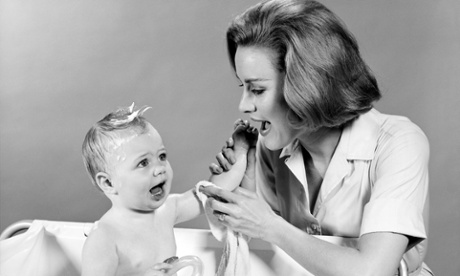
Reflections on motherhood are having something of a cultural moment. In the 2014 collection Labor Day, writers like Heidi Julavits and Cheryl Strayed shared their experiences of birth and new maternity. Earlier this year, Elisa Alpert published a sharp and visceral novel called After Birth, which catalogued the rage-filled recollections of a doctoral student with lingering angst about an unplanned C-section. Shortly before I gave birth to my baby, my Twitter feed resounded with the raw birth story of the writer Meaghan O’Connell. And all this was apart from all the ambient gestational noise on Facebook, where you are exposed to the media consumption of people with whom you attended a youth group in 1994, and who share posts from sites like Babble, Mom.me or the Motherhood section of the Huffington Post. As Rachel Cusk put it in her book A Life’s Work: On Becoming a Mother, the “desire to express myself on the subject of motherhood was from the beginning strong, but it dwelt underground, beneath the reconfigured surface of my life”.
Adrienne Celt’s debut novel, The Daughters, sits alongside that rich company. Celt’s narrator is an opera singer with a newborn baby, assessing the reconfigured surface of her own life: “Since Kara was born I haven’t sung a note. I’ve lain in bed with her soft weight splayed across my chest, and I’ve inhaled the milkfat scent of her hair.” This woman, Lulu, had a traumatic delivery; a rupture nearly killed her, and did in fact kill her beloved grandmother, who succumbed to a heart event from the shock. (The novel, unsurprisingly, takes place in an operatic key.) Like many mothers, Lulu has a complicated relationship to the new arrival:
“Sometimes I forget that Kara is a real baby, that she isn’t just a manifestation of my own difficulty with babyness – that in fact when her pupil dilates, her nostril flares, it is a genuine person’s experience of something outside itself. Which means there is something inside itself as well. Not just blood and a shining purple liver the size of an apricot.”
Recovering from the birth in her Chicago apartment, dealing with the singer’s version of writer’s block, Lulu occupies herself with memories of her grandmother and reflects on the complications of her life, namely that her new daughter is likely the product of an extramarital affair about which her besotted husband is oblivious.
Having children indeed makes women think about mothers, both their own and their comrades in the gestational trenches. Lulu’s mother, we are led to believe, is at the receiving end of an ancestral complaint – something that befell Lulu’s foremothers in a mystical Polish past, wherein a deal was made with the devil in a sort of fairytale which, like Pan’s Labyrinth, masks a historical trauma. In this case, Lulu owes her existence to the dark seeds and malignant flowering of the Holocaust in her great-grandmother’s idyllic Polish forest.
Given all that, it is perhaps not surprising that so much of The Daughters is written in a dreamy, mystical key, reminiscent of Alice Hoffman, whose books often deal in groups of witchy women: “Proximity between birth and death runs in every family, but it seems to run especially close in ours,” Lulu portends. Celt’s novel has other problems: the plotting is mushy, and the Polish interludes are confusing.
A new mother myself, I am highly attuned to the thrumming of the universe, and not always to the aesthetic good. I am also sensitive to the swiftness with which writing related to motherhood is consigned to a mommy-interest vertical of the Huffington Post. But I am nonetheless helplessly moved by books about women who are trying to balance this particular act of creation with the ones that defined their lives prior to motherhood. In the latest issue of Harper’s, the writer Sarah Manguso describes her fear about being both an artist and a mother: “For years, I asked writers who were also mothers how they prioritized the various components of their identities – was Writer below Mother, and if so, would it be possible to reverse that?” For female writers and artists, the math can be particularly grim. It’s an old chestnut that women have their offspring and men have their art.
The operatic key has a few virtues. I don’t always care for her telling, but I admire the way that Celt’s novel acknowledges the radical shift of motherhood on a lusty, dark note, without agonizing about parenting choices or apologizing for the mother’s creative or sexual needs. The Daughters ends with Lulu about to decamp for two weeks to Italy – where she will once again perform – leaving her daughter behind: “Kara will stay behind and learn things and I will scramble to catch up when I return. Not her first words, her steps, but maybe her first taste of mashed pears and the thoughtful way she considers them.” Women fall in love with their children, but they have to go about their lives too. As Lulu prepares to resume her career – her art – she imagines her daughter growing older and climbing a tree: “I stand resolute below … holding out my arms.”