Tesla is a company that prides itself on minimalism, whether it's for cost-cutting purposes or style or a little of both. But in doing so, the automaker sometimes overcomplicates basic car functions, like opening doors.
Now, flush, electronic door handles aren't unique to Tesla—the brand just helped to popularize it in recent years. But despite the uptick in cars featuring the tech, first responders still have issues opening these high-tech doors in a hurry. And when seconds count, that tiny engineering decision means lives can be lost.
Get Critical Materials in your inbox.
The must-read auto and tech briefing, every weekday.
Welcome back to Critical Materials, your daily roundup for all things electric and tech in the automotive space. Also on deck: Nissan dealers scream for more hybrids and used Cybertruck values are predicted to hit $35,000 in 18 months. Let's jump in.
25%: Tesla's Door Handle Death Count Hits 15: Bloomberg

Retracting and flush door handles aren't unique to Tesla. Plenty of manufacturers have motorized or electronic handles today. The problem is what happens after a crash—specifically, when the car loses power. A recent investigation by Bloomberg highlighted several crashes in which occupants couldn't find the interior manual door releases—or first responders struggled to open Tesla doors from the outside.
A follow-up story by the outlet revealed that at least 15 deaths can be attributed to Tesla's door handles. Bloomberg says the door handles at least contributed to the fatalities when the occupants were unable to exit the vehicle after the crash. Tesla didn't respond to the outlet's requests for comment.
Here's Bloomberg's reporting:
As part of a broad investigation into the risks of electric door handles, Bloomberg attempted to quantify for the first time the number of fatal crashes in the US in which door functionality played a role. This reporting turned up at least 15 deaths in a dozen incidents over the past decade in which occupants or rescuers were unable to open the doors of a Tesla that had crashed and caught fire.
The figures represent a small fraction of the hundreds of fatal electric vehicle crashes over that period, but the numbers are growing. More than half of the deaths in Bloomberg's analysis occurred since November 2024.
The pattern is disturbingly consistent. A crash disables the low-voltage system, which leads to electronically-actuated door handles (both inside and outside of the car) being unable to respond. Manual releases exist, but they are placed inconsistently based on vehicle and even down to model year. This can render them ineffective in an emergency scenario.
Tesla's defense is fair, too. Its cars meet all federal safety standards and similar systems exist across the industry. And yes, other automakers use electronic handles, but Tesla still dominates the list of complaints—partly because it popularized the design, but also because its fleet size magnifies the consequences when things go wrong.
Bloomberg continued:
The matter is now drawing attention from regulators, with the US National Highway Traffic Safety Administration opening a defect investigation into whether door issues prevent people from getting into certain Tesla Model Y vehicles, and authorities in China and Europe considering rule changes. As part of the US probe opened in September, NHTSA has asked the automaker to provide a detailed list of consumer complaints and reports involving crashes, injuries, fatalities or fires.
[...]
The automaker has said any safety issues with doors are industrywide and not unique to Tesla. Still, the company is considering changes, such as engineering a way to disable the locks automatically when battery voltage runs low, and to release the doors in the moments leading up to the battery dying. Tesla's design chief told Bloomberg in September that the company was working on a redesign of its door handles to combine the electric and manual door-release mechanisms.
Regulators are now circling globally. China has already drafted proposed rules for new cars and the U.S. National Highway Traffic Safety Administration opening a defect investigation into the door issues surrounding the Tesla Model Y.
50%: Nissan's Dealers Say Hybrids Are Needed To Protect Profits
Nissan's U.S. dealers had a really polarizing 2025. Nationally, they managed to sell enough cars to prop up market share by 17% (from 4.2% to 4.9% year-over-year) while also somehow making less money than ever. Retail share is up and metal is moving, but profits are so razor-thin that they're basically theoretical.
According to dealership data shared with Automotive News, the average Nissan dealership is scraping by with around 0.9% return on sales. This works out to about $38,000 in profits annually, which pretty much makes selling cars a stressful hobby at best.
Nissan's National Dealer Advisory Board chairman Mike Rezi says that the way to fix this isn't to sell more EVs or do more financing gymnastics—it's to sell more hybrids.
Here's a snippet from Rezi's interview with Automotive News:
It starts with the product. We need compelling vehicles to drive retail throughput.
The redesigned Sentra, the updated Pathfinder and the e-Power hybrid Rogue will help lift sales.
The missing piece is Rogue. It’s a solid product, but it’s 5 years old and lacks a hybrid option, so it’s gone stale in the market.
Five years is an eternity in the auto world, where new tech makes or breaks sales. Couple that with an ICE-only powertrain and it becomes clear why other models in the segment are eating Nissan alive.
“Fresh product is what we need to sell more cars,” said Rezi. He believes that the e-Power Rogue will "one hundred percent" close the gap with other automakers that have outpaced Nissan. It just goes to show—the EV market may be slowing down, but everybody realizes electrification is the future.
75%: Used Cybertruck Values Continue To Decline
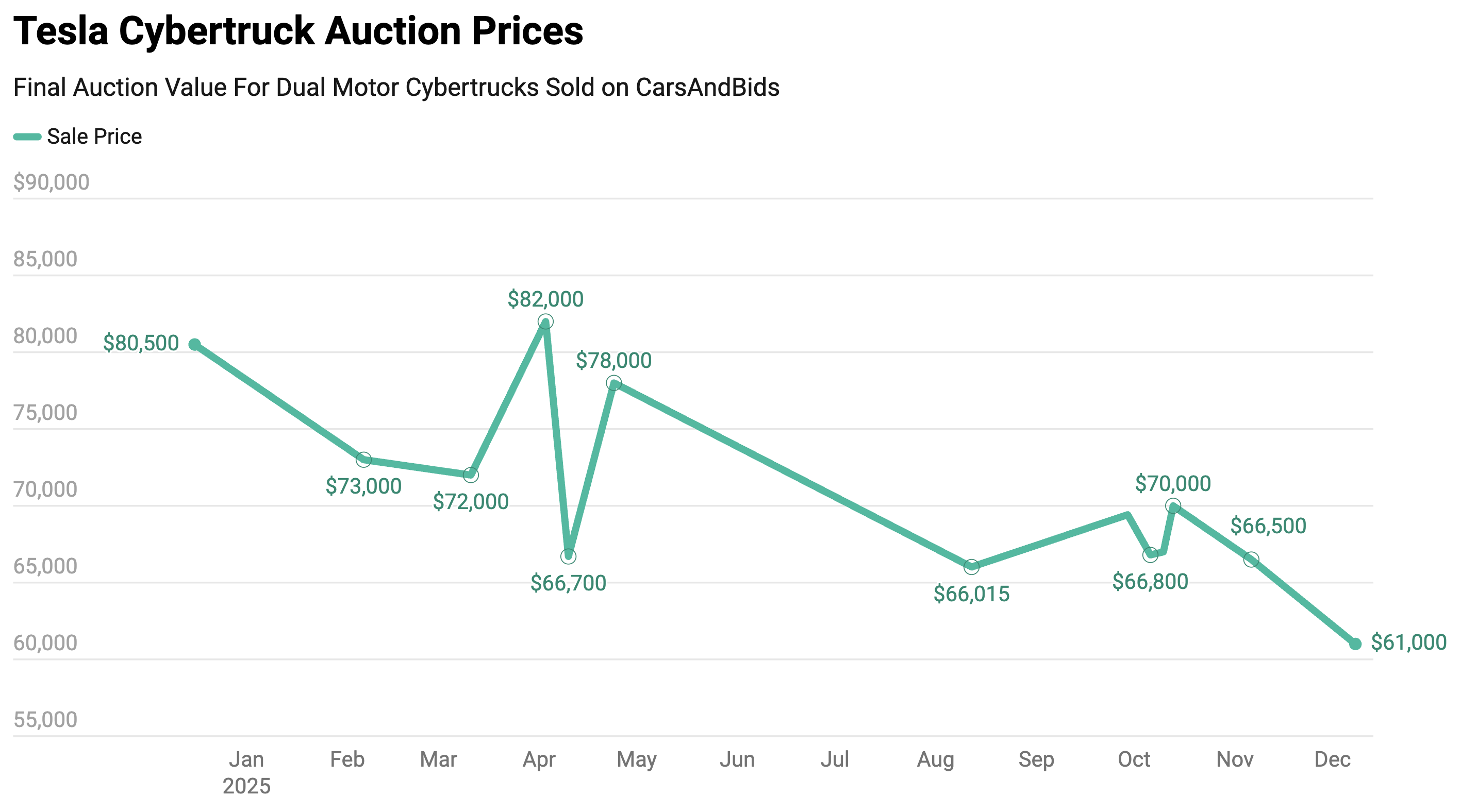
The Tesla Cybertruck market continues to implode. As demand for new units craters, so does the used market. That has sent used Cybertruck prices into the $60,000s. And some experts expect prices to fall further in the coming months.
While we're seeing listings nationwide for the Cybertruck in the $70,000s, the actual bidding market (which is what Doug DeMuro's Cars & Bids auction site relies on) has pushed the value down even further. In fact, one sold for just $61,000 on the site earlier this month.
The 2024 Tesla Cybertruck Dual-Motor AWD had just 19,900 miles on the odometer when it sold on December 8. That price doesn't include the 5% buyers fee ($3,050), but is enough to convince DeMuro that the value of the $80,000-plus electric pickup isn't going to stabilize anytime soon.
"They were cool for a year," said DeMuro on his podcast. He later continued: "This is going to be $35,000 in 18 months, you mark my words."
EVs are admittedly sensitive to price fluctuations. More premium-segmented vehicles (like the Cybertruck, for example) have historically dropped hard. Couple that with Tesla having brand-specific depreciation and you've got a recipe for a great deal—if you're into that sort of thing.
100%: Is $35k Enough To Convince You To Buy A Cybertruck?
It's hard to argue that Tesla doesn't make a compelling EV offering. And—CEO Elon Musk's reputation aside—buying a used one is almost a no-brainer when it comes to a value perspective. And, looks be damned, a $35,000 Cybertruck would be a hell of a buy. But is that enough off the top to convince you to buy one?