I recently received a letter that reads, "I am thinking about closing our garden." The letter made me wonder what will happen to the plants growing there. Plants enrich our lives but, at the same time, they are living things and need care. I wondered what would happen when people can no longer take care of their gardens anymore.
-- Carrying a burden
The letter was sent by a 62-year-old woman, who called herself Satoko, from Gunma Prefecture.
More than half of her 350-square-meter lot is a garden, which was landscaped at her husband's behest. It has a lawn and about 20 trees, including pine, kinmokusei (Osmanthus fragrans) and crape myrtle. There is also a hedge. Her husband, who took care of everything from pruning to disease and pest control, died of cancer in 2015 when he was 60 years old.
Her husband worked diligently in the garden with great affection for the plants. Although Satoko was not interested in growing flowers and trees, she did her best after his death, at least at first, as she felt she could hear him saying, "The branches and the lawn have grown too much." She mowed the grass, sprayed fertilizer in the garden and pulled the weeds. She disinfected the trees and made sure that no branches hung over her neighbor's house.
However, the work was becoming too much for her, especially because she has back problems. She thought she might have to begin reducing the number of trees. Her husband left a will, with details about the funeral and grave, but said nothing about the garden.
"My daughter isn't interested in the garden either, so I'll have to make a decision about dealing with this," she wrote.
-- Shedding tears
There are a number of companies online that offer garden-closing services. Their work also includes garden renovations, such as reducing the number of trees, replacing a natural lawn with an artificial one and preventing the growth of weeds with weed-control mats and pavement.
Many clients of these services are elderly people who say they can no longer climb a stepladder to prune plants and trees, as well as others who have inherited their parents' property, according to Smart Garden, a company in Toyonaka, Osaka Prefecture, that handles garden-closing work.
Yamashita Green, a company in Hachioji, Tokyo, accepts trees from such people and finds new owners for them.
Rikito Yamashita, 42, the company president, said he came up with the idea about eight years ago when an elderly woman whose husband had died asked him to cut down an azalea tree, saying it was in the way of work needed to scale back the size of her house. When Yamashita was about to cut down the tree, the woman started to cry. She said that her husband had deeply treasured the tree. So, instead of cutting it down, Yamashita dug it up and planted it in his company's material storage area.
Since then, he has asked clients the reason for cutting down trees and has often taken some back to his company. As his storage area began to fill up with these trees, he started to look for people to accept and care for them.
Yamashita does not charge customers for these trees, but he does request money for labor and the use of heavy machinery to transfer the trees to new locations and plant them. So far, his company has received about 1,000 trees and found new locations for half of them.
-- A token of thanks
In August, a 52-year-old woman from Kanagawa Prefecture left seven potted trees, including a laurel tree, to Yamashita.
She loves plants and animals and majored in horticulture at a junior college. As a single woman with a clerical job, she enjoys traveling abroad and visiting hot springs. She bought a secondhand house 10 years ago. Its garden was beautifully landscaped with maple trees and other plants. She also planted several trees in the garden herself. However, she has not been able to satisfactorily care for the garden due to her job, and she looked forward to working in the garden after retiring.
However, she was diagnosed with cancer the year before last. She had surgery and was treated with anticancer drugs. Despite this, in April she was told that her cancer had spread to a place where it would be difficult to perform surgery. Also, unfortunately, the use of anticancer drugs would not work well, either.
Although she was shocked, she began making end-of-life preparations. She arranged her funeral service, got a posthumous name that includes the kanji character for "green" and reserved a woodland burial space where her ashes will be buried under a tree. She also found new owners for her two pet cats and reduced her belongings.
She was concerned about what to do with her garden. She had a Nanking cherry tree that was a gift from her mother when she bought the house. When the woman harvested fruit from the tree for the first time, she made wine with it. The woman looked forward to seeing swallowtail butterflies come to lay their eggs on the sansho pepper tree every year. The plum tree, which served as a bonsai for New Year decorations, has grown enough to bear fruit.
She looked for places where these trees could continue living as a token of her thanks for them because they had given her so much joy. So, she called Yamashita Green, which she found on the internet.
As the trees were not large enough to need heavy machinery to transplant them and her home is near the company, the cost was only 20,000 yen for the work, the woman said.
She was relieved to hear two weeks later that the trees had been planted in Kofu, Yamanashi Prefecture.
-- Finding new homes
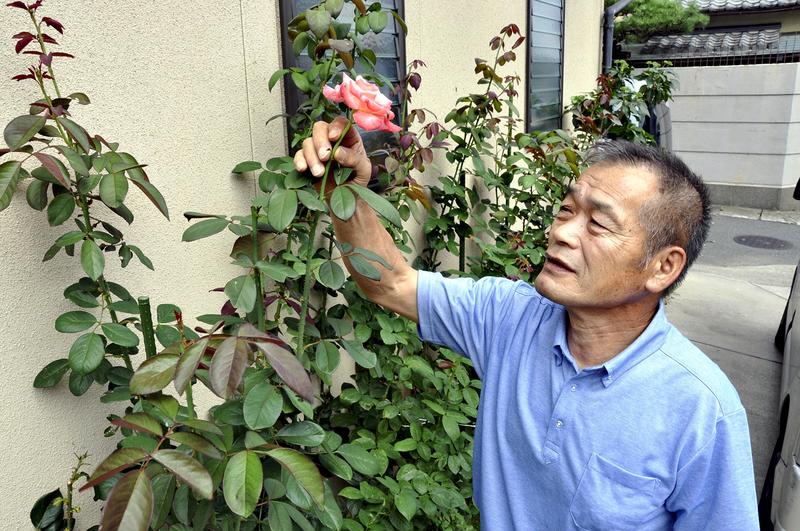
Takeshi Miyabe, 66, used to live alone in Fuchu City, Hiroshima Prefecture. Back then, Miyabe belonged to a group of rose enthusiasts in the neighboring city of Fukuyama and loved cultivating roses. He began breeding new varieties and planted some 500 rose bushes comprising 250 varieties in a field of 2,000 square meters. When the rose bushes flowered, people from near and far traveled to see them.
But six years ago he moved to Ukyo Ward in Kyoto City when his eldest son said to him, "Come to Kyoto and help me with my job."
Miyabe was concerned about what would happen to his roses and wanted to put them in the care of people who would keep them alive. So, Miyabe asked relatives, acquaintances and fellow rose lovers to search for candidates who would care for his roses. Cultivators were found for almost all of the 500 rose bushes thanks to the many rose lovers in Fukuyama City, which encourages its citizens to plant them and dubs itself the "town of 1 million roses."
Miyabe sometimes visits Fukuyama, and he comes across strangers who show him a photo of their plants and say, "The roses you gave me are blooming beautifully."
"I would have had no alternative but to cut down the rose bushes if it weren't for my fellow rose enthusiasts," Miyabe said. "When you get older, I think it's important to pass along the roses you own, to a certain extent, and build a personal network of rose enthusiasts."
-- Hold off on hoarding
How can we ensure that our plants continue to be tended when we leave this mortal coil?
"It is imperative that you clarify your intentions in a will or an 'ending note,'" said an official of the Ihin Seirishi Nintei Kyokai (the association for the certification of experts engaging in the cleaning out of belongings of the departed) in Chitose, Hokkaido.
Members certified by the association do as much as possible, if requested by bereaved families, to dispose of someone's belongings properly, including contacting those who are likely to accept the items and finding such people via social media.
It is also important not to own too many plants that will need to be cared for. In most cases, a bereaved family member can take some plants as a memento of the departed, if it is just one or two potted plants. If no relatives can be entrusted with the plants, it is advisable to dispose of them while the gardeners are still alive. The official from the cleaning-out organization recommended that people "find possible plant successors from among friends and those in the neighborhood."
-- Monumental task
There are municipal governments that take over trees and mediate tree ownership transfers for those who reside the city, but the systems in place can be difficult to navigate.
In Katsushika Ward, Tokyo, the local government takes, free of charge, trees with a height of no more than 2.5 meters that are grown in the ward and plants them in ward-owned lots. Anyone who wants one can dig up the tree themselves and take it home.
The Nagareyama municipal government in Chiba Prefecture mediates deals between those who want to give away trees and those who are willing to accept them. In fiscal 2019, three of 32 registered trees were transferred to new owners.
The Atsugi municipal government had promoted a project for more than 40 years in which it took over ownership of trees and then gave them away, but it suspended the program two years ago. No one applied for a tree for six consecutive years, making it difficult for the municipality to manage them.
(translator's comments)
●山下力人の名前の読みと年齢をご確認ください。
●スマートガーデン、やましたグリーンはどちらのHPにも英語名称がありません。
●記事右上の写真は説明がなくて趣旨も分からないので、英訳していません。
→山下さんに名前の読みを確認し、夫妻が写った写真の使用許可を得ました(角谷)
Read more from The Japan News at https://japannews.yomiuri.co.jp/