Mark Ravenhill is a sharp sociological observer: in Shopping and Fucking and Some Explicit Polaroids he provided graphic accounts of urban angst. But his new 90-minute play, although boasting a masterly performance by Ian McKellen, seems like a distillation of familiar ideas: it tells you more about what Ravenhill has been reading, rather than actually experiencing.
His hero, Paul, is a state functionary who administers the cut: a brutally clinical operation which apparently eliminates individual desire and historical memory. But guilt manifests itself. In the first scene he, somewhat improbably, reveals his suicidal despair to a potential victim. Later we see the corrosive effect of his secret shame on his marriage. Finally, after a reversal of power, we find an imprisoned Paul craving punishment from his son, who is part of a cleansing new order.
Clearly the play is intended as a political fable. But its weakness is that we never know what the cut stands for: it is a vague symbol that could apply to any regime - communist or fascist, secular or theocratic - prizing social conformity above individual freedom. And, if the cut is intended to banish memory, Ravenhill's seems in order. His play echoes Sarah Kane's Cleansed, in its portrait of state brutality, and Pinter's Ashes to Ashes, in its study of the private face of public cruelty, without possessing the former's demonic horror or the latter's imagistic intricacy.
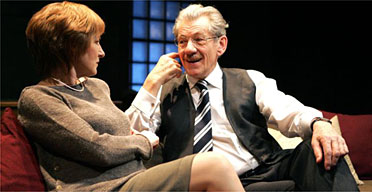
But there is always the acting; and, in Michael Grandage's exquisitely paced production, the central domestic scene makes compelling viewing. As his wife probes his professional mystery, McKellen's nervously authoritative Paul crumbles into rage, bluster and tears. Every gesture tells, so even the way McKellen clears a plate implies someone clinging to order. And his cry of "I'm a good man", has a defiant sadness. This is high-class acting, perfectly matched by Deborah Findlay's stylish attempt to combine bourgeois decorousness with needling investigation.
Presentation is immaculate: Paule Constable's lighting is dramatic, and Adam Cork's sound score is nerve-jangling. But, at a time when state power is increasing in specific, well-charted ways, Ravenhill's play offers us symbolic generalities. What one craves is a modern Brecht who deals with living, correctable injustices.
· Until April 1. Box office: 0870 060 6624.