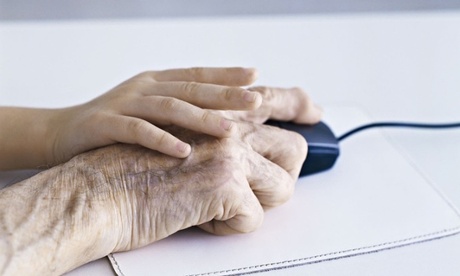
I was sitting at a table with my family. Absent-mindedly, out of the corner of my eye, I noticed a leaf, and idly tried to pick it up. But it would not come. My children starting laughing at me. They pointed out that it was actually a picture of a leaf printed in a newspaper. I was having a senior moment – one of many that I experience on an increasingly regular basis.
The dropping off of brains cells is only part of it. The journey of all parents is ultimately the same – from the revered to the ridiculous. This is a natural process that will happen in any case and is healthy for the individuation of the child. Playing noughts and crosses in the wrinkles on my forehead, as they have done, is doubtless part of that healthy process.
But the speed of change in society means that now it goes well beyond the simple fact of “being old”. Adults almost inevitably will become idiots because most of them cannot keep up – primarily, but not only, with technology and changing attitudes.
There was a different kind of idiocy gap when I was a teenager – a cultural gap. Pop and rock music was quite alien to my parents, most particularly punk, a phenomenon they found utterly bewildering. My parents’ preference for Frank Chacksfield and Mantovani put them firmly in the neanderthal camp, along with their terrible taste in clothes. By the time I was 15 they were absurd to me, beyond the pale.
I never dreamed that the same would happen to me – but for different reasons. The presence of balding pates and withered shanks at rock concerts, or the continuing interest of the middle aged for style and fashion, means that the cultural gap I experienced is now less obvious.
The differences are elsewhere. I do not post a photo of every meal I eat. I do not post a vlog or a blog. I am not constantly checking my screens to see what new scrap of gossip or information is popping up. I am not on Instagram or Snapchat. I do not take selfies (although I know what a selfie stick is – perhaps the saddest invention yet of the human ego).
In politics, my eldest daughter, Jean, a fourth-wave feminist, thinks my gender consciousness – which I once thought was in pretty good shape – is at best rudimentary, at worst heretical. Meanwhile, the things I grew up being angry about in the days of the cold war, primarily the idea of freedom of conscience and speech in the face of tyranny, have been supplanted by profound concerns about offending, by word or deed, minority or marginalised groups – the seemingly unstoppable rise of Balkanised identity politics.
The hyperanxiety about the “inappropriate” uses of gesture and language that vex my daughter are not necessarily misplaced – but coming from my generation and class (1950s, working), it’s just not part of my psychological DNA. The fact that we have to exercise such extreme caution in expressing our perceptions and feelings lest we commit thoughtcrime (Orwell was also part of my conditioning), seems to contain its own seeds of intolerance and unfreedom.
Perhaps – horror of horrors – I will end up, in my own way, like those tragic characters of my father’s generation who still unselfconsciously refer to “coloured” people and “cripples”. I have my own knowledge and my own understandings, but they are becoming as remote to the understandings of my children as the war generation were to the 60s generation.
They say all political careers end in failure – perhaps the same applies to parents. I can only hope the relationship between me and my kids follows the same trajectory as that between myself and my own mum and dad. For whereas once I thought them simply archaic, I came to understand that they just had other kinds of knowledge and different points of reference. And as for my senior moments – well, if I pick up a leaf that is really only a virtual leaf, is that really so different from what they are doing on their screens every day?
• Follow Tim on Twitter @timlottwriter