It is around midnight on Sunday that Yvette Cooper dances into the Metropole hotel, Brighton, waving a fish supper in a polystyrene box above her head like a football scarf. She could be 18 years old, high on alcopops and Duran Duran. “Her name is Rio and she dances on the sand.”
The man on security does a double take. He asks for her pass. The former chief secretary to the treasury and shadow everything produces her lanyard with dazzling insouciance and continues to fish-dance her way in. What does it all mean – is she demob-happy or despairing; embracing Corbynism or giving the ultimate two-fingered salute to new-old Labour? It does make you think how different things might have been if the high-minded, often terrifyingly intense Labour leadership contender had only hinted at her capacity for joie de vivre.
Perhaps we shouldn’t be surprised. After all, this turns out to be the week that the scourge of capitalism John McDonnell lectures on fiscal rectitude, scourge of the lobby Jeremy Corbyn celebrates 32 years of rebellion by leading the party into a new era, and the moon turns red.
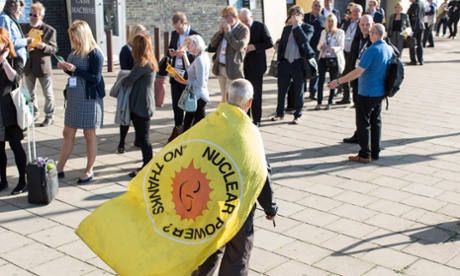
Labour conference is all about the spirit of Corbynism. It is impossible to miss, whether in the form of life-size cutouts, or the many Labour loyalists who bear an uncanny resemblance to Corbyn, or a sun that refuses to stop shining. New Labour might have wanted it to pour on Corbyn’s parade, but nature is having none of it.
The number of Corbyn clones is disarming. Nor are they confined to men of a certain age. Older women, younger women, even a 14-year-old boy have the distinct whiff of Corbyn about them. A group of recently prominent New Labourites including Rachel Reeves are turfed out of a pub and told they will have to hold their fringe meeting in the street. The old world order has been toppled.
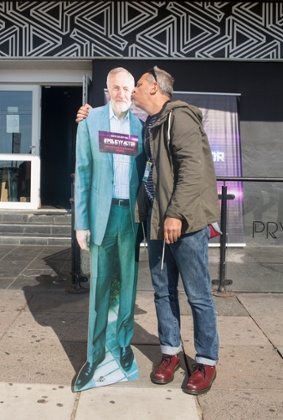
Roger Gillard, 72, is selling a special edition of the leftwing magazine Chartist, renamed Corbyn as a one-off. It features an image of Corbyn watching over the funeral pyre of Tony Blair and New Labour. Gillard says everything feels different this year. “More people have come who are ordinary members rather than trade union delegates and people in suits.”
University lecturer Keith Edwards is another dead ringer for Corbyn. “D’you know how old I am?” he asks. “Sixty-six. Just like Jeremy.” He left the party after becoming disillusioned with New Labour and has now rejoined. “When Blair took office I did feel it was great moment for Labour, but then he lost the cause and was just managing a Tory agenda. With Corbyn, I feel at long last someone is speaking the language that is concerned with the values of the Labour party – egality, fairness, anti-austerity.”
On the beach, Durham councillor Mike Dixon rocks the Corbyn Casuals look – a beard, a pair of shorts and attitude. “Corbyn was elected by the members, not just the people who have just joined. We’re sick of being told what to think: keep your mouth shut, don’t rock the boat, we know what’s best for you. Now he’s come along and said: ‘All right – we don’t know what’s best; we’re going to find out what’s best.’”
Eighty-three-year-old Ann Cross is also in holiday mode – sunnies and floppy hat – and singing hallelujahs to the new dawn. Part of the appeal of the new leader is that he never wanted to lead in the first place, she says. “Other people get caught up with their position in power and end up not trying to change the situation. As time goes by, I get much more angry. I haven’t got much longer and it’s got to change. We’ve got to see a fair distribution and the NHS in safe hands. The idea of selling it off is horrific.”
Corbyn was the first politician she heard campaigning about TTIP (the Transatlantic Trade and Investment Partnership), which she regards as a sinister plot to drive down wages globally. No one had talked about it before, she says. “That’s because it’s a mystery,” she adds, with a conspiratorial smile. “D’you know the meetings are held in secret?”
The cult of Corbyn is astonishing. The eternal outlaw who never sought promotion, never mind the leadership, has been given the biggest mandate ever by party members. He not only didn’t want power, he despised it. In June, I interviewed him two hours after he had secured the 35 nominations he needed to run for the leadership. Why had he stood? “We had a discussion among a group of us on the left about how we might influence future developments of the party. All of us felt the leadership contest was not a good idea – there should have been a policy debate first. There wasn’t, so we decided somebody should put their hat in the ring to promote that debate. And, unfortunately, it’s my hat in the ring.” Why did it have to be his hat? “Well, Diane [Abbott] and John [McDonnell] have done it before, so it was my turn.” So he took some persuading? “Yeah. I have never held any appointed office,” he said.
Three months on, he has become the Chauncey Gardiner of contemporary politics. He is by no means the simpleton played by Peter Sellers in Being There, but, like Gardiner, every utterance, however gnomic, is now thought to contain a greater truth. Corbyn disciples now regard the man who would turn up at a political rally at the drop of a pamphlet as a seer. Corbyn is famously uncharismatic and this has served him well. He has become a blank slate on which believers project their dreams. His story could equally be a biblical parable about patience or a (far-fetched) political satire.
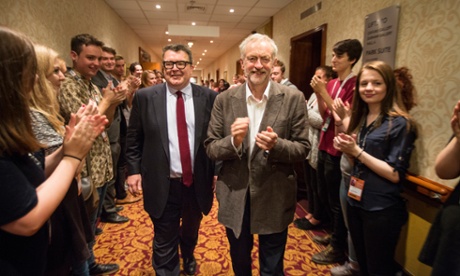
Sunday evening, 6pm, and new young Labour members have lined up for a welcome to the conference. The queue extends down the hotel corridor. There is an expectant buzz even before they enter the Cambridge room. Corbyn has pulled out of a Sinn Féin event, and the rumour is that he will welcome the Labour youngsters personally.
Jack-Theo Wilfan is 14 years old and smooth-cheeked. Yet he has the unmistakeable air, and sweatshirt, of a Corbynista. “I wanted to see what conference was like. I was interested in hearing Jezza speak.” Could he imagine having called Tony Blair Tezza? “No. But Jezza’s got the personality and approachability that Tony Blair and Gordon Brown, and even Ed Miliband, didn’t have. He’s been there and done everything. He’s like a grandfather figure.” Wilfan is from Weston-super-Mare, and his parents are police officers. “We live in a traditionally Tory town. Most people there think Jeremy Corbyn is too extreme for the country.” He tells me his parents are waiting for him in the car.
The crowd walk into the Cambridge room and the doors shut on the waiting media, leaving only the muffled burr of energetic conversation. Then the room goes quiet. They have heard something. Corbyn is walking down the corridor, along with minders, dwarfed by his jacket, a strange mix of meek and assertive. The great silverback mouse makes his entrance. The doors open and the crowd split down the middle like the Red Sea to allow him through. They clap him in and chant: “Jez we can! Jez we can!” He claps back. And the doors shut again. The odd sentence can be heard from outside. The familiar rhetoric that was dismissed as fossilised only a few months ago now sounds animated and urgent.
“I do not like the way in which modern politics is conducted … it’s just a bit of repartee in a theatre, it’s a total turn-off … the unaffordability of the private rented sector … the lack of council housing is going to be addressed in our campaigning … I’m also appalled by the way our mental health services are underfunded.”
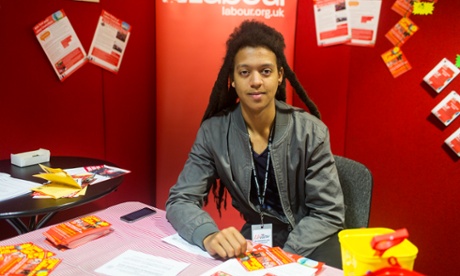
On the way out, 19-year-old Solomon Curtis is effusive. Curtis is an impressive young man with dreadlocks way down his back, a supremely posh voice and a winning passion. The politics student stood for Labour at the general election in the East Sussex constituency of Wealden. He was 18 then, the youngest prospective MP since the 1830s. Although he lost in the seventh-safest Tory seat, he increased the Labour vote. In recent months, he has been campaigning for Corbyn. “He is enthusing an entire generation that wants to see the next generation do better than the last generation. It’s about straight-talking, honest politics. Jeremy can bring back people who not only voted, say, Green or Lib Dem, but those who told me they wouldn’t vote for anybody. For anyone involved in politics, that is the most disappointing thing you can hear.”
At the Odeon cinema, Progress, the Blairite wing of the party, holds a packed rally. Stella Creasy, the MP for Walthamstow who lost the deputy leadership contest to Tom Watson, addresses the crowd about the “new reality”. She doesn’t mention Corbyn by name, but doesn’t have to. “We have to fight for the world to come, not the world long gone; to be excited by the future, by doing things differently, not frightened of it. Fighting for traditional institutions of the state risks us fighting the battles of the 20th century. Not the 21st … As Eleanor Roosevelt said, the future belongs to those who believe in the beauty of their dreams. Well, Progress, I’m here to tell you not to stop dreaming, to start believing, because the future is there for the making.”
Outside, a couple of well-dressed Progress members chat intensely – both are corporate lawyers, and agree to talk to me if I change their names. Yes, says Andrew, New Labour did make mistakes – but Corbyn’s Labour is about to make a far bigger one. “People want to say: ‘OK, can we do things differently?’, and I’m not sure we can yet. I feel it’s a huge indulgence. People say membership has doubled in size to 600,000 so we’re bound to win, and I’m like, no, no – if we had 12 million new members it still would not be enough because we’ve got to reach those people out there who care about how they are governed, but also have other things going on in their lives.”
“We lost the intellectual argument, there was a real sense of fatigue, and we got very technocratic,” his friend Rachel says. “But I agree we’re being very self-indulgent.” Can they accept that many Labour voters might not relate to people as privileged as them? Rachel, a councillor, says supporters can’t afford to think like that. “I cannot possibly imagine the hell that some people in my constituency are going through. Some come to my surgery in tears because they are about to lose their homes. I’m not interested in old labels – Blairite, Trots, whatever; I don’t want to fight the battles of the 80s, I want to help people now. I will say one thing about my clients: they don’t want me to be them, they want me to help them. And I think the same goes for politics as well.”
Later that evening, I spot Margaret Beckett in a restaurant. Beckett has had a tough few months. She was one of the 35 MPs who nominated Corbyn for the leadership battle to widen the debate, but didn’t want him to win. She recently said she was a “moron” for having done so. When she introduced shadow chancellor John McDonnell on stage, a friend said she had the air of Catherine of Aragon waiting to be banished.
As she leaves, she passes by my table. I ask her: do you think it’s the worst political decision you’ve ever made? “Yes,” she says instantly. “Yes, I do. Don’t get me wrong, he’s doing some good things, but if I’d known the outcome, there’s no way I would have done it.” She still seems broken by her decision. She takes a step forward, then turns back. “Well, there’s no point in pretending, is there?” she asks.
Afterwards, I head for the Metropole, where politicos and media and lobbyists drink till the early hours. It is full of people talking loudly – all pristine white shirts and suits and slicked-back hair. If I’d been told it was a reunion for Bullingdon Club, I wouldn’t have been entirely surprised.
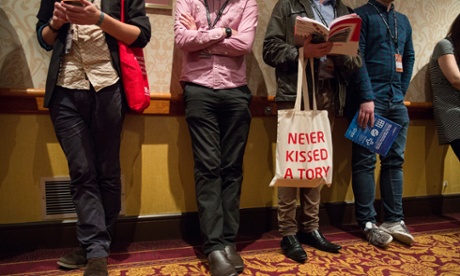
On the way home, a woman asks if we can take her up the road in the cab, and hops in the back with me. Her name is Elaine Evans, and I ask her if she can hold my tape recorder. “I might be very shaky. I’ve got Parkinson’s and have had a couple of glasses of wine.” Evans is 61 and here as a delegate of the Parkinson’s society. She says she doesn’t understand why people are saying this is the end of the Labour party. “I think it’s the beginning. The media give him such a tough time, but normal people, young people, my kids, think Corbyn’s brilliant.” What do they like so much about him? “They can see he’s not a Tory.”
Monday morning, 8.15am, and the British Humanist Association is hosting its no-prayer annual breakfast. The bacon butties are long gone by the time shadow business secretary Angela Eagle launches her attack on Tim Farron. “At a time when we have a huge revival of fundamentalist religious belief, we have a newly elected leader of the Liberal Democrats who is an evangelical Christian who believes in the literal truth of the bible. He does. He just doesn’t want to talk about it a lot because he knows how much it will embarrass his own party.” It is a reminder that fundamentalism takes many forms.
John Austin, 18 years a Labour MP and a former chair of the leftwing Campaign group, is a longtime friend of Corbyn. “I retired at 65, so young Jeremy is doing very well I think.” He understands exactly why the public got tired of the New Labour way of operating. “There’s not a lot of democracy in the Parliamentary Labour Party. Policy came from Tony Blair or the top, it was stated publicly, then MPs were expected to follow it. There was never any debate in the PLP about the major political issues.”
How did that make him feel? “You couldn’t have a debate without being labelled disloyal. Jeremy realises you don’t have to agree on everything; that’s what a democratic party is about.”
Austin says Corbyn has a knack of disarming members of the public. “They read what the media says about him, then they meet him, and Jeremy is what Jeremy is. He can be infuriating at times, but what you see is what you get.” He’s not a charmer? “Well, I think he is, but he doesn’t seek to charm. And he would not be afraid about upsetting you if he thought your views were abhorrent.” How is he infuriating? He laughs. “His unreliability in keeping his diary. That can be infuriating if he’s coming to speak somewhere and he’s doubled-booked. I think he’ll have somebody to manage that now.”
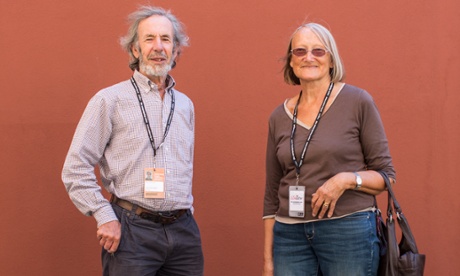
I leave the breakfast with the recently elected former journalist and army reservist Clive Lewis, now the shadow energy minister, who says he is surprised by how things have turned out for him. “I was expecting more time on the backbenches to be honest, with the kind of opinions I hold.” What opinions? “I’m a socialist.”
Lewis delivers a lucid explanation of why he thinks Corbyn’s time has come. “Where we are with austerity now, I think history will say this was the high-water mark of neoliberalism. In the 1980s, they promised everybody would have a home in a share-owning democracy. Neoliberalism was an infant economic theory, so a lot people were taking it on trust and saying: ‘OK, let’s try this.’ But now we’ve had 35 years of it, and we don’t have a shareholder democracy; corporations have bought those shares out. We don’t have people owning their own home; a large percentage are renting and 40% of homes are now buy-to-let, in many cases owned by Rachmanesque landlords. So things have changed. People in the 1980s went to university and came out and got a decent job, but they see their children with thirty to forty to fifty thousand pounds’ worth of debt and working in Costa. So people are beginning to realise – This. Isn’t. Working.” He punctuates the last three words with full stops. “I think the right of the party is coming to terms with the fact that they have been devoid of an alternative to neoliberalism.”
Lewis thinks the party might not even have survived till the next election without a Corbyn victory. “Look at how desperate the membership were after the welfare bill abstention. The membership would not have tolerated it. I genuinely think our core would have collapsed, so in many ways I think Jeremy has ultimately saved the party.”
It’s another sunny day, and there appear to be even more contented Corbynalikes strolling around the conference centre. But my Jezza antennae have failed. Cindy and Dennis Matthews voted for Yvette Cooper (who later that night is spotted dancing to Abba’s Dancing Queen with Keith Vaz). “Corbyn comes out, his image was wrong, he was scruffy, he didn’t look like a leader, but he was the one who was different from the rest,” says Dennis. I stop him. Do you see a bit of Corbyn in yourself, I ask. He grins. “Well, I have heard that before. I do need a haircut, but I have had beards for many years. I once shaved my beard off for charity and Cindy didn’t want to know me when I got home.”
Cindy says she was positively hostile to Corbyn at first. “I had arguments with friends who were going to vote for him, and I said: ‘But he’s not going to be electable,’ and their argument was: ‘Well, at least he’ll be leftwing.’ But as time went on, I started to see what they felt. The Labour party had gone too rightwing, there was too much fudging. He said what he believed instead of parroting the party line. I was worried and still am, but in the conference there is a real buzz. I went to the women’s conference on Saturday – 1,200 women, and when he came in we all stood up, excited.” She laughs, embarrassed. “And he’s not exactly terribly photogenic or anything, is he?”
Even the famously abrasive former spin doctor to Ed Miliband, Tom Baldwin, is in a sunny mood – ish. Within seconds, though, he is talking about the existential crisis in politics. “A lot of the old assumptions have been ripped up; the laws by which we understood politics for the past 20 years. But the new rules aren’t in place, let alone do we know that they work. We haven’t even got a conventional wisdom yet.” He says it’s as scary a time for political journalists as politicians, “because they make their living interpreting politics and applying the rules they’ve always applied”.
Is he optimistic about Corbyn’s new-old Labour? “I don’t think Corbyn’s going to work. We splashed around in some of the puddles of Corbynism and it generally didn’t work for us. But the one thing he’s got, which is interesting, is that he doesn’t look scared. Most politicians look scared. I don’t know whether it’s age or having spent 32 years out on the margins.”
What about when he got rattled by the Sky cameras? “He looked irritable but not scared. Not great. But when he was doing the [Andrew] Marr interview, Marr said to him: ‘Can you see the Grand hotel down there?’, and he just turned round and said: ‘No.’ Now Ed or Cameron would have stood there and gone: ‘No, I’m not playing that game. I’m not looking over my shoulder – I know what you’re trying to do.’ He’s comfortable in his own skin. Ed wasn’t comfortable in his own skin.”
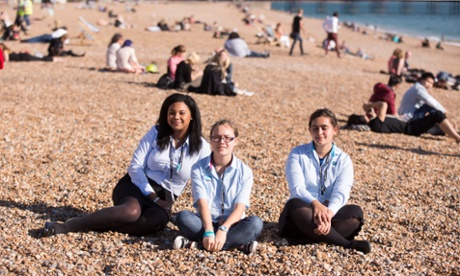
On the beach, close to the Metropole, three young women are relaxing in their Girlguiding uniforms and Labour conference lanyards. They stand out a mile in the macho world of conference. The women, who are here to promote their Girls Matter campaign, insist they can’t talk politics because they represent a charity and have to be neutral, but they can’t disguise their enthusiasm for this strange, musty old world. “You can see here that a lot more young people are getting interested in politics now,” says 20-year-old Annabel Davies. “Things are not changing fast enough,” argues 17-year-old Ashvini Rae. “Less than a third of politicians are women, and far less are women of colour.”
Fair enough, says 17-year-old Larissa Kennedy, but at least they are changing. Politicians know they have to make themselves relevant. “It’s probably not how politics has been in the past, but it’s new and exciting.” Kennedy says she noticed a strange thing at conference: “I’ve seen a lot of Jeremy Corbyn lookalikes. I think he’s set a trend. With the new leader, everyone’s pumped up and ready and inspired about what he has to say.” Perhaps not everybody – but she has a point. It’s funny how a sixtysomething beardy can inspire a generation. As I head off, Larissa shouts at me that she’d like to go into politics. “Come back in 10 years, and you can do a Where Are They Now?”
- This article was amended on 1 October 2015. An earlier version referred to the Dead Sea where the Red Sea was meant.