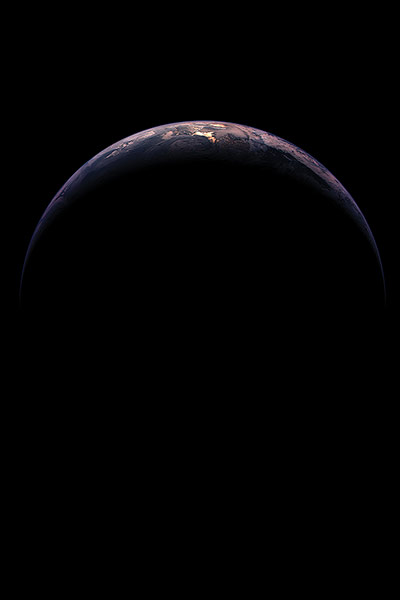
Low rays of sunlight turn the Southern Ocean between South America and Antarctica golden in this serene view of a crescent Earth, captured by the European Space Agency's Rosetta spaceprobe during its 2009 fly-by. Our planet is unique in the solar system for its abundant surface water, often attributed to its position in the 'Goldilocks zone' of moderate temperatures. The transformation of water between liquid, vapour and ice is a crucial force in shaping Earth's surface and encouraging its abundance of life. Photograph: ESA ©2009 MPS for OSIRIS Team MPS/UPD/LAM/IAA/RSSD/INTA/UPM/DASP/IDA
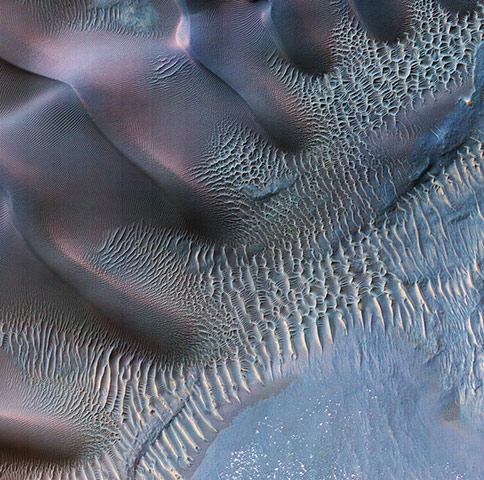
Complex sand patterns ripple across a crater floor in the Noachis Terra region of the Martian southern hemisphere. While the northern regions of Mars are dominated by low rolling plains, the southern hemisphere is more chaotic and heavily cratered. Windblown sand accumulates in the floor of these craters, where it is frequently blown into beautiful dune patterns, some of which are unknown from Earth's deserts and probably owe their unique forms to the tiny size of Martian sand grains. Photograph: NASA/JPL-Caltech/Univ. of Arizona
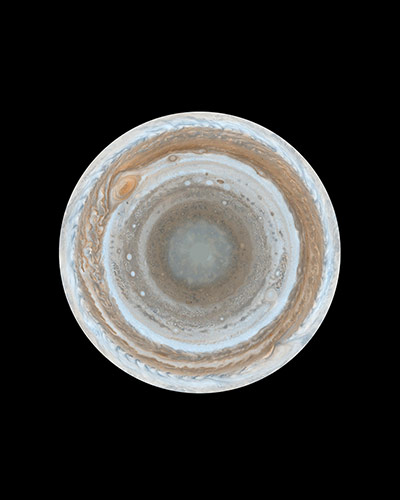
Jupiter's southern hemisphere is rendered into a mass of concentric cloud patterns in this unusual view, constructed from data gathered with the Cassini spaceprobe during its December 2000 fly-by of the giant planet. The image stitches together data from 36 separate exposures taken over the course of nine hours as the spaceprobe passed by some 10 million kilometres (6.2 million miles) away. Despite an equatorial diameter 11 times larger than Earth's, Jupiter rotates in less than ten hours, wrapping high- and low-pressure weather systems into parallel bands around the equator. Photograph: NASA/JPL/Space Science Institute
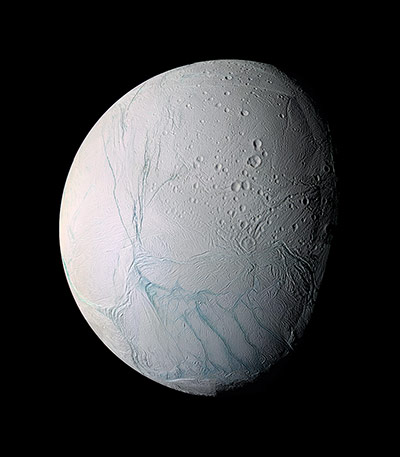
Saturn's moon Enceladus presents a hemisphere of gleaming whites and blues in this enhanced-colour image from the Cassini spaceprobe. In normal light, the satellite appears brilliant white - the most reflective and therefore brightest landscape in the solar system - but here colour differences have been exaggerated to highlight features such as faults and the 'tiger stripes' of the southern hemisphere. Enceladus owes its pristine appearance to a widespread covering of fresh snow, produced by geyser eruptions from reservoirs of liquid water just below the surface. These in turn are caused by 'tidal heating' - a result of Saturn's powerful gravitational forces. Credit: NASA/JPL/Space Science Institute Photograph: NASA/JPL/Space Science Institute
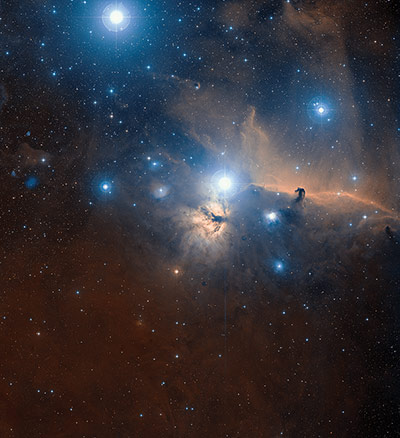
The horsehead is the most famous of all dark nebulae, but its distinctive chess-piece shape is only a brief phase in its ongoing evolution as dust and gas within it collapse to form new stars. The nebula lies around 1,500 light years from Earth in the constellation of Orion, and is roughly two light years across at its head. Beyond the horsehead lies the softly glowing emission nebula IC 434, whose striated appearance is caused by the weak magnetic field of the Milky Way itself. At far left in this image lies the bright star Alnitak in Orion's belt. Photograph: ESO and Digitized Sky Survey 2.
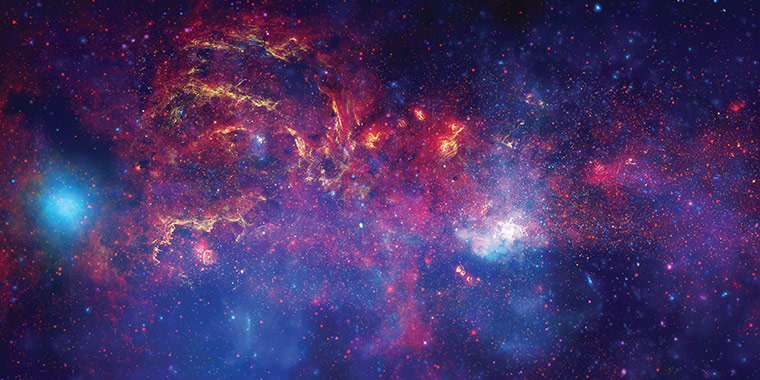
Some 26,000 light years and countless intervening clouds of stars, gas and dust separate Earth from the core of our galaxy. In visible light it is totally hidden from our view behind the bright star clouds of Sagittarius., but orbiting telescopes that observe at other wavelengths can pierce the veil to reveal a strange landscape of twisted dust clouds, violent stars and superhot gas. Right of centre, a blaze of blue and white reveals a huge cluster of heavyweight stars swimming in a sea of hot gas: they mark the exact centre of the Milky Way, orbiting around an invisible supermassive black hole with the mass of 4 million Suns. Photograph: NASA, ESA, SSC, CXC and STScI

Clouds of red and blue mark sources of invisible infrared and X-ray radiation, overlaid on a stunning Hubble Space Telescope image of galaxies in the midst of a cosmic collision. The Antennae Galaxies, NGC 4038 and NGC 4039, are a pair of merging galaxies round 45 million light years from Earth, named for the distorted spiral arms that stretch away on either side of their bright centre. The heart of this interacting system, meanwhile, offers an unusual detailed view of a galactic merger. Head-on collisions between individual stars are rare - the real action is driven by interstellar gas clouds slamming into each other and unleashing enormous waves of star formation. Photograph: Chandra X-ray Observatory Center/X-ray: NASA/CXC/SAO/J.DePasquale; IR: NASA/JPL-Caltech; Optical: NASA/STScI
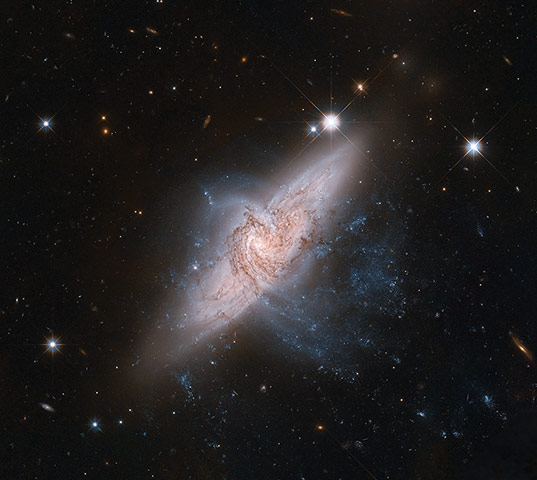
A trick of perspective results in an image of stunning beauty as one spiral galaxy crosses directly in front of another in the constellation of Hydra. Galaxy NGC 3314 had long been recognised as peculiar in its appearance, but it was only in 1999, thanks to Hubble Space Telescope images, that it was revealed as two separate galaxies. The foreground spiral is about 117 million light years from Earth, with the larger background galaxy 140 million light years away. As a result, the dusty skeleton of the closer galaxy - the region where new stars are continuously being created - is thrown into stark silhouette. Photograph: NASA, ESA, the Hubble Heritage (STScI/AURA)-ESA/Hubble Collaboration, and W. Keel