In the pop artist Larry Rivers’s haunting 1959 painting The Last Civil War Veteran, a man lies on his death bed under the flags of both the Confederacy and the Union. It is one of a series of works in which Rivers depicts the Confederate flag as a piece of Americana, a totem of history, a pop icon. He is far from the only artist to have used it in this way.
As the flag of the old American south comes under scrutiny for being an image of – and maybe an incitement to – racism and murderous bigotry, it is worth remembering that for a long time it has had a more ambiguous, apparently innocent reputation in popular culture.
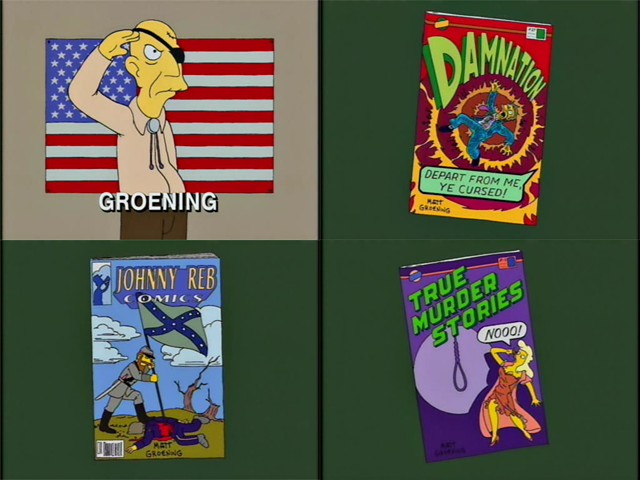
No one accused the Dukes of Hazzard of white suprematism when the good ol’ boys who had a rollicking time in the 1970s TV series flaunted the starred diagonals of the flag that has become famous as the “Confederate battle flag” on their Dodge Charger. Similarly, no one has taken issue with its appearance everywhere from a Primal Scream album cover, which used a photograph of the stars without bars by William Eggleston, to Matt Groening’s self-parodic appearance as a flag-waving, far-right propagandist in The Simpsons (the joke being that it’s the opposite of the truth).
The Confederate flag suddenly looks like a starkly, horribly political totem, but can a flag have only one meaning? It is not even completely authentic: in reality, the southern states had several flags in the civil war, and the famous image is just part of a battery of original insignia, reduced in memory to one. Back when Larry Rivers was exploring it as a pop art icon, Jasper Johns made his great image of the Union flag with layers of collaged newsprint under its wax-painted stars and bars. In Flag, Johns captures the many stories hidden within nationhood. Flags are complex documents.
It is reasonable now to wonder if the Confederate flag is pure racist imagery, but its widespread cultural use would suggest it is more complicated than that. It also raises a bigger question. Is white southern identity itself something that needs to be abandoned or condemned? The proud cultural history of the south embraces everything from Jack Daniels and country music to the novels of William Faulkner and paintings of Cy Twombly – can that cultural richness be dismissed as archaic conservative nostalgia, or worse?
In reality, the struggle between regressive prejudices and human decency in the south has long been fought within its cultural traditions, not against them. The obvious example is country music. Robert Altman’s portrayal of country as a cynical conservative style in his film Nashville now looks like a hopelessly ignorant view of a tradition that includes radical voices like Steve Earle and Townes van Zandt.
The white American south has kept some of its most pestilential prejudices intact since the civil war. But it is not racist to drink bourbon, listen to Texas outlaw music or eat crabcakes, and it may not be racist to display a flag. In the end, it is just a piece of cloth.