V.O. Chidambaram Pillai (1872-1936), one of the stalwarts of the freedom struggle and whose 150th birth anniversary was observed on September 5, is always remembered for his intense and somewhat strange interactions, of course through correspondence, with Mahatma Gandhi.
One of his letters relates to money mobilised by South African Tamils for him, which was handed over to Gandhiji. There is a misconception that Gandhiji did not pass on the money to VOC, as Chidambaram Pillai is popularly known. The theory continues to be floated to this day. Even during the last birth anniversary of VOC, such messages were shared on social media. The Hindu examined this account to ascertain the historic and factual position.
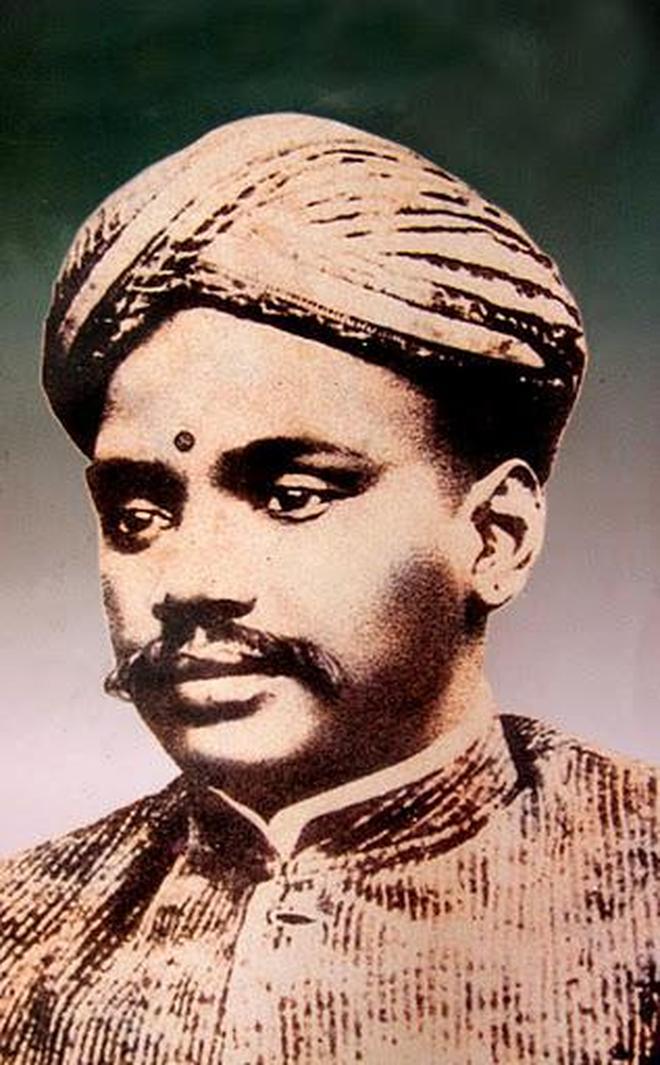
VOC, the stalwart also known as Kappalottiya Tamilan (The Tamil Helmsman), was in penury after coming out of jail in December 1912, spending four years in the Coimbatore and Kannur jails. A staunch follower of Bal Gangadhar Tilak (1856-1920), VOC was convicted along with his close colleague, Subramania Siva (1884-1925), on the charge of sedition. Though Siva was the prime accused in the case and VOC was only the second accused, Arthur F. Pinhey, the then Additional Sessions Judge of Tirunelveli district, awarded a comparatively lighter sentence of 10 years of transportation to the former but transportation for life to the latter. The severity of the punishment not only attracted widespread condemnation from a host of leaders but also triggered a wave of unrest and violence in the undivided Tirunelveli district that included the present-day Thoothukudi and Tenkasi districts.
The “offence” committed by the two nationalists was that Siva delivered four speeches during February and March 1908 and VOC was the organiser of the events, which were held as part of the celebrations to mark the release of Bipin Chandra Pal (1858-1932), who was charged in March 1907 by the Bengal government with contempt of court and awarded a six-month imprisonment.
On appeal, VOC’s imprisonment was reduced. More than the fact that the nationalist had to do hard labour, he must have been depressed by the development that ships belonging to the Swadeshi Steam Navigation Company (SSNC) were sold to the competitor British company, against which VOC had planned and launched the Thoothukudi-Colombo steam services before going to jail. The SSNC was also dissolved. Four years of imprisonment had ruined VOC’s family as all the savings and wealth had to be spent on legal battles. After the imprisonment, the nationalist, a littérateur of eminence, had to work as a clerk in a bank or run outlets selling rice and ghee for a livelihood.
It was against this backdrop that the nationalist came to know in 1915 through Vediappa Pillai of South Africa that funds were mobilised among Tamils living there and handed over to Gandhiji. In May 1915, VOC wrote to Gandhiji, who was then living in Ahmedabad, seeking the payment of the amount due to him, according to V.O. Chidambaram Pillai, a biography authored by R.N. Sampath and Pe.Su. Mani and published in 1992 by the Publications Division of the Union Ministry of Information and Broadcasting. The authors noted that the letter did not find its place in the Collected Works of Mahatma Gandhi. Nor was it included in D.G. Tendulkar’s exhaustive biography on Gandhi.
An article published in this newspaper in January 2003 and written by A.R.Venkatachalapathy explained that a series of letters were exchanged between VOC and Gandhiji. It took a while for Gandhiji to do verification in South Africa about the collection of funds before remitting the amount due to VOC. The article stated that in the third week of January 1916, Gandhiji informed VOC that the amount of ₹347.12 (a princely sum those days) would be paid. A few weeks later, VOC had disclosed to a friend of his that the amount had been received.
What may appear to be an odd aspect of the interactions between the two was that during Gandhiji’s stay in Tamil Nadu in the months of April and May 1915, VOC attempted to meet him and explain his plight in person. Dr. Venkatachalapathy mentioned that the two did meet, even though it was not known how long the meeting lasted.
However, M.P. Sivagnanam (1906-1995), a Tamil scholar and freedom fighter, in his seminal Tamil work (1982) on the role of Tamil Nadu in the freedom struggle, stated that there was no meeting between the two. Ma Po Si, as Sivagnanam was popularly called, even attributed this to the influence of moderates on Gandhiji, who regarded Gopal Krishna Gokhale (1866-1915) as his political mentor. For VOC, Gokhale’s contemporary, Tilak, was political guru.
Sampath and Mani recorded that at a public meeting presided over by Kasturi Ranga Iyengar (1859-1923) in Chennai on March 17, 1919, Gandhiji and VOC shared the platform, speaking one after the other against the Rowlatt Act. The greatness about VOC was that despite being a staunch follower of Tilak, he recognised Gandhiji’s leadership early, in the words of the biographers, as a “beacon light to the dawn” of the country’s freedom.