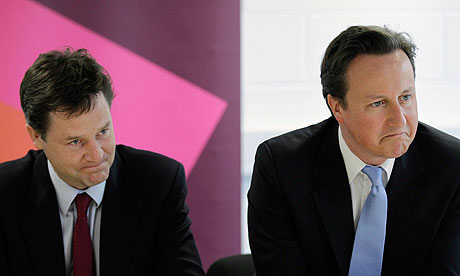
Our recent research with the public suggests that the coalition government is not yet perceived to be making a positive impact on charities. We asked the public how far they agreed or disagreed with the statement 'the coalition government has had a positive impact so far on charities'. Only 2% strongly agreed and 9% agreed, which is hardly a ringing endorsement. The situation was little better for the NHS or small businesses, with only 13% and 15% agreeing or strongly agreeing that the government has had a positive impact. Big businesses fared a little better with 22% saying that the government has had a beneficial effect.
In terms of how the public see the parties' relationship with charities, 19% of respondents say Labour is most supportive, compared with 12% choosing the Conservatives and 11% for Liberal Democrats. The maths geniuses amongst you will see that this leaves the majority of the public (55%) as 'don't knows' with 4% naming another political party.
So far so predictable. The reality is that governments find it hard to make a positive impact on many areas of public life. Indeed, to quote from the Queen talking to Alice in Through the Looking Glass by Lewis Carroll: "it takes all the running you can do, to keep in the same place. If you want to get somewhere else, you must run at least twice as fast as that".
Are the public right that the coalition government is struggling to have a positive impact on charities, or has the impact just not been noticed? Part of the answer to that question lies in the way the Conservatives launched their approach to charities and the wider third sector with the 'big society' initiative. While most people adopt a policy of 'underpromise and overachieve' in their working lives, the Conservatives did the opposite. They waxed lyrical about substantive changes to the way society works and our relationship with it. They overpromised and are now in the process of underachieving.
It is in the bloodstream of politicians to make bold promises; the problem is that it is not clear that there was any plan for delivering big society, nor any significant resources with which to do it. When Iain Duncan-Smith or Andrew Lansley promise reform, the mechanism through which they could do so is fairly clear: legislation, budgets, civil servants, public bodies and the like. The mechanisms and resources to deliver big society are much smaller and much less clear, while the nature of the changes is more diffuse.
The lack of positive impact by the government is compounded by the fact that the policy agenda from the sector's side appears to have run out of steam as well. How does the sector itself want to be different in five years' time? What does the sector want the government to change in terms of legislation or policy? I struggle to remember what the sector is asking for (again and again and again).
Philanthropy and giving appears to be one of the areas where change is wanted, and nfpSynergy's own research with people in the sector shows that worries about 'funding' come right at the top of the list of organisations' concerns. But even there the nature of the change that is wanted is very opaque and there is little sector-wide coherence. The latest campaign wants people to 'give more' which is as about as nebulous as it gets. Government has promised a 'giving summit' but seems uncertain what the summit is going to be about and has alreadypostponed it.
So in the end if we want the public to think that the government has had a positive impact on charities, we should be clear about what the sector wants that impact to be. We need to be clear that either the sector or the government has an agenda for change that it wants to deliver. And at the moment how many readers could put their hand on their heart and say that they know what either sector or government wants.
No wonder the public is unconvinced.
Joe Saxton is founder and driver of ideas at nfpSynergy
This content is brought to you by Guardian Professional. To join the voluntary sector network, click here.