The battle between Japan and China for manufacturing leadership continues as interest in the drug Avigan increases due to its possible efficacy in treating COVID-19, the disease caused by the novel coronavirus.
In March, the Japanese government was desperately trying to find a domestic company capable of producing a raw material for the drug, originally intended for new strains of influenza under the generic name favipiravir.
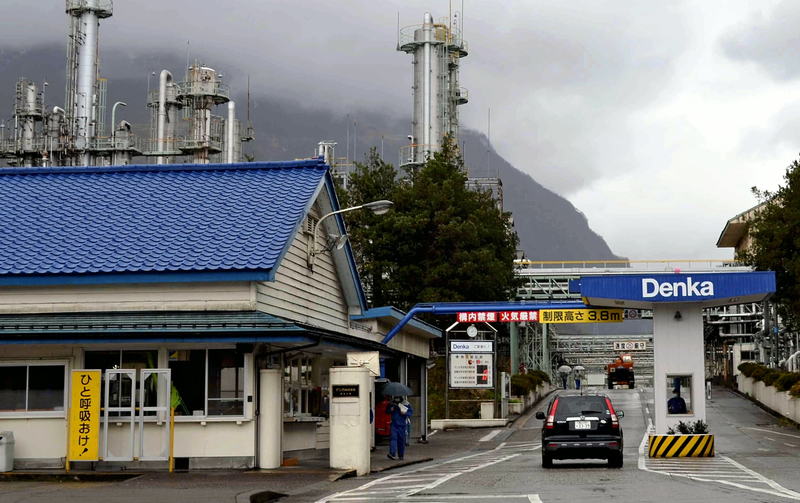
That month, Tadashi Mogi, director for technology affairs and advanced capacity building at the Economy, Trade and Industry Ministry, called a member of the chemical industry and learned that the material, diethyl malonate, had been produced by chemical manufacturer Denka Co. at its plant in Niigata Prefecture. But three years ago, the plant had suspended operations.
The person then told Mogi that the plant was scheduled to be demolished this summer.
The following day, Mogi visited Denka's headquarters in Tokyo and met with an executive in charge.
"The government will pay all the necessary expenses," Mogi said. "We want your company to restart the plant."
The executive responded: "This is a time of national crisis. We want to devote all our strength to do everything we can."
Fortunately, there had not been any conspicuous damage to the plant and production restarted on May 16. If the plant had already been torn down, domestic production of diethyl malonate for Avigan might not have been possible.
"We somehow managed to get this far," Mogi said, "thanks to a series of coincidences."
In line with the growing trend of globalization since the 1990s, China had assumed the role of "the world's factory." In a bid to cut costs, Japanese corporations competitively shifted their production bases offshore, where labor costs were low. Denka suspended production at its Niigata plant because it was beaten in the price competition by Chinese rivals.
A subsidiary of Fujifilm Holdings Corp., which manufactures Avigan, also has its production base in China for producing raw materials.
According to an official related to the matter, Fujifilm has sometimes struggled to respond when it was caught between the Japanese government, which asked the company to boost production of Avigan at home, and China, which wanted it to sell Avigan in its country.
The global pandemic of the novel coronavirus has stopped the cross-national movement of people and goods. The pandemic has also highlighted the fragility of global supply chains in which a country cannot procure its own medicine or daily necessities such as face masks during emergencies.
Prime Minister Shinzo Abe called on Japanese companies to shift their offshore production bases back to Japan during an online program on May 15, saying: "We'll protect Japanese corporations that have technology. We will secure sufficient funds to deal with this."
Reviewing supply chains is also directly connected to the economic security of Japan. Referring to the fact that an economic team was set up within the National Security Secretariat in April, Abe said, "We want to realize our economic policies from the viewpoint of national strategy."
On the basis of the revised Foreign Exchange and Foreign Trade Law, the government has positioned 12 sectors -- 558 companies in all -- as "core business sectors" that are deemed particularly important from the viewpoint of national security. It has made it mandatory for all foreign investors seeking to acquire more than 1 percent in such a company to notify the government in advance.
In response to the coronavirus situation, companies in the pharmaceutical and medical equipment sectors will also be designated as core businesses this month. Fujifilm has already been added to the list, and Denka is scheduled to be so designated.
Though it does not specifically name China, the government aims to protect Japanese companies whose share prices have fallen amid the coronavirus situation from being bought by China.
Behind the battle with the virus, the battle between nations over national security has been intensifying.
Read more from The Japan News at https://japannews.yomiuri.co.jp/