The collapse of BHS and the recriminations over the department store’s pension scheme have shone a spotlight on private defined benefit pension scheme deficits.
BHS isn’t the only company with a scheme deep in deficit. Data from Mercer, a financial consultancy, today gives one indication of the aggregate size of the deficit of FTSE350 firms. It says they rose to £92bn at the end of April, up £11bn over the month.
£92bn is a big and scary sounding number. But how bad is it in the scheme of things?
Mercer kindly provided me with their data going back to 2007 and I used it to construct this chart:
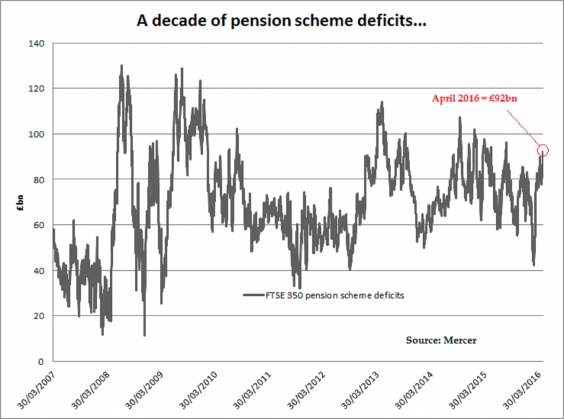
What this shows is that deficits were considerably bigger in 2013 and during the 2008-09 financial crisis, when they were well over £100bn. But by the standards of the past decade the deficit is still pretty high at the moment.
There’s clearly also some considerable variability here.
Why? It’s important to grasp that there’s several things going on under the surface.
The aggregate pension scheme deficit of UK firms is the difference between their assets and liabilities.
The performance of the assets depends on the performance of the stocks and bonds in which the schemes are invested. And the value of the liabilities depends largely on UK government bond yields, which are used to value the present value of future pension liabilities. To put it simply, the lower bond yields are, the bigger liabilities are.
Bond yields will go up and down depending on how close (or far off) financial markets think an interest rate rise from the Bank of England is.
Mercer says deficits rose in April because government bond yields fell. This was due to a combination of traders betting on a rate rise being further off and investors worrying about the impact of possible "Brexit" and buying safe assets (pushing down their yields).
And stock prices are based on market expectations of the future earnings of companies. We all know how volatile stock markets can be.
Here’s how assets and liabilities have moved in recent years, again using Mercer data:

The volatility of the two series explains why there’s lots of variability in pension scheme deficits.
Some have sought to put the blame for these scheme deficits on the Bank of England for deliberately holding down bond yields through its Quantitative Easing (QE) policy of money printing.
Others see this as an excuse, saying firms, such as BHS, have simply failed to inject enough cash into the schemes in recent years.
From this data there does seem to have been a step change in the size of deficits after the financial crisis and around the time when the Bank of England started its QE programme. Before then aggregate deificits averaged less than £50bn.
Does that mean people are justified in castigating the Bank?
Not really. Low short-term interest rates and QE (which has influenced the longer-term rate) certainly haven’t helped pension schemes, but the Bank of England’s mandate is to achieve stable consumer price inflation. Its job is not to assist private firms in meeting their pension promises to workers.
Note too that low interest rates will have partially offset the impact on liabilities by boosting the value of schemes' bond and equity holdings.
It's possible to feel some sympathy for firms with large historic defined benefit pension schemes in the current climate of low interest rates. These generous retirement schemes were generally set up by previous managements in an era when life expectancy was lower and the true future cost of the promises was unknown.
Yet the sympathy should only extend so far - especially when today's managements have been paying out large cash dividends to shareholders while watching pension deficits spiral upwards.