Much to the horror of my Italian boss, I was recruited for my job in Rome through an internet job-board. "But you don't even know her!" was apparently the anguished cry. Fortunately my immediate supervisor, an Italian-Australian, could persuade my boss that I had the requisite skills and had been interviewed. I don't think my boss ever read my CV.
Who you know is one of the fundamental rules of working in Italy. Personal contacts and networks are crucial for hiring and doing business, which is why my boss was appalled that they'd had to resort to the faceless internet to find a suitable candidate. One of the quickest and most traditional routes into a job is through personal recommendation — a practice that extends into all aspects of life in Italy.
My contract came after weeks of uncertainty, by which time I'd already decided to move to Italy. I realised much later that a lengthy wait to see how the market was shaping up, followed by a last-minute decision, was typical of Italian working practice. If I'd grown tired of the delay and decided to go elsewhere, what then for the company? Italians don't really do 'what if' scenarios. They'd have found a 'solution', a last-minute workaround, regardless of how much stress that placed on the employees who'd then have to rush around trying to fix a staffing problem while simultaneously doing their own jobs. Our company was typical of a mid-sized operation, in that there was no designated HR person. Although this meant we were unfettered by performance reviews, or health and safety regulations, individual departments were also responsible for their own hiring and resource management.
The lack of long-term planning and organisation is probably what gives Italy its reputation for chaos. "If you want a typical 9-to-5 job, go and work for the Government Ministries" my boss retorted to complaints that we had no time to plan or carry out projects adequately. Being dependent on the whims and last-minute changes to plan of salary-paying clients means that a British reliance on efficiency is practically redundant. Instead, the most prized skill is the flexibility to adapt to different circumstances at the last minute. You juggle your other ongoing projects and extend their deadlines in turn.
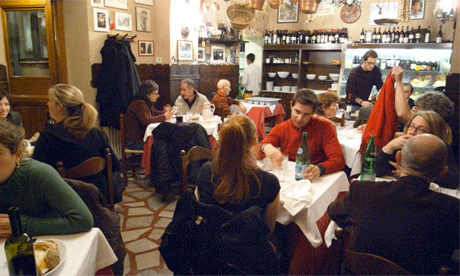
The constant manoeuvring around obstacles means that, much like the driving in Italy, there are few fixed rules. But the one, sacred principle is that all workers, from CEOs to office interns, down tools at 1pm to have lunch. Part of permanent workers' pay is made up of luncheon vouchers, which are normally generous enough to get a decent-sized bowl of pasta. Lunchtimes are the great leveller in Italian companies: no matter how grand your title, you are an equal at the table and can freely discuss politics or company policy. Of course, once back behind your desk, you revert to hierarchy.