Maxim-um points
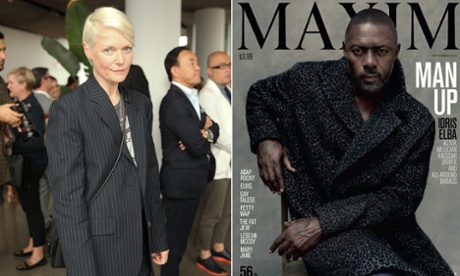
If you cast your eyes over the “men’s shelf” of your local newsagent’s magazine section this week, you may find one less underwear-clad woman staring back at you than usual. Why? Because, for the first time ever, US Maxim has a (fully clothed) lone man on its cover: hello Idris Elba.
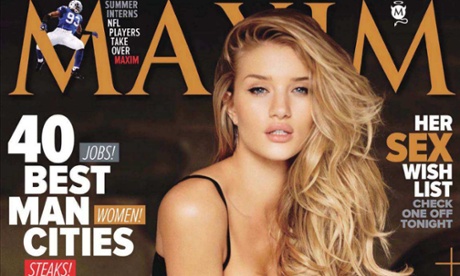
The move is a fair attempt to reinvent one of the most archetypal lads’ mags of the 1990s by toning down its, well, downmarket image; the September issue has swapped hot babes in bikinis on the cover and replaced them with a likeable bloke. The canny cover is down to Kate Lanphear – a former New York Times style director – who has held the role of Maxim’s editor-in-chief for the past year. Maxim’s man-cover issue aside, Lanphear was also widely credited for bringing the magazine’s notorious “Hot List” into the 21st century, by handing the 2015 top spot to someone “based on her accomplishments”, rather than just their looks. And so, Taylor Swift was pictured in her first men’s magazine cover with minimal makeup, looking directly into the camera. “I was determined to have someone whose talent really transcended their beauty,” Lanphear said at the time. (Helped, of course, by the fact that Swift is still beautiful.)
Net-fix

After last month’s report on the difficulties new mothers face being accepted back into the workplace, it is more reassuring to learn that, in plans unveiled this week, the US company Netflix is offering fully paid leave for new parents (mother or father) for up to a year after birth or adoption. A year! Fully paid!
The company already has a solid reputation for valuing its employees – who are trusted to decide how they want to work and can take unlimited holiday, so it’s perhaps no surprise that the company takes a progressive attitude towards parents.
What’s really encouraging is that other companies – including Microsoft – appear to be following suit. The day after the Netflix announcement, Microsoft revealed that it would be upping paid leave for US employees who become new parents. As Time reports:
“Previously, it provided eight weeks of fully paid maternity leave and 12 weeks of parental leave for all parents, eight of which were paid, and four were not. Now, all 12 of those weeks will be paid, and mothers get a total of 20 weeks.”
Of course, as the Guardian points out with this handy map, these parental leave policies are still lagging behind some of those in Europe, but there’s no denying that they are steps in the right direction.
Grow up, Hollywood

Yet another story about ageism and sexism in Hollywood. This week, the cast of women who have recently spoken out against discrimination in the industry can add some fresh academic clout to their argument as a new study by the University of Southern California’s Annenberg School for Communication and Journalism, corroborates what Helen Mirren, Emma Thompson et al have been saying for years: that it is a bleak world out there for the “more mature” female actor. In fact, forget the truly “mature”; it seems that once you hit your mid-40s you’re done for in Tinseltown.
According to the study, among the 100 top films of last year, none starred a woman over 45. And only two were directed by women (that’s one less than in 2007). And – if you thought those statistics were depressing – of those most popular movies surveyed between 2007 and 2014, only 30.2% of all speaking parts or named characters were female.
But the inequality isn’t by any means restricted to women. As the author of the study, USC professor Stacy L Smith, told this paper:
By examining the trends over time, it is clear that no progress has been made either on screen or behind the camera when it comes to representing reality. This report reflects a dismal record of diversity for not just one group, but for females, people of colour and the LGBT community.”
China’s crackdown

For a growing number of women not yet ready to have a child – whether because they are single, focusing on their career or just really good at forward planning – egg freezing is increasingly becoming the go-to way to organise motherhood. But if you’re a single woman living in China who wants to put her eggs on ice, bad luck, because the state won’t let you.
In fact, unmarried women are not allowed access to any assisted reproduction technique in China. It’s not a new law – in the decade since egg freezing has been available in the country, only married women (and then only in specific circumstances) are permitted to use the service. However, the policy made headlines this week after one of China’s most prominent actors, Xu Jinglei, revealed that she travelled to the US in 2013 to have her eggs frozen.
Jinglei, who is single and 41, told a Chinese magazine in July that her only regret was that she “was a little bit late in doing so”. It was a revelation that sparked a furious online debate surrounding the status of single women in China, and whether or not they have any reproductive rights to speak of.
It prompted the state-run broadcaster, the ominously named CCTV, to air a programme highlighting the risks associated with egg freezing. The state maintains that the reasons for the ban are to help prevent black market trading of ova, and because experts are warning of the health risks that can arise from having children after the age of 35. And yet, that still doesn’t answer the question of why women are not allowed to decide for themselves what to do with their own eggs.
ICYMI
Are these the greatest books by women you’ll never read?
Binders Full of Women Writers: can a secret Facebook group be inclusive?
Why women entrepreneurs are far less likely to be funded
How to be a sexier woman by clicking on this article (and other top tips)