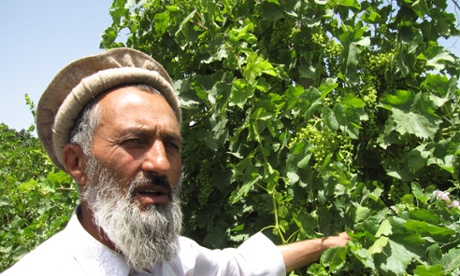
Before its decades of war, Afghanistan was the proud producer of 70% of the UK’s raisins, seen by many as the best to be found anywhere. Through the years of conflict that followed, the figures plummeted, leading Fair Trade food producers Fullwell Mill to consider if the FAIRTRADE Mark could help Afghan smallholders regain their valuable export markets.
Fullwell Mill has often focussed on hard-to-reach farmers in post-conflict countries - including Uganda in the 1990s. Because raisins sell in such large quantities there seemed to be a real opportunity to help transform lives and to develop agriculture at scale.
For five years, the Sunderland-based company worked with US international aid agency Mercy Corps to help the Parwan Raisin Producers Co-operative (PRPC) on the Shomali Plain, north of Kabul, by arranging technical training and markets in order to improve quality and free them from low local prices.
Fullwell Mill for many years has been involved with producing dried mango, pineapple, banana and other fruits from some of the world’s poorest countries, all of which seemed to have a limited market compared to the popularity of raisins.
“We had been looking to broaden the range of Fairtrade commodities we could trade and to be involved with larger scale commodities that would have a bigger impact on local communities,” director Adam Brett explains. “With Afghanistan, others saw risks but I saw opportunity. It’s hard to remember from the perspective of 2015 but, in 2008 – 2009, there was some optimism, a feeling that the military situation might start to calm down and Afghanistan might be starting on a positive path to peace.”
After years of work and a series of costly setbacks, Fullwell Mill made the tough decision to pull out of the project in 2013-14. But Brett decided he didn’t want the experiences to be wasted. Fullwell Mill is now re-starting the process, focusing on a different group of farmers in a different part of Afghanistan – and with lessons from the past firmly under its belt.
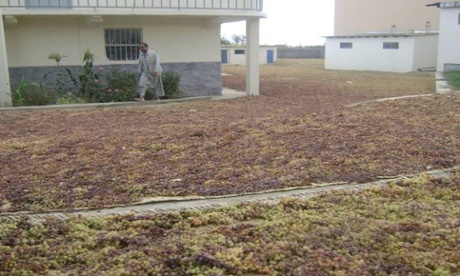
In its work with the PRPC growers, Fullwell Mill faced many challenges. One was to get farmers to take on new techniques and standards so that their products could compete in highly regulated markets such as Europe. This included greatly improved cultivation practices, pre-sorting the grapes to remove damaged fruits, drying grapes on special mats, rather than the ground, and a series of improvements to the post-harvest handling of the products. The farmers were pre-paid an advance and paid a premium price for their products to encourage them to do the extra work needed to improve quality.
They also had to be persuaded not to sell their raisins to the first bidder who came to them, no matter what price they were offered. One of the hardest tasks was to convince them to trust that the “foreigners” would become reliable customers, following decades of bad experiences.
Another problem was gaining Fairtrade certification. No Fairtrade inspector could visit farms in a conflict region. “We had to agree a whole new form of certification with Fairtrade International, as its inspectors were not allowed to travel to Afghanistan to check that stringent environmental, labour and organisational standards had been met,” remembers Brett. “It was finally agreed that some of the farmers could instead travel to Pakistan and be audited there, even though that too was a dangerous region. Independent Mercy Corps staff were drafted in to report to Fairtrade on the conditions and situation of the farmers.”
The raisins were processed at four centres, carefully marked with batch codes. They were then washed at a large-scale factory in Kabul, sent in containers across Pakistan and then by boat to the UK. “We were beset by all sorts of problems,” remembers Brett. “In one year the Pakistani authorities unloaded the container and left the raisin boxes on the roadside until it rained, ruining the raisins. Perhaps we should have paid them the bribes they wanted … We faced road block after road block, problem after problem.”
Back in the UK, there was interest in the product, including from some large supermarkets. Loyal Fairtrade businesses including Traidcraft were good customers and provided a valuable outlet for the raisins in their Geobar range, but the bigger deals with the more mainstream supermarkets fell through.
Then in 2012, after passing quality tests in Kabul on hundreds of samples, the product arrived in the UK where all four containers were deemed unusable – two for quality reasons, two because of the presence of stones. This left Fullwell Mill with a £100,000 bill.
“We had been working with farmers who were producing good quality product and were pleased with the training they had received, but some low quality product must have entered the supply chain,” says Brett. “We knew something had gone wrong. The farmers said it must be bad conditions at the processing facility, the processing facility said it must be the farmers, so it was the word of one group against the other. We were not able to oversee all the production all of the time, or find out what really happened.”
Fullwell Mill decided it had to walk away from the work, but recently it has restarted – working with a USAID sponsored programme developing dried fruit and nut exports in Mazar-e-Sharif, northern Afghanistan. Thousands of very poor farmers supply processing businesses and the project aims to uplift all parts of production. The long term plan is that this work will be certified Fairtrade.
“There is a high level of lawlessness in the country still”, says Brett. “If you go out on the road you can meet a man with a gun who says, ‘Give me your car.’ There isn’t a police force to get it back. There has been extremely long periods of unrest and instability and no one here has really known living at peace in their lifetime.
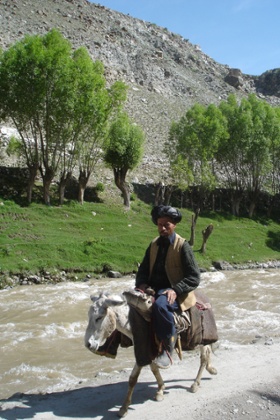
“For farmers in all honesty war is not the biggest problem,” he adds. “They are working in high altitude areas, with little rain and intense sun, temperatures can exceed 40 in summer and plunge below freezing in winter, in much of the north there is virtually no rain between May and September. In many ways their biggest difficulty is not war but getting enough water to drink.”
What excites Brett is that if everyone can make this venture work, there will be a substantial trickle down impact into the local farming communities and the economy. He believes that selling Afghan raisins at scale is still a possibility.
He hopes that the USAID programme will assist with funding of laboratory facilities. A gifted chemist has already set up a small-scale lab in Mazar and is willing to expand it to host the complex tests to ensure that the quality standard is high. Once this facility is in place, poor quality raisins should be identified quickly and excluded from a batch. If this is followed though, farmers will recognise that they can only sell good quality produce.
“We hope that going back into Afghanistan gives us an exciting and unique product that customers will be curious about and want to have,” adds Brett.
“I genuinely believe that, if Afghanistan can move toward stability, the country will become a powerhouse for trade. If you can bring some growth and development to a country that has had no peace for more than 30 years, why wouldn’t you want to be part of that?”
Content on this page is paid for and provided by Fairtrade Foundation, sponsor of the spotlight on commodities series