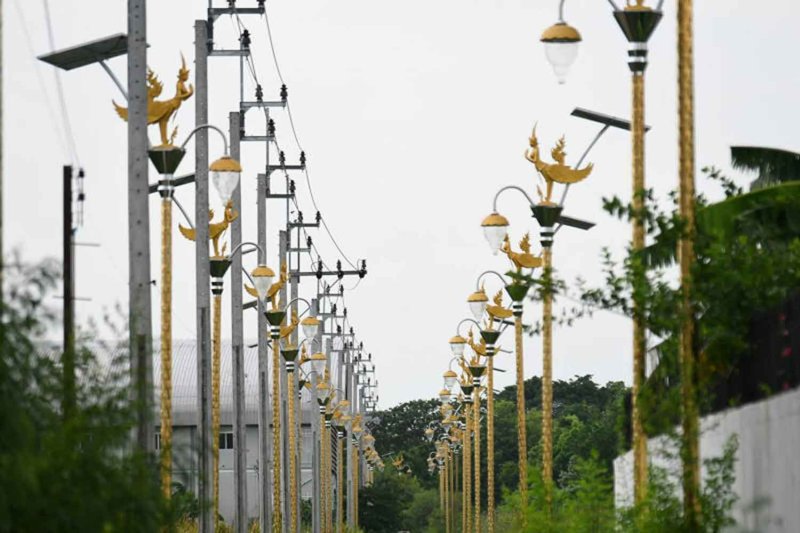
Over the years in Thailand we have become familiar with tales of malfeasance involving such unlikely items as parliament clocks, school pianos, kindergarten toys, illegal onions and even disappearing cows. Then, a dozen years ago along came a new one …the humble lamppost.
I admit to having forgotten about the " Kinnaree lamppost affair" until it resurfaced recently with news that after years of legal proceedings two officials have been sentenced to five years in the jug concerning thousands of overpriced lampposts in Samut Prakan.
It is a complex case so we will skip the details, but it basically came down to a racket involving the purchase of more than 6,700 fancy but pricy Kinnaree-themed lampposts. (Kinnaree is a mythical half- woman-half-bird creature.)
Decorative lamp posts are actually an accepted part of Thai culture as long as it doesn't involve dodgy dealings. Around the country many exotic streetlamp decorations can be seen, some tasteful, others less so. Most reflect the local culture. Chai Nat has royal barges adorning its lamps while Nonthaburi had models of traditional vendors in boats. A bit of local colour displayed in creative ways on lampposts doesn't do any harm. At least the street lights perform a useful function.
On my particular soi the main concern is not what the lamp posts look like but that their lights are actually functioning. The dog appreciates them too, for totally different reasons.
Singing in the rain
Perhaps the most famous lamp post is the one Gene Kelly swings from in that splendid sequence from the 1952 musical, Singin' in the Rain. As he splashed his way through the puddles Kelly's performance is all the more remarkable because he was unwell, suffering from a fever. Getting absolutely drenched hardly helped. Nonetheless, the creative way he uses both the lamppost and the umbrella as props in his dance routine is quite astonishing. The 10-foot-tall green fibre-glass lamp post used in the film was later stolen from the back yard of someone who collected such movie memorabilia.
Formby fan
Another musical example of the versatility of the lamppost is George Formby's classic 1937 hit song, Leaning on a Lamppost, in which he uses a street lamp as an unlikely support for pursuing a romance. Unlike some Formby numbers it is not saucy, and the lyrics inform us "I'm leaning on a lamp post at the corner of the street in case a certain little lady comes by…"
Lamppost aficionados will be pleased to learn that the song was a favourite of Britain's late Queen Elizabeth and ranked in her personal top ten. According to the Daily Mirror, the Queen told her private secretary she could sing all of Formby's songs.
A tale of two expeditions
This week I was hoping to report on a fearless mission to hunt down the remains of the world's largest dinosaur in deepest Chaiyaphum. Alas, the search for Nagatitan chaiyaphumensis proved a dismal failure due primarily to my wretched planning . A couple of wrong turns didn't help matters either. My old navigational skills based on "that road looks interesting, let's go down there" don't seem to work anymore.
Suffice to say most of the time was spent in the car before ending up in the totally wrong place somewhere in a remote part of Nong Bua Daeng district. Finally, after stumbling through fields along an overgrown ankle-breaking path without a hint of a pre-historic creature, we threw in the towel. The days of "Intrepid Crutch" are long gone.
A couple of days later I enjoyed a far more rewarding trip to a large avocado and durian farm just across the provincial border in Phetchabun. The farm is on the hilly slopes adjacent to Nam Nao Natonal Park. The view across the wide valley was quite stunning and with the gusty wind whipping across the slopes it definitely felt you were somewhere special. I returned home with a basket of seductive dark green avocados which were eagerly consumed while my wife got stuck into the durian.
Nothing to sniff at
I admit to not being a huge fan of durian. It's not so much the pungent odour but that the creamy fruit is too rich for my taste. However, it is the smell of the durian which evokes more debate than any other fruit, which has led to it being banned by airlines, posh hotels and so on. It has variously been likened to decomposing fish, dead cats, stale vomit and rotting garbage.
There have been attempts to produce odourless durian but this did not go down too well with connoisseurs. To them a durian is not a durian unless it stinks. Among those who opposed non-smelly durian was the Post's food critic, the late Bob Halliday, better known as Ung-ang Talay. When asked his views by the International Herald Tribune Bob remarked: "Making a non-smelly durian is like producing a thorn-less rose. It's really like cutting out the soul."
Take cover
The durian can also be quite an effective weapon as a Thai colleague discovered many years ago. He returned home late after a night out with his mates to be greeted by his furious wife wielding a durian. She scored a direct hit and he was limping about the office for weeks. Those spikes can be really painful. Hell hath no fury like a woman hurling a durian.