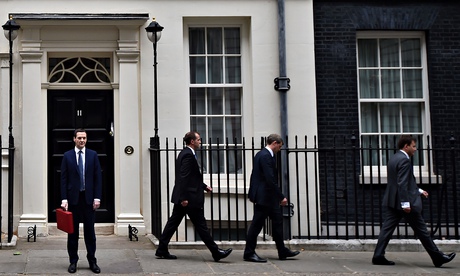
It’s boys’ day at Westminster. True, what with the two to one gender imbalance, it’s boys’ day most days, but this is Big Boys’ day, a day of unmitigated chest-thumping, testosterone-packed swinging from branch to branch of the political forest.
The way that budgets are made and presented to parliament in Britain must be one of the most extreme examples of democratic failure in the voting world. Which is odd, when its origins lie with the moment when the people first challenged the established power of the monarch, although less so when the role of machismo is factored in.
The first mistake is to imagine that budget day has much to do with the national economy in any serious and important sense. The budget is all about a few hours in parliament and a few days in the media. Chancellor George Osborne would like us to believe he is reshaping the country’s political future. So he may be, but not in the way we see it. The budget is a legal ambush of public opinion.
He tours the TV studios with dazzling statistics, emphatic argument and headline figures that tell a very partial story about what is actually happening to the debt or the deficit – themselves inadequate descriptors of national economic health – and mainly paints the picture the chancellor wants us to see.
This is the man who gave us the omnishambles budget in 2012, the year of the pasty tax when he tried to impose VAT on food served at a certain temperature and the attempt to cap tax relief on philanthropic donations. That’s what happens when the next day matters more than next year.
Those two examples were the star exhibits in a paper the Institute for Fiscal Studies produced in 2013 that set out ideas for better budget making. But Osborne is not the first chancellor to get caught out by the detail. Gordon Brown had his moments too. Taxes that seem to offer good political headlines are often unworkable, or produce adverse consequences, or merely add another layer of futile complexity.
In one salutary passage, the IFS points to one mistake that has been made and unmade repeatedly since Denis Healey first made it in 1978. Political kudos of a new low tax rate to help those paying tax at the bottom end of the scale – for Gordon Brown it was the 10p rate – “complicates the tax system and achieves nothing that could not be better achieved in other ways”. Like in-work tax credits, Mr Osborne.
The willy-waving of the budget speech is part of the problem. The secrecy of the process behind it is the other.
There are worse ways of budget making. Just think of Washington DC. But there are many better ways, too. Nicola Sturgeon, the SNP first minister, set some of them out in a thoughtful talk she gave to the LSE just before the last budget in March.
The Scottish government, like many other European governments, has to produce a draft budget. In Edinburgh, it is followed by four months – four months – of consultation before the legislation comes before parliament. There is an equality audit that examines the impact of proposals on different groups. There is time for tax experts to trawl over the collective impact of tax changes and how they will interrelate with existing taxes. Mistakes like Gordon Brown’s apparently attractive and entrepreneurial proposal for zero-rated corporation tax on companies making less than £10,000 profit a year, a wheeze that led to every taxi driver in the UK registering as a limited company, are still possible of course, but much less likely.
There are other ways of giving better budget making a chance – say, putting the people from HMRC in charge of gathering tax in the same room as the people who make tax policy at the Treasury.
There could be stronger, more expert scrutiny of budgets in parliament, which would mean seriously beefing up the Treasury select committee (and maybe replacing the grandstanders with people who understand the questions they ask and then listen to the answers).
Democracy needs its theatre, and politicians love a stage. But a better budget doesn’t have to lack drama. It’s just that it would be less of a first night, more of a read-through. Followed by a dull, detailed assessment where the chancellor confronts not an enthralled audience, but reality. How about it, boys?


.png?w=600)