It’s been nearly a decade since John Boyne’s The Boy in the Striped Pyjamas, a tale of friendship between the son of a Nazi officer and a nine-year-old prisoner of Auschwitz, became an almost instant bestseller. The book was criticised for the implausibility of its plot, with some critics arguing that it toned down the horror of the death camps; yet its fable-like quality and involving prose ensured it was admired by many. Boyne, who has since shown versatility in his writing both for children, with stories about floating boys and mysterious toymakers, and for adults, with the slickly eerie This House Is Haunted, among other books, has now returned to similar territory, as he asks that most terrible of questions: what would you have done?
Here, he pulls off a remarkable feat, which is to make us feel deeply sympathetic to and yet horrified by the actions of Pierrot, the boy of the title. After his father, a drunken German soldier, is killed by a train, his French mother dies of consumption. Orphaned, and passed from place to place like a parcel, he is eventually taken in by his aunt, a housekeeper in Austria. These early sections are well constructed, and set up a friendship between Pierrot and a deaf Jewish boy, Anshel, as well as showing how children who are blown about and ignored by the forces of history become dangerously exposed. Pierrot meets both tenderness and torture: is it better, he asks himself, to be a bully or bullied?
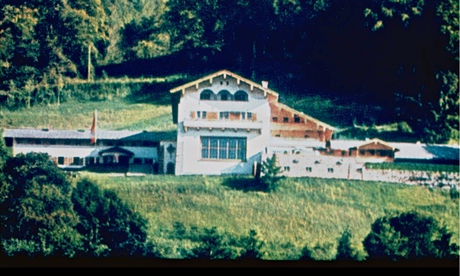
In The Boy in the Striped Pyjamas, 12-year-old Bruno believed he was in a place called “Out-With”; here, seven-year-old Pierrot finds himself in a large mountain retreat where the staff are terrified of the approach of “the master”. Adult readers will soon realise that the house is Hitler’s Berghof (pictured); and here the novel takes a dark turn.
Pierrot is swiftly drawn in by the uniforms and the power. Isolated from the rest of the world, he becomes by the age of 15 a pet of the Nazi regime, swanning about with all the arrogance of youth, completely unable to see why the children of the village might not like him. Over the course of a few years, Pierrot becomes Pieter, his Jewish friend forgotten. Effectively trapped as he is on the mountain, Pierrot has no room to develop or think; his only reading material is that supplied by Hitler.
There are many chilling moments. Hitler remarks, when talking about his dog: “I can never discipline her, that’s the problem. I am far too soft-hearted.” Perhaps the most troubling is when Pierrot is asked to take notes at a meeting; he wonders in passing why the showers that are being built won’t be delivering water. The Duke and Duchess of Windsor visit, Wallis Simpson sweeping in, bemused at why the English don’t understand Hitler, the Duke nervously biting his nails and bleating about his brother not answering his calls. There are cameos from a lively Leni Riefenstahl and a skeletal Goebbels; Hitler himself is part-father figure, playing with his dog and giving Pierrot presents, and part-maniac. The plot turns on a betrayal, stark in its horror, yet entirely plausible; and on Pierrot’s attraction to a local girl. His clumsy attempts to woo her are made doubly intense by his inability to see himself from the outside.
Just how complicit is Pierrot? The novel places him squarely in the guilty camp. As a study of innocence corrupted, it is not subtle – the question of nature or nurture is not really addressed – but it is always good for young readers to be reminded of the shadow cast over Europe, and Boyne has written a compelling account of the attractions of power, the malleability of youth and the terrible pain of a life filled with regret.
• Philip Womack’s The King’s Shadow is published by Troika. To order The Boy at the Top of the Mountain for £10.30 (RRP £12.99) go to bookshop.theguardian.com or call 0330 333 6846. Free UK p&p over £10, online orders only. Phone orders min p&p of £1.99.