Get all your news in one place.
100’s of premium titles.
One app.
Start reading
The Guardian - UK
The Guardian - UK
Entertainment

The book pirates of Peru

Peru books: Lima book shop
Book piracy exists all over Latin America and the developing world, but any editor with regional experience will tell you that Peru’s problem is both profound and unique. The combined economic impact of the informal publishing industry is roughly equal to that of their legitimate counterparts. Pirated books printed in Lima are shipped all over the country, and have been seen in Bolivia, Ecuador, Chile, and as far away as Argentina. Here, an authorised edition of a Charlaine Harris novel on sale in Lima bookstore underscores the gravity of the situation. The red sticker reads “Buy Original”. Most new books printed in Peru carry similar appeals
Photograph: Claudia Alva
Peru books: Amazonas book market, Peru
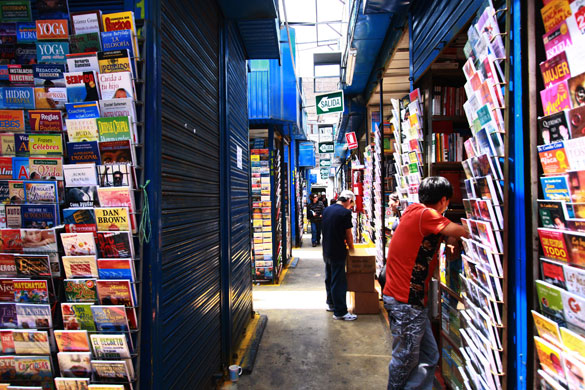
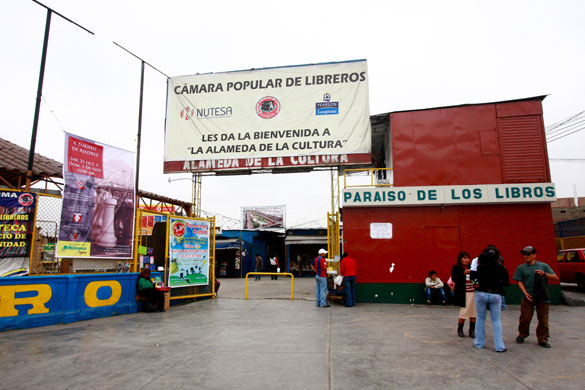
The informal book market commonly known as Amazonas is thought to be the largest of its kind in Latin America, with some 200 vendors selling used, antiquarian, and pirated volumes. The sign here says it all – Paraíso de los libros, or “Paradise of Books”. You can find almost anything here, provided you have the patience to look for it. Some critics have called Amazonas the epicentre of book piracy in Peru
Photograph: Claudia Alva

Peru books: Book flea market in Lima Peru
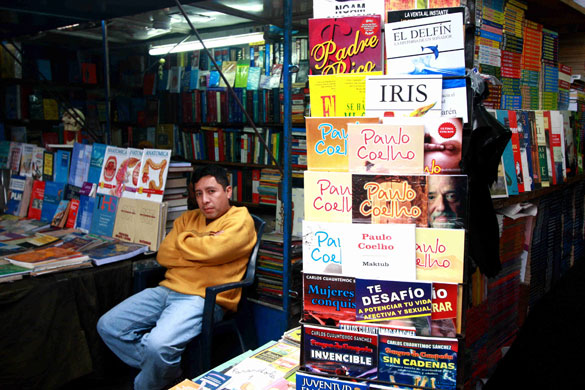
Paulo Coelho is one of Latin America’s bestselling authors in both authorised and unathorised editions. His novel, O vencedor está só [published in English as The Winner Stands Alone], appeared on the streets of Lima not only before it had been published in Spanish, but before the official translation had even been completed
Photograph: Claudia Alva

Peru books: Book flea market in Lima Peru
As a cultural artifact, the book has undeniable power, and the idea of a poor, developing country with a robust informal publishing industry is, on some level, romantic: the pirate as cultural entrepreneur, a Robin Hood figure, stealing from elitist multinational publishers and taking books to the people. The myth is seductive, and repeated often. In a country where a new book can cost 20% of the average workers’ weekly wage, it’s worth asking who could afford to read if it weren’t for pirates?
Photograph: Claudia Alva
Peru books: Book street vendors Peru
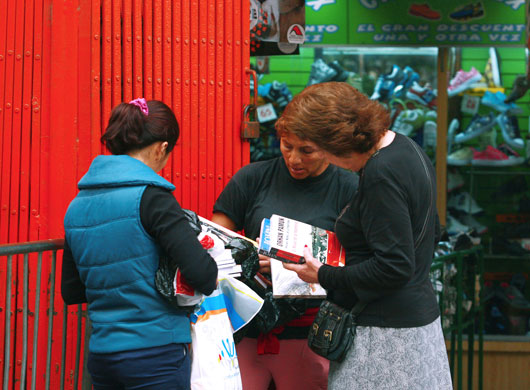
There is one problem with the myth about pirates bringing literature to the masses: street-level vendors tend to congregate in the same middle and upper-class neighborhoods where you find the bookstores. Their clients are people with money. One critic calls it a cultural problem: “The same people who would never consider buying fake whisky think nothing of buying a pirated book. There’s no respect for intellectual production in this country.” Here, an upper-class woman buys a copy of Orhan Pamuk’s most recent novel The Museum of Innocence
Photograph: Claudia Alva
Peru books: Book market in Lima, Peru
Literacy in Peru grew dramatically through the last century, and along with this progress came a desire for books and all they represent. Still, millions of rural Peruvians are monolingual speakers of indigenous languages, and remain politically and economically marginalised as a result. In a country divided by race, ethnicity, and language, acquiring fluency and literacy in Spanish has often been seen as an important first step towards socioeconomic advancement
Photograph: Claudia Alva
Peru books: Public library in Carabayllo, Peru
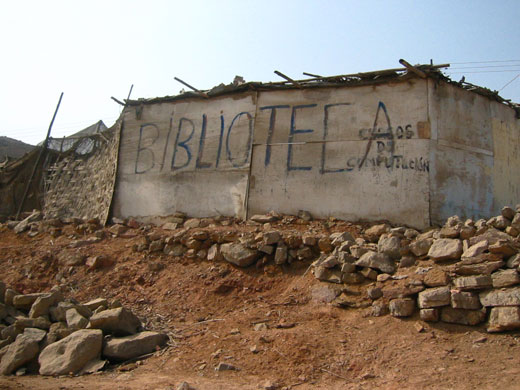
For some 30 years, the National Library of Peru’s budget to acquire new books remained unchanged: zero. There is really no library system to speak of in Peru. Outside the capital, the situation is particularly acute, but even within the city, most municipal libraries consist of a few donated volumes, a few pirated editions among them. This photo was taken in Carabayllo, a district in North Lima
Photograph: Daniel Alarcón
Peru books: Pirate book vendor in Lima, Peru
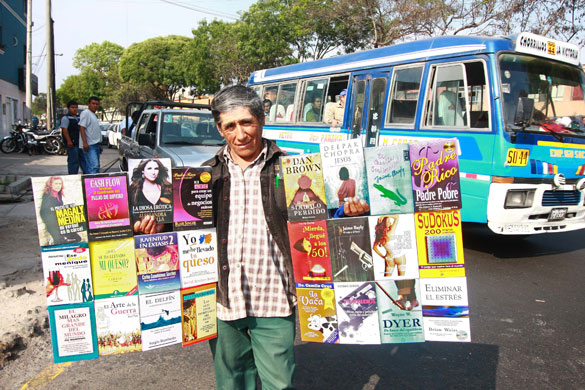
The book pirates operate in plain sight: vendors ply the streets of the capital, carrying heavy stacks of books as they drift through stopped traffic, or spreading a torn piece of blue plastic tarp on a sidewalk, laying their wares out hopefully for all to see. You can find them in front of high schools, institutes, and government buildings, or wandering the aisles of the markets where most Limeños do their shopping
Photograph: Claudia Alva
Peru books: Pirate book seller in Lima Peru
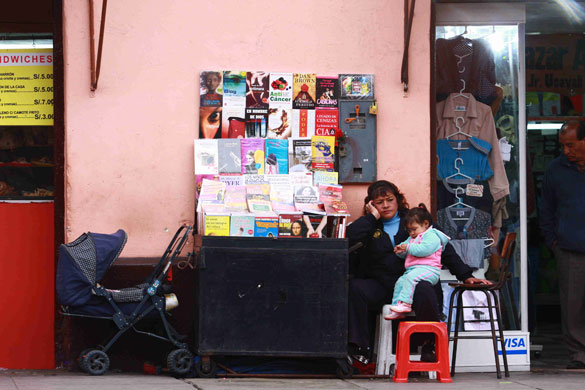
A woman sells the usual mix of pirated Isabel Allende, Stephenie Meyer, and Dan Brown, a common sight on the streets of central Lima. More suprising is the book on the second row from the top, far right: a translation of Tim Weiner’s history of the CIA, Legacy of Ashes, winner of the 2009 National Book award
Photograph: Claudia Alva
Peru books: Lima book fair
Books hold a special place in the cultural life of the city. Last year, over the course of two weeks, 270,000 people attended the Lima book fair, an increase of 15% from the 2008 event, and sales were nearly $2.5m US, up 20% from the previous year. In fact, since 2003, sales at the fair have nearly quadrupled. Pirates use the fair to decide which books to print next. Most Limeños can only afford to buy one or two new books a year, so they wait for the fairs to look for bargains. The photo shows a warm-up event for the 2009 North Lima book fair. Hundreds of local schoolchildren participated
Photograph: Vanadis Phumpiú
Peru books: Book flea market in Lima Peru
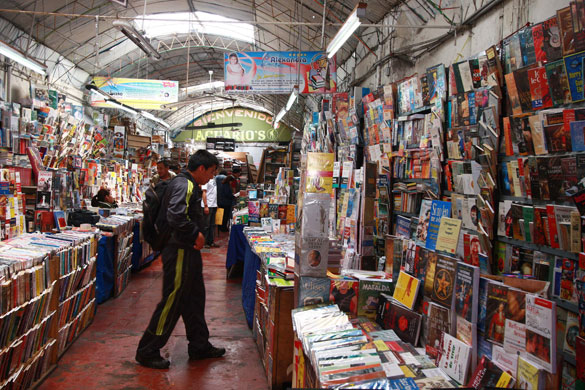
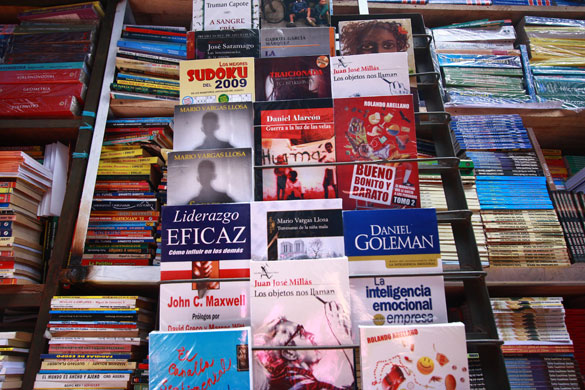
Until I saw this photo, I’d never seen a pirated edition of my first book of stories, War by Candlelight – which was always something of a disappointment to me. Most Peruvian writers have a complicated relationship to the concept of piracy – it is, in some ways, the equivalent of reaching the bestseller lists. You both hope for and dread being pirated. It’s certainly flattering to see one’s work in such good company, flanked by Mario Vargas Llosa, Juan José Millás, Gabriel García Márquez, Truman Capote, and José Saramago – along with the obligatory volumes of Sudoko and self-help, naturally. An early morning raid of this gallery in June of last year yielded 90,000 unauthorised books. The vendors were restocked within a day
Photograph: Claudia Alva
Sign up to read this article
Read news from 100’s of titles, curated specifically for you.
Already a member? Sign in here
Related Stories
Top stories on inkl right now
One subscription that gives you access to news from hundreds of sites
Already a member? Sign in here
Our Picks
Fourteen days free
Download the app
One app. One membership.
100+ trusted global sources.