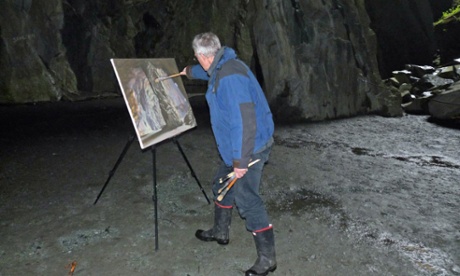
Seen as the black sheep of the Heaton Cooper family of Lakeland artists, Julian Cooper has indeed been an infant terrible, with paintings far removed from the usual Lakeland genre. One day he portrays a model with red hair drinking Dungeon Ghyll beck water, the next it’s a footballer bending it like Beckham against a Fairfield Horseshoe background. Then came paintings of the Eiger and Andes.
Today his paintings of long-abandoned quarries are highly prized. He seemed oblivious to objective dangers like rock-falls as he painted at his easel in an old quarry near Tilberthwaite, daubing yellow ochre, umbers, siennas, red oxides from large tubes. How he looked the part in his quarryman’s wellingtons, at one point throwing a jar of turps at the canvas, then dabbing it with a rag.
Cavalier in temperament, he is the son of watercolour painter William Heaton Cooper and sculptor Ophelia Gordon Bell. He says his empathy for quarries arises from accompanying his father as a little boy to stay in Fell and Rock Climbing Club huts, “all spooky dormitories, wet clothing and ropes”. It was seeing his dad’s crag drawings, superimposed with dotted lines to depict respective routes, in the FRCC guidebooks that appealed to him as more abstract than his landscapes. “I would do my own versions in my little sketchbook,” he said, “fascinated by the way Lakeland rockfaces were breached by so many lines of weakness. It is these cracks, chimneys, and grooves that climbers follow and which father was so adept at reproducing.
“As I took up cragging I saw at first hand how leaders relied on these drawings, peering closely at the pages of their well-thumbed guidebooks while perched on tiptoe, and trying to follow the dotted lines as rain spattered the page and somewhere below their second-on-the-rope called up panic-stricken ‘What’s happening? It’s nearly dark!’”
The guidebook drawings have been now superseded by photographs, but his father’s creations are still sought-after collector’s items.
• An exhibition “Lines of Ascent” based around William Heaton Cooper’s drawings of Lakeland crags, used in the definitive Fell and Rock Climbing Club guides for 40 years from 1930s onwards, will open at the Heaton Cooper Studio, Grasmere, on Wednesday 19 November.