They say imitation is the sincerest form of flattery, and clearly director Terrence Malick agrees. Instead of phoning his lawyer, the legendary naturalist film-poet has taken a more welcoming position as the well-publicised producer on AJ Edwards’s feature film debut The Better Angels. Edwards was one of five editors on Malick’s latest, To the Wonder, and has been part of the Malick camp since 2005’s The New World. And one could never accuse him of not taking good notes.
The rushing camera through rustic settings, sun-dappled images of man and nature, late romantic classical music and somewhat mumbly – and not always relevant –voiceovers are all present here, as is Malick’s increasing resistance to plot-heavy film-making. While The New World told the John Smith/Pocahontas story through a whirl of impressionistic cinematic sensations, Edwards scoots a little further down the American mythological timeline to a key juncture in Abraham Lincoln’s boyhood. Though if you blink during a few establishing images, you may think this is just a story about a troubled kid.
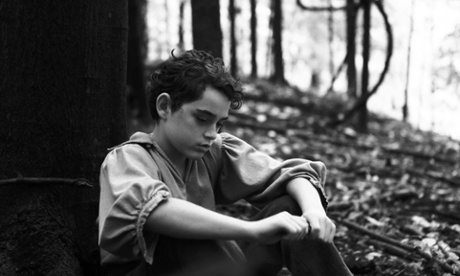
We’re in the Indiana woods. It’s a rough life, and Young Mr Lincoln’s father (Jason Clarke) is a hard working, taciturn man. His mother (Brit Marling) sees something special in the quiet child who prefers reading to hoeing. The gorgeous black-and-white glimpses of an outdoorsy life are soon clouded by hardship. An orphaned cousin (our narrator) comes to live in the small domicile (yes, a log cabin, one could call it) and then mother dies due to milk poisoning.
Dad leaves an older sister in charge then returns with a new wife (Diane Kruger) who has some children of her own. A community is slowly built, including a school. A teacher (Wes Bentley) recognizes that lil’ Abe, an autodidact, is not meant for a life of subsistence farming and rail-splitting. Despite Dad’s protests, all signs point to the boy going out into the world and, eventually, onto the five dollar bill.
Whereas The New World had drama lurking beneath the onslaught of gorgeous frames, The Better Angels at times resembles a group of folks puttin’ on a show at a restoration village. Whenever the swirling camera calms down for a minute and actual scene work begins, the movie drops dead. Unlike, say, The Tree of Life, the fragmented character moments sprinkled throughout this cinematographer’s ballet do not have the clarity or emotional punch to get out from behind the window dressing. There’s slow cinema and there is boring cinema, and this is an unfortunate example of the latter.
There’s also the purely American problem of struggling with dorky Hall of Presidents-style flashes whenever we see representations of our founding fathers. The recent biopic of Simón Bolívar, The Liberator, is no masterpiece, but it didn’t cause any “Oh, gimme a break” reflexes when thinking about its subject in additional contexts. (Spielberg’s Lincoln tackled this head-on, opening his film in a stagey setting, Tony Kushner putting quotables in characters’ mouths as they “exeunt”.)
Braydon Denney is perfectly fine is his first film role as 10-year-old Abraham Lincoln. It’s just that Edwards has gone all-in on hoping drama would spontaneously generate from a wash of lovely but inert ambience. Lincoln spoke powerfully about “the better angels of our nature”, but when it came to enforce policy, he knew when to take action.