One of the catchphrases that you hear throughout the draft cycle is “scheme fit.” The more hours that people spend studying the draft and revisiting how players succeed — or fail — upon entering the NFL the more people realize that all the pre-draft evaluations and scouting reports matter much less than where the players actually land. The systems they are going to be in, the coaches they are going to be learning from, and the other players around them are going to be much more important in determining whether they boom, or bust.
To that end, here are some of the best scheme fits from Round 1 of the 2020 NFL Draft, along with two potential misfits that raise serious questions.
Scheme Fits
Tua Tagovailoa, QB, Miami Dolphins

It was often said of longtime baseball manager Gene Mauch that he was better at taking impossibly flawed teams to the middle of the pack with his managerial genius than he was at taking good teams and making them truly great. Some guys are just that way, and current Dolphins offensive coordinator Chan Gailey might be the NFL’s version of Mauch. In five years as a head coach for the Cowboys and Bills, Gailey compiled a 34-46 record, and lost the two playoff games his teams made.
But if you want a guy who can take a broken offense and turn it around with pure schematic invention, there are few better. Perhaps the most obvious example of this was when he was the Chiefs’ offensive coordinator in 2008. Kansas City lost starting quarterbacks Damon Huard and Brodie Croyle to injury, leaving third-stringer Tyler Thigpen as the man under center. The Chiefs were without franchise back Larry Johnson at times due to injuries and suspensions, so Gailey didn’t have much to work with.
Undaunted, Gailey took a then little-known schematic constraint called the Pistol formation — which is now the primary shotgun set in the NFL — and worked his offense from desperate to above-average.
“When Damon and Brodie went down, I think L.J. was still on a suspension, and we were able to do the regular shotgun with Kolby Smith from Louisville and Jamaal Charles from Texas,” Thigpen told me in 2010. “But once that suspension was up, and Larry was back in the lineup, that’s when we went more to the Pistol offense. Kolby and Jamaal were used to that zone type of running, where you press the side and make a cutback, or whatever the case may be — whatever lane they’ve got. We tried running that offense for one or two weeks when Larry came back, and then we realized, ‘Hey, he’s not that kind of back.’ That’s when we changed to the downhill kind of running. The Pistol is really like an I-formation, whether you put the back in the near set or the far set.”
The Pistol also presented advantages for Thigpen.
“Whether it was a quarterback draw, a misdirection with a one-back offset, having the back go to the left and bringing him back to the right, it would look to the defense like a zone left run instead of a cutback to the right,” he said. “The play action was really good, because you couldn’t see the back, and whether he had the ball or not, with the offensive line up front. I remember a couple times, just running boots and faking to [the back], and it was just wide open when I came out on the boot. It was tough for the defensive end, when he’s coming off the edge, to see whether you gave it or not. Normally, he has that advantage when you’re coming out from under center to see whether you’re close to the back or not — what kind of fake it is.”
You get the point. Now, imagine what Gailey will do with Tagovailoa, who comes to the NFL with a game that’s equal parts Drew Brees and Russell Wilson. There are few better coaches for Tagovailoa to work with in his transition to the NFL — and there are few coaches who will be more astute in combining what he needs with what Tagovailoa can already do. Boots, advanced play-action, zone-read stuff… you name it. Tagovailoa will flourish under Gailey, and it will be exciting to watch.
Clyde Edwards-Helaire, RB, Kansas City Chiefs

Whether it was Brian Westbrook or LeSean McCoy, Andy Reid always loved to have a versatile back in his Eagles backfields when he was the team’s head coach from 1999 through 2012. Reid has long been one of the NFL’s best teachers and play-designers of the screen game, and both Westbrook and McCoy benefited heavily from that during Reid’s tenure.
Ideally, Kareem Hunt would have been Reid’s new-wave weapon in Kansas City, but off-field issues took that idea away. Damien Williams was decent in that role last season, and Reid brought McCoy to the roster for a reunion, but neither back was able to work in that milieu as Reid would prefer. The Chiefs have Patrick Mahomes and an array of ridiculously athletic and explosive targets, but that doesn’t mean Reid is willing to throw his ideal running back paradigm to the side.
That’s why the Chiefs took Edwards-Helaire with the last pick in the first round. Yes, the “running backs don’t matter” guys will scream about this, but the LSU alum, who gained 1,867 yards from scrimmage and scored 17 total touchdowns last season, made it easy for Reid to make this call. He is an outstanding receiver, a surprisingly tough runner for his size (5-foot-8, 207 pounds), and because he’s worked a lot on his pass-protection, he projects well as a third-down back.
“About three or four weeks ago, when we were working through the final wave of this process – and at that point I usually give Coach a couple guys to take a peek at – I told him that once he finishes looking at him, he’ll remind him of Brian Westbrook,” Chiefs general manager Brett Veach said of Edwards-Helaire, via the team’s official site. “Coach called me back later and said he was better than Brian. That’s no slight to Brian either, because I got to play against him at the University of Delaware and he was a Ring of Fame player in Philadelphia.
“Edwards-Helaire is just a unique talent. He’s explosive, he has the ability to make something out of nothing and that’s what you look at with these running backs. This guy can consistently make plays when there is really nothing to be made, and now throwing him in there with [wide receiver] Tyreek Hill, [wide receiver] Sammy Watkins, [tight end] Travis Kelce, [wide receiver Mecole Hardman] and [tailback] Damien Williams, we think it’ll be really exciting.”
Exciting, indeed. If Reid rates Edwards-Helaire higher than Westbrook, you can bet he’ll see a ton of time on the field in 2020. And in that offense? Watch out. The Chiefs just became even more impossible to defend.
Justin Jefferson, WR, Minnesota Vikings

After the “big three” wide receivers of Henry Ruggs III, Jerry Jeudy and CeeDee Lamb, evaluators were split on who the fourth-best receiver in the class was. The rise of Denzel Mims from the Senior Bowl to the Combine had some in his camp, Jalen Reagor’s film at TCU, coupled with the understanding that it came with poor quarterback play, had some in his camp, and even Brandon Aiyuk or Laviska Shenault Jr. were getting votes in this category.
Another receiver in the mix was Justin Jefferson, the LSU target. However, thanks to an extremely productive 2019 season operating out of the slot, Jefferson was viewed primarily as a slot target. Given the relative ease of playing that position, juxtaposed with living live on the boundary, was he worthy of an early pick?
The first team to put that to the test was the Philadelphia Eagles. On the clock with the 21st-overall selection, Howie Roseman and company turned in the virtual card with Jalen Raegor’s name on it. More on him in a second. But that left Jefferson waiting. But not too long, as the Minnesota Vikings grabbed him with the 25th pick in the draft.
This might be an ideal scheme fit.
To rely on an old lawyer trick for a moment, let’s take a perceived negative and make it a positive. One of the knocks on Jefferson, valid or otherwise, was that a lot of his production came on crossing routes working over the middle of the field and simply finding space, rather than separating against man coverage. While that ignores the fearless manner in which Jefferson works across the field, let’s for the sake of argument call it a weakness.
Now think of the Vikings’ offense. So much of what they do schematically builds off the outside zone running game. Working off that design, they incorporate play-action with Kirk Cousins either implementing a half- or a full-roll away from the run fake and looking for targets along the boundary or, as you might be realizing, working across the middle. Jefferson can instantly produce as that receiver working over the middle of the field on those designs.
Here is another thing to keep in mind. Even if you believe Jefferson cannot function as a boundary receiver – a believe we tried to dissuade you of here at Touchdown Wire – Minnesota is one of the teams that relies on 12 offensive personnel the most. The Vikings used that personnel package on 35% of their overall plays last year, second most in the league according to SharpFootballStats.com. So Jefferson can be used as more of a flanker on these designs, rather than a detached X type of receiver.
This seems to be an ideal scheme fit.
Jalen Reagor, WR, Philadelphia Eagles

The team that passed on the aforementioned Justin Jefferson did so for the right reasons, given their offense and their quarterback.
Jalen Reagor is perhaps the ideal West Coast wide receiver. His footwork off the line of scrimmage and in the short-area of the field is nearly perfect, and in TCU’s offense he aligned heavily along the right side of the offense and into the boundary, giving him the experience to face and beat press coverage. He relies on a hesitation/stutter-step move to beat the press, and it worked consistently for him in the college game. Reagor also brings tremendous burst after the catch, and can be deadly on crossing routes and quick slants.
You know, the routes that litter a West Coast playbook?
Remember, West Coast systems are built around yardage after the catch. Reagor delivers that for an offense that badly needs some weapons in the passing game. But Reagor is not limited to what he does underneath. Some of his best routes come when he is working downfield, either on a straight vertical route or on a double-move. First, take this vertical route that highlights his ability to “stack” a defender (while also illustrating the level of quarterback play he endured last year):
Now look the cushion he erases on a double-move:
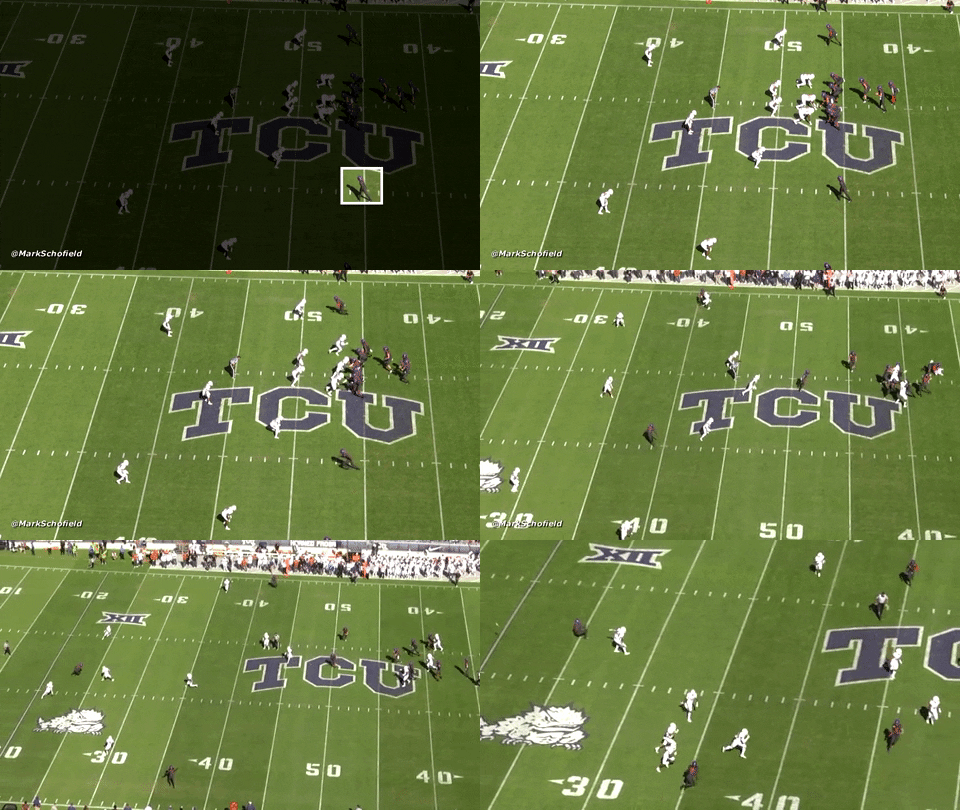
Reagor brings the experience of a West Coast receiver to the table, but also offers the downfield play-making ability the Eagles lacked when both Alshon Jeffery and DeSean Jackson went down with injuries. Carson Wentz should be a very happy man this morning.
Tristan Wirfs, OL, Tampa Bay Buccaneers

Tom Brady is the greatest quarterback in NFL history, but even the GOAT has his Kryptonite. And in Brady’s case, the one thing that has consistently provided problems is interior pressure. Brady is an outstanding pocket quarterback who prefers to step up away from outside pressure, and if he doesn’t have that move at his disposal, he’s not exactly going to rival Lamar Jackson with his speed out of the pocket. The New York Giants took full advantage of this in Super Bowls XLII and XLVI by sending Justin Tuck right up the middle, over and over, to get in Brady’s face and cut off his escape hatches.
The Buccaneers have one outstanding guard in Ali Marpet, and they took Ryan Cappa in the third round of the 2018 draft, but tackles Donovan Smith and Demar Dotson were less than spectacular in pass proteciton at the tackle spots. That’s Reason 1 the Buccaneers took Iowa tackle Tristan Wirfs with the 13th overall pick. At 6-foot-5 and 320 pounds, Wirfs has the length and agility to play either left or right tackle in the NFL, but this weightlifting monster and former wrestling champion might look like a great guard as well, if that’s where the Bucs choose to place the bulk of their line talent.
“He went to Iowa and played a lot of football for a program that does a really, really good job of developing offensive linemen,” Buccaneers Director of Player Personnel John Spytek said of Wirfs, via the team’s official site. “Then you just put the tape on – he’s athlete, he’s graceful. His athletic ability stood out at the combine, but it was clear when we watched him back in September, the early tape this year, that he was going to be a high pick and it just kept trending that way… This has been a long process, but we’ve liked Tristan for a long time.”
Wherever he lines up, Wirfs will improve that line. It would be interesting to see if he kicks inside at any point in time. I’ve compared him to Isaiah Wynn, who the Patriots took in the first round in the 2018 draft, and who spent time at guard in college.
Brandon Aiyuk, WR, San Francisco 49ers

Last season, the 49ers had two dominant receivers, and neither one of them fit the typical mold for an actual receiver. There was tight end George Kittle, who was. among other things, Jimmy Garoppolo’s most consistent deep target. And there was rookie receiver Deebo Samuel, who was Kyle Shanahan’s Swiss Army knife in that Samuel could line up all along the formation and do multiple things. That still left Shanahan, the NFL’s best offensive play-caller, one guy short. Every offense needs a receiver who can get open vertically, help take the top off a defense, and help his quarterback create explosive plays. When the 49ers took Aiyuk with the 25th overall pick, they got that guy — in spades.
“You wouldn’t just peg him at one position,” Shanahan said after the pick of his newest target. “You know, he can do all three. He can play the X, he can play the Z, he can play the F. He’s got the speed to get on top. He’s got the quickness to play in the slot. He’s got the toughness to go over in the middle. And the guy is just completely committed to me in to being as good as God ever intended him to be.”
All true, based on the tape. In many ways, Aiyuk reminds me of a more explosive version of Emmanuel Sanders, who San Francisco traded for last October to try and jump-start their downfield passing game. Sanders was okay in that role, but Aiyuk — who proved last season that he could be a consistent deep receiver and play in the slot at times — makes Shanahan’s offense even more illegal than it was before. Good luck, NFC West.
Patrick Queen, LB, Baltimore Ravens

Some teams just handle the draft so well. The Minnesota Vikings had a great draft, picking players at 22 and 31 that many connected to them at their original draft slots of 22 and 25. As we highlighted with Justin Jefferson, Jeff Gladney, the TCU cornerback, is a great fit for their defense.
Then there are the Baltimore Ravens. The defending AFC North Champions entered the first round with needs at both linebacker and edge defender that they could potentially address in the first round, and they stayed right in their spot at 28 and saw perhaps the best linebacker in the draft after Isaiah Simmons fall into their lap.
Kenneth Murray came off the board before him, going to the Los Angeles Chargers at 23 after a trade with the New England Patriots, but from where I sit, Queen is the more pro-ready linebacker. Murray is a “see ball kill ball” kind of player, who breaks on things happening in front of him with a quick hair trigger and destroys what he sees.
By contrast, Murray is a more cerebral linebacker, who understands his run fits, knows how to diagnose what is taking place in front of him and executes his assignments crisply. Just watch him sort of slide and glide down the line of scrimmage here against Clemson, fit his gap responsibility, and then finish the play:
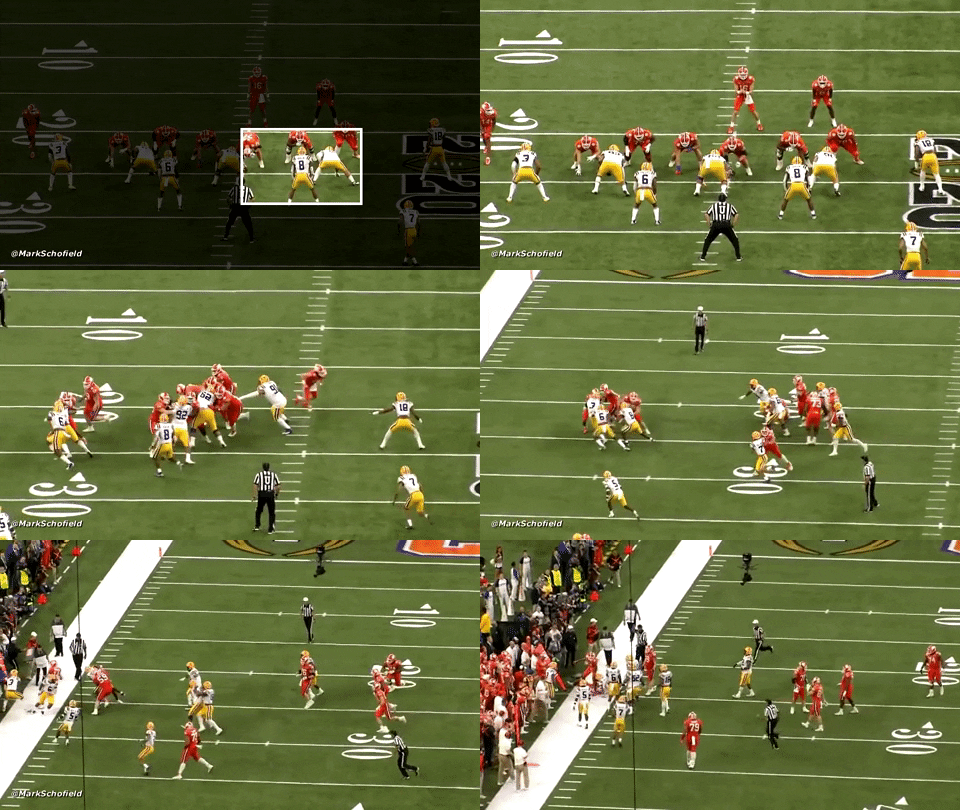
Queen remains in control and never panics, and when the running back finally tries to make something happen, Queen drives him out of bounds with a perfect hard hit.
But what might set him apart from Murray – and makes him a great fit in Baltimore – is what he does against the pass. Pass coverage is his strength as a linebacker. He has a good understanding of route concepts and has a great internal clock for zone coverage situations. He knows exactly when to peel off a receiver and break on the next threat. Queen gets good depth on his backpedal when tasked with dropping into a deeper zone or into a Tampa 2 intermediate hook zone.
If you’re playing Travis Kelce, say in an AFC Championship Game, a linebacker that brings that to the table is a big plus.
Noah Igbinoghene, CB, Miami Dolphins

One of the best parts of the NFL Draft process is when teams provide a crystal-clear vision of how they want to operate schematically. Think, for example, of the Kansas City Chiefs trading up for Patrick Mahomes in 2017. They knew that while Alex Smith was a safe quarterback who rarely made mistakes, for their offense to truly click they needed a quarterback who was willing to take chances at times.
What Brian Flores is building in South Beach is his own version of what he and Bill Belichick assembled in New England: A secondary with talent and flexibility at the cornerback position. Belichick, as Flores well knows, loves to play matchups with his cornerbacks against the offense’s wide receivers. Sometimes it might be a simple as taking his best coverage corner and putting it on the offense’s second-best receiver. Then, Belichick takes his number two CB and puts him on the offense’s best receiver, with dedicated help from a safety. That takes both players out of the game plan.
Other times, Belichick will play matchups based on skill-set. A long vertical receiver might see a cornerback with similar length and long speed. A shifty slot type of receiver might draw their best coverage player. Even a dangerous tight end option like Zach Ertz might get special attention in the form of Stephon Gilmore.
So sure, the Dolphins added Byron Jones to the secondary in free agency, making him and Xavien Howard the highest paid cornerback tandem in the league. But they were not done there, and they added Noah Igbinoghene, the athletic Auburn corner, at the end of the first round. In Igbinoghene, they now have another long and athletic cornerback who can play both inside and outside, and with those three options, Flores can dream up any matchup combination he can think of on Sundays.
The last missing piece perhaps? A rangy, true free safety so that Miami can play a ton of Cover 1 in the secondary. If they add Ashtyn Davis to this mix – as Touchdown Wire predicted in our Day Two mock draft – watch out.
Misfits
Jordan Love, QB, Green Bay Packers

Two things can be entirely true: Green Bay is a great landing spot for Jordan Love, and Jordan Love is not the best fit for the Packers in 2020.
Let us begin with the first part of that statement. Love needs an environment where he can develop, and in a setting with some modicum of a record with quarterback development. Obviously, with Aaron Rodgers on the roster Love is not seeing the field absent injury. In addition, Matt LaFleur was part of the staff that helped develop Jared Goff from a quarterback who looked like a bust after 2016, to a guy guiding a team to a Super Bowl appearance. So this is ideal for the quarterback himself. He can sit, watch, learn and develop.
But from Green Bay’s side of the coin, the fit is a difficult one to see.
First off, this is a team that was a game away from taking on the Kansas City Chiefs in Super Bowl LIV. How does adding a backup quarterback who, in a best-case scenario, does not see the field in 2020 get you closer to the promised land? The Packers need to add a receiver across from Davante Adams and perhaps a linebacker in the heart of their defense. Love certainly does not play either position. He also does nothing to extend what is remaining of the “Rodgers Window.”
Additionally, the scheme fit is a question mark. One of the biggest knocks on Love is his decision-making. Now he is being dropped into a system that places an emphasis on making the right read and getting the ball out on time and in rhythm. LaFleur’s offense is rooted heavily in West Coast concepts, and as such the projection of Love into a system comes with concerns.
It is hard to see how Love makes the Packers a better team in 2020.
Now, in 2022 and beyond, however, this could pay dividends. Provided that Love develops in a favorable manner, learns to take care of the football – and avoid the “17 teachable moments” he had in 2019 – and grows into the passer that LaFleur must have fallen for during the draft process. But 2022 is a long way off, and betting on development at the quarterback position is often a fool’s errand.
Jordyn Brooks, LB, Seattle Seahawks

From James Carpenter, to Bruce Irvin, to Germain Ifedi, to Rashaad Penny, to L.J. Collier, the Seahawks have had some pretty interesting first-round picks in the Pete Carroll and John Schneider era. Seattle’s front office seems to want to take chances with players who fit an athletic and schematic profile with their high picks, but there’s also a tendency to leave out some of the specifics. Often, the Seahawks have been left with prototypes they talked themselves into, with middling results.
Brooks could easily be another one of those types. Last season, the Seahawks went back to the future with base defense — they had three linebackers on the field on the field on 67% of their snaps, by far the most in the NFL, and an exceeding rarity when most teams are throwing five or more defensive backs on the field at least 70% of the time. Brooks fits that mold as a downhill thumper — he’s one of the best run-stoppers and tacklers in this draft class.
“The guy was involved in 20% of the plays,” Schneider said of Brooks’ potential role. “His production is off the charts. I think that staff obviously looked at him in a very similar manner that they did to Bobby [Wagner]. It was incredibly helpful to be able to evaluate that.”
The problem with the Wagner Theory is that Wagner projected perfectly as a run-and-chase linebacker who could cover in his Utah State tape. The way that defense was set up, he was the only linebacker on the field at times, and he had the range and quickness to get it done. That has extrapolated very well to Wagner’s NFL career.
Brooks is a more complicated evaluation in this role. While he’s very quick in a straight line, he’s not an ideal fit as a coverage linebacker. Brooks is a stoutly-built defender who takes a bit to long to get to form when he’s trailing back to cover. So, if the Seahawks imagine they’re getting the next Bobby Wagner in Brooks, they may have sold themselves another bill of goods.