“It’s not every job where you get to go home and say: ‘Wow, I saved someone’s life today’,” says Faye Kennett. As a senior operating department practitioner (ODP), she looks after surgery patients from check-in to recovery: she’s the last person they see before they go under, and the first they see when they wake up.
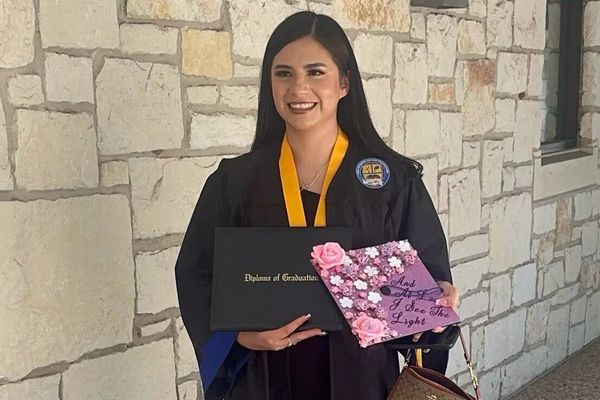
“It’s an incredible privilege to see how patients’ lives are changed for the better by surgery,” says Kennett, who graduated from Buckinghamshire New University in 2016. “You don’t need to have a health qualification prior to training, either – I did a law degree and then worked in retail before discovering the ODP role. It’s the best decision I’ve ever made. I get to work with a multidisciplinary team. Surgeons, anaesthetists, radiographers, healthcare assistants – we all recognise and respect each other’s skills. And I’ve experienced a huge range of specialities, from liver transplants to obstetrics.”
At Buckinghamshire New University, the BSc (Hons) in Operating Department Practice uses the very latest equipment, a range of clinical placements and a lot of enthusiasm to give students all the skills they’ll need for this little-known but hugely important role. “We teach students how to deal with stressful situations here, so when they go out and do it for real, they will know what to do,” says Shane Roadnight, associate professor of operating department practice, who began his healthcare career as a hospital porter. “Bad things happen in real life, so we prepare them for it in a controlled environment in our simulation labs.”
The university’s state-of-the-art training facilities take students through every stage of the process. On the fully equipped ward-simulation room, complete with beds, sinks and patient alarms, they learn how to talk to patients before an operation. That means helping them to feel at ease but also collecting vital medical information, from what medication a patient is on to whether or not they could be pregnant.

But it’s not a case of just asking questions. The ODP must learn to ask specific questions, and in the right way. “For example, I could ask if a patient is feeling fit and well,” says Roadnight. “And they could reply ‘yes’ and not give me any more information because the medication they are on – for, say, high blood pressure – is working fine.
“So instead, I could ask if they have any medication at home and then they would say: ‘Yes, I’m on blood pressure tablets.’ It’s all about getting that open dialogue, while not putting words in their mouth.”
“Patients” are then taken to the training facilities’ anaesthetic room, carefully recreated with all the equipment you’d expect. There is also one significant extra detail – screens that can be moved in and out to make the room smaller or larger.
“This is because most anaesthetic rooms in hospitals are very small and, when the room is small, it becomes a more stressful environment,” says Roadnight.
In the operating theatre simulation room, the ODP learns the skills they need to support the surgeon – from passing the correct instrument to holding a camera still for keyhole surgery. Even the table is exactly the same as those used in hospitals. Students get to practise on Dave, the £76,000 medical simulation dummy who does everything from losing control of his bladder to dying mid-procedure. “When patients are asleep, they are still your patients,” Roadnight points out. “They still have nutritional needs, or religious beliefs.”
They then move to the recovery room for the final stage of the operation journey, where the patient still needs to be closely monitored.
Learning doesn’t just happen in the simulation rooms, either: Roadnight also arranges simulated emergency scenarios, such as a patient suddenly having a cardiac arrest in a corridor. Students are given pagers and must respond as soon as they go off – even if they’re in the middle of their lunch. Kennett says that the scenarios have been invaluable: “When I’ve come across them in real life in my clinical practice, I’ve thought: it’s OK, I know what to do, because I’ve done it in simulation. You know it’s fake, but it feels very real at the time.”
Many exercises are filmed so that students can see where they went right or wrong, while fellow students or a teacher watching from behind two-way glass in the control room can offer advice about what to do next. Traditional lectures have their place, too, where students learn everything they need to know about the human body and how it works. And regular placements at a range of NHS trusts and specialities are key: the course is 60% practice, 40% theory. Each student is assigned a mentor at every placement to guide them. Once they leave, students can expect to be in high demand as there are just over 13,000 ODPs in the UK.
And there’s no such thing as a typical ODP. “We’ve had students who have been bankers to bookmakers, of every age, from every walk of life,” says Roadnight. “What matters the most is that you care, and that you are prepared to work hard – because this job can be tough. Whatever the patient’s condition is, whoever they are, as ODPs we give them the best care that is humanly possible, right here, right now – whether they are asleep or awake.”
To find out more about studying ODP at Buckinghamshire New University, visit the website or call 0330 123 2023