
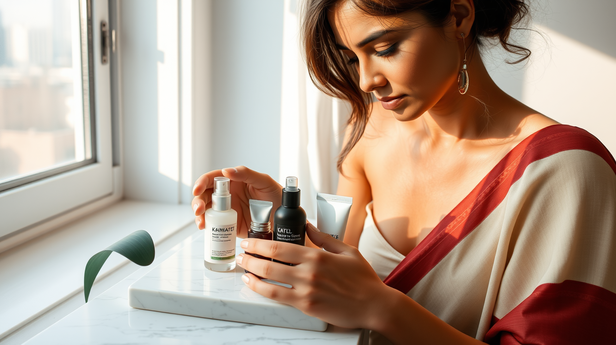
Why Indian skin gets left out of the minimalism conversation
The global minimalist beauty movement arrived with a specific skin type in mind: pale, dry, and prone to sensitivity in cold climates. The three-step routines promoted by Scandinavian and Korean-adjacent brands, gentle cleanser, lightweight moisturiser, SPF, were built for skin that does not produce much melanin and lives in low-humidity environments. Indian skin, which spans a wide range of melanin levels and sits in climates that shift from coastal humidity to dry northern heat, was never the reference point.
That gap matters because melanin-rich skin behaves differently under stress. It is more prone to post-inflammatory hyperpigmentation, meaning any inflammation, a popped pimple, a harsh scrub, a mismatched acid, leaves a dark mark that takes months to fade. It also tends to produce more sebum in humid conditions, which makes heavy Western moisturisers a poor fit for most of the year in cities like Chennai or Mumbai.
What minimalism actually means for a skin routine
Minimalism in beauty does not mean using fewer products because fewer is virtuous. It means cutting products that create problems while keeping the ones that solve them. For Indian skin, this distinction is consequential.
The non-negotiables in a minimal routine for Indian complexions are three: a mild, low-pH cleanser that does not strip the skin barrier; a targeted active ingredient that addresses either hyperpigmentation or texture; and SPF, every single day, indoors included, because UVA radiation passes through glass and is the primary driver of uneven skin tone in melanin-rich skin. Dermatologists at AIIMS have consistently flagged photoprotection as the single most underused intervention in Indian skincare, particularly among women who believe darker skin does not burn and therefore does not need sun protection. It does not burn as easily, but it accumulates UV damage and responds with pigmentation far more readily than lighter skin.
The active ingredient slot is where Indian skin benefits most from a targeted choice. Niacinamide at 5 to 10% concentration reduces melanin transfer to skin cells, controls sebum, and strengthens the barrier, making it the single most useful ingredient for the widest range of Indian skin concerns. Vitamin C in a stable form (ascorbyl glucoside or ethyl ascorbic acid, which are more shelf-stable in Indian heat than L-ascorbic acid) addresses existing hyperpigmentation. One of these, not both layered together, is the minimalist approach that actually works.
The Indian ingredient case
Minimalism opens a useful door for ingredients that have been used on Indian skin for generations and have since earned clinical backing. Bakuchiol, derived from the bakuchi plant used in Ayurvedic medicine, functions as a retinol alternative, it stimulates collagen, reduces pigmentation, and does not cause the peeling and photosensitivity that make standard retinol difficult in sunny climates. A 2019 study published in the British Journal of Dermatology found bakuchiol as effective as 0.5% retinol in reducing wrinkles and hyperpigmentation with significantly less irritation.
Turmeric, specifically curcumin, has demonstrated anti-inflammatory properties in peer-reviewed research, though the concentrations in most commercial face products are too low to replicate study results. Raw application of turmeric mixed with chickpea flour, the ubiquitous besan ubtan, has been a functional skin treatment in Indian households long before the ingredient appeared in Western serums. The minimalist logic here is to use it as a weekly treatment, not a daily one, and to pair it with the SPF that prevents the pigmentation the ubtan is working to correct.
What to cut
The minimalism trend's sharpest gift to Indian skin routines is permission to stop. Stop the physical exfoliating scrubs with walnut shells or apricot kernels, these create micro-tears that worsen hyperpigmentation on melanin-rich skin. Stop layering three different acids under the assumption that more chemical exfoliation accelerates results. Stop the heavy night creams formulated for European winter skin, which sit on top of Indian skin in July and feed fungal acne.
The products that survive the cut are the ones doing specific, verifiable work. A cleanser that does not disrupt the skin's pH. One active. SPF. On days when the skin barrier needs support, after sun exposure, during hormonal shifts, in dry winter months in Delhi or Pune, a ceramide-based moisturiser earns its place. That is four products. That is the routine.
The SPF problem in Indian beauty culture
Sun protection has a compliance problem in India that minimalism can help solve. The traditional objection is cosmetic: most SPFs leave a white cast on Indian skin tones, and the texture of older chemical filters felt heavy in humidity. Both problems have been solved by newer formulations. Tinted mineral SPFs and hybrid chemical-mineral filters now exist at accessible price points from Indian brands including Minimalist, Dot & Key, and Re'equil, all of which have developed products specifically tested on Indian skin tones.
The white cast problem was never a reason to skip SPF. It was a product formulation problem that the Indian skincare market has now addressed. A minimalist routine that includes SPF consistently, not just on beach days, not just in summer, does more for long-term skin tone evenness than any brightening serum used without sun protection beneath it.
The real argument for minimalism in Indian skincare is not aesthetic restraint. It is that Indian skin has specific vulnerabilities, to pigmentation, to humidity-driven congestion, to barrier disruption from over-exfoliation, that a bloated routine tends to worsen, not fix. Fewer products chosen precisely means fewer opportunities to inflame the skin that then takes six months to recover.