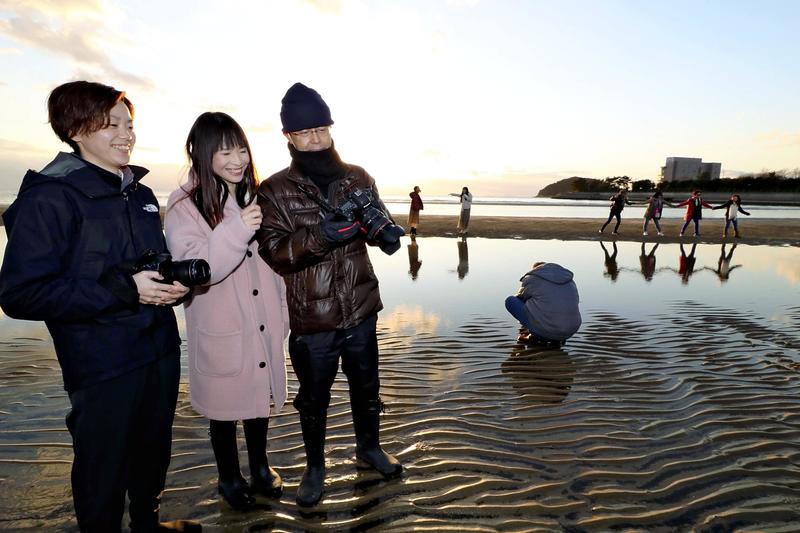
The magic begins when the tide is low. At Chichibugahama beach, where Mitoyo, Kagawa Prefecture, faces the Seto Inland Sea, a fantasy-like view spreads out in which the surrounding scenery is reflected in the tidal pools. It's a natural mirror of breathtaking proportion.
It is reminiscent of the Uyuni Salt Flat of Bolivia, known as one of the world's most spectacular scenes. About three years ago, the beach started making the rounds on social media, and in 2019 alone, nearly 400,000 people ventured to the site.
Chichibugahama had long been popular among the locals for clamming and swimming. That was before it was transformed into an even more popular tourist spot dubbed "Japan's Uyuni Salt Flat."
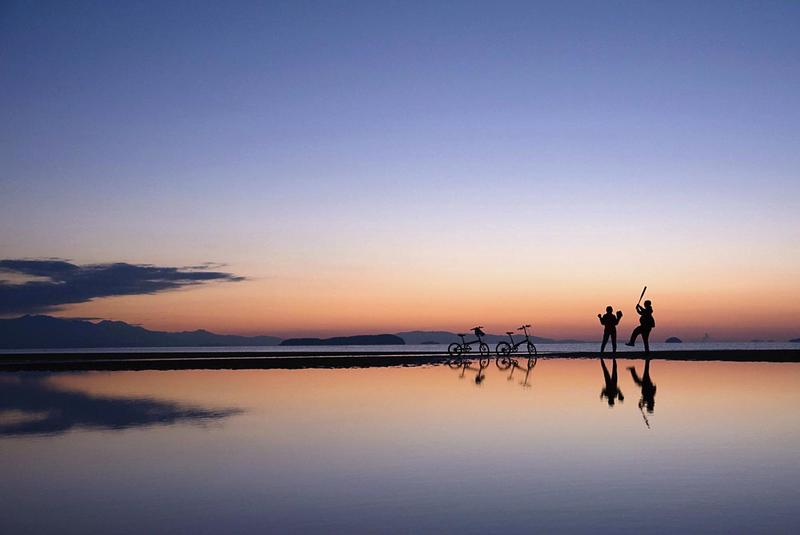
Ayuko Nagai, a photographer from nearby Marugame, was the first to notice the "natural mirror reflecting the sky." In February 2016, the 30-year-old Nagai visited the area to catch the evening view. Friends who had accompanied her stopped their bicycles at the water's edge. Suddenly, her friends' reflections were displayed in the tidal pool at their feet.
"I had always wanted to visit Uyuni Salt Flat at least once in my life, and right before my eyes I was seeing the same view," Nagai said.
Enthralled, she began snapping photos, one of which she submitted to a contest held by a tourism organization that earned an honorable mention. But it wasn't until a year later, out of the blue and in a way she never imagined, that things really took off.
Yukari Ishii, 38, an employee of the Mitoyo City Tourism Association, posted the photo on the association's Facebook page. The response was overwhelming. "It's just like Uyuni!" read more than one comment.
Ishii, a native of Mitoyo, had often grown irritated by friends who would look down on her hometown, saying there was nothing worth seeing. And true enough, there really wasn't a tourist spot with high name recognition.
But Ishii, upon seeing Nagai's photo, was convinced that Chichibugahama could become the trump card for tourism in the city, where "nature at its finest comes out in photos."
The timing was just right, coinciding with the Instagram boom. In just a few days, the post drew over 40,000 hits, and to this day the tourism association still receives inquiries by telephone and email.
To help tourists take their own high-quality photos, local photographer Takashi Iwata, 58, has offered his assistance. A pamphlet he prepared on the best time, place and conditions for taking photos, titled, "Chichibugahama: How to take the best scenic photos!" is available at the tourism association office. "The best time is when there is little wind, and in the 30 or so minutes before and after sunset," Iwata said. "However, if the wind produces waves, that makes for a nice shot too."
About 25 years ago, a plan emerged to fill in parts of Chichibugahama. At the time, local citizens formed a group called the "Chichibu no Kai" to oppose the project. Even after their efforts paid off and the plan was abandoned, the group remained, and currently undergoes activities such as cleanups to preserve the beach.
Takashi Kamoda, 79, chairman of the group and a founding member, said he was surprised with the recent developments. "I never even dreamed that our beach could become such a popular spot," he said. "Our efforts to protect it has made it a place that many people can enjoy."
By keeping it as it was, new life was breathed into Chichibugahama. "If we can devise ways to capture the scenes so that it moves hearts, we think this can become a place for tourists to gather, even without having to spend money," Ishii said.
International scenic spots right at our backdoor
The Uyuni Salt Flat doesn't only produce a breathtaking reflection of the surrounding landscape, it also offers an alluring view when the drying salt spreads out expansively in a sea of white. It is similar to the winter scene at the Notsuke Peninsula in Hokkaido, which covers the towns of Betsukai and Shibetsu, when the shallow coastline freezes over -- a different kind of scenic landscape from Chichibugahama, but another quite popular location.
There are a number of tourist spots throughout Japan that appear similar to sites with famous scenery around the world. The ruins of the Takeda Castle in Asago, Hyogo Prefecture, appear to float among the clouds, which has been likened to Peru's Macchu Picchu. In Otaru, Hokkaido, the Blue Grotto shares the name with its famous blue cave cousin in Capri, Italy.
Read more from The Japan News at https://japannews.yomiuri.co.jp/