The advent of multi-party politics poses questions not just for the constitution and the shape of the next government, it also creates a headache for the producers of the BBC’s election coverage and the latest incarnation of its swingometer.
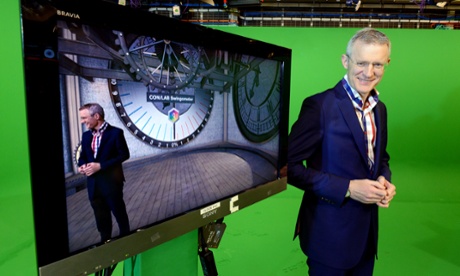
Faced with the most complex and unpredictable election in a generation, presenter Jeremy Vine will unveil no fewer than four different swingometers on 7 May, each of them imposed on to the clock faces of a virtual version of the Westminster tower that houses Big Ben.
Celebrating its 60th birthday this year, this year’s swingometer is a far cry from the original device, essentially a wooden arrow on a nail, that was used by a BBC regional output to follow the fortunes of two Southampton constituencies in 1955.
Vine, the BBC Radio 2 lunchtime presenter who inherited the swingometer mantle from Peter Snow a decade ago, said: “We have really struggled. The key thing is we just desperately want to do the swingometer because it is such a big heritage thing, but it has to fit with this election.
“It’s not straight red or blue, that’s the trouble, but it’s still a joyful thing. It does actually strangely work.”
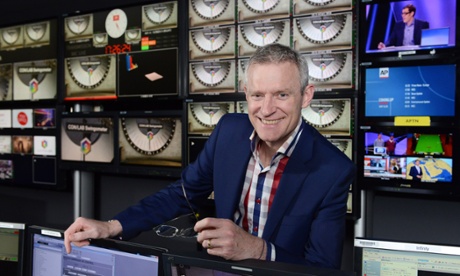
Vine will appear in a lovingly recreated interior of the Elizabeth Tower, complete with cogs and clock tower machinery, during this year’s broadcast.
Along with dials representing the swing between Conservative and Labour, Conservative and Lib Dem, and Labour and Lib Dem, it will also feature the Scottish National party for the first time, the fourth swingometer charting the battle between Labour and Nicola Sturgeon’s party in Scotland.
Such is the projected scale of the SNP vote that the dial had to be rebuilt to allow the swing to go up to an unprecedented 30%.
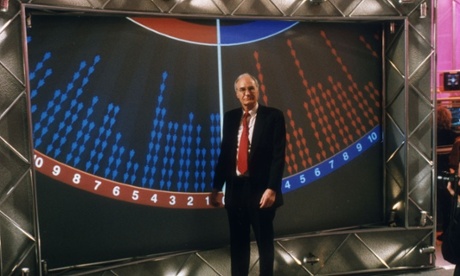
Snow, who spent 25 years covering general elections until 2005, said the original device and its many reinventions caught viewers’ imagination because it was “such a beautiful concept: a very striking but very simple image that tells (or used to tell) the central story of the election.
“Swing is such an easy measure to understand and the notion of us voters swinging from one side to another has a magic ring to it.”
Vine promises there will be a “wow” factor to this year’s coverage. One mooted idea was a virtual hot air balloon, in which the presenter would float over Britain and drop into constituencies, was deemed over complicated. A Minority Report-style effect, in which Vine would seemingly pull statistics out of thin air, remains an ambition for when the technology is robust enough.
But this year, there will also be a retro element which may be lost on some viewers. “The clicker that I use to click the graphics on, I think it’s a remote controlled car lock from a Ford Escort,” said Vine. “I look at it sometimes and think, we’re not that cutting edge. It’s a bit Life on Mars.”
Vine has emerged from what he described as the BBC’s “cartoon phase”, including the 2008 local election in which he donned a cowboy hat and American accent and had a “shootout” with a virtual Nick Clegg.
“We went into this thing of trying to create slightly more wacky cartoon graphics. It was when Clegg was the new kid in town,” said Vine. “I said I would wear the hat but I drew the line at leggings.”
Vine’s favourite graphics are from Tony Blair’s win in 1997 when “John Major was buried by a landslide and all the tall buildings blew up”.
Snow turns the clock back five years earlier, to John Major’s win in 1992. “My favourite was that year’s magnificent great pendulum glittering with neon lights that I could swing from one side to the other turning the seats of the losing party into the colour of the winner.”