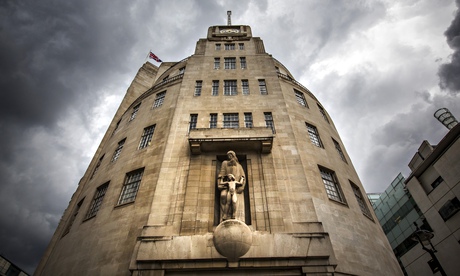
The debate about the future of the BBC engages some deeply held beliefs about who we think we are and, indeed, whether there is any “we” in the first place. It clearly goes beyond the question of whether it is right for BBC1 to show programmes about creatures engaging in highly ritualised sexual display, where the government’s view seems to be, roughly, that Strictly Come Dancing would only be acceptable if made by David Attenborough. And it even goes beyond the details of particular funding mechanisms and governance arrangements.
It partly touches matters of national sentiment and identity. London Calling, Dimbleby in the Abbey, The Goon Show, the shipping forecast, the highs and lows of successive Olympics or World Cups or other Great British Sporting Disasters – most of us have only the patchiest knowledge of the history of the BBC, but there is a widely shared feeling that somehow it’s been there for us at moments of national significance and anyway it broadcast some of our favourite programmes when we were younger.
We accept that there is no surviving footage of King John signing Magna Carta, nor a recording of the interview with Wellington after Waterloo (“We take it one battle at a time and now we’re really focused on doing well in Crimea”). But in so far as pluralist, multicultural Britain still has any sense of a shared past, the BBC is thought to stand in a particularly intimate relation to it.
But it also touches deep questions about political and social values. Historically, broadcasting in most countries has been based on one of two models. There have been state radio and television stations, guaranteed to support the official government line and likely to be given over to hours of rousing martial music in the aftermath of a coup. And there have been commercial broadcasters, attempting to make a profit for shareholders by selling a mix of, in the purest examples, pap, populism and porn.
For contingent historical reasons (it was by no means inevitable), broadcasting in Britain followed a different path, perhaps a typically hybrid or muddled one. A royal charter established the BBC as an independent corporation directly supported by a licence fee levied on all those who owned a radio or, later, a television. It was publicly supported but independent of government – perhaps a classic example of the saying “It’s all very well in practice, but it’ll never work in theory.” That model proved remarkably durable, able to resist government pressure during the Second World War yet also able to hold its own against commercial radio and television from the 1950s. But now we live in different times. Some of what is different is to do with technology: when a lot of people no longer watch their TV programmes on television sets, the old basis for the licence fee is called into question. And some of what is different is to do with the globalisation of communications: should we rethink the role of a “national” broadcaster when its material can be sold or accessed in any part of the world?
But even these are not the questions that are fundamentally at stake in the current debate.
However limited or disguised the government’s proposals may appear to be in the short term, this debate is about the peculiar form of fundamentalism that is now challenging older faiths all across the world. Market fundamentalism is a particularly dogmatic and intolerant sect: profit is the one true god and all other beliefs are heresy, to be stamped out. You know you are in the presence of a true believer by the sense of conviction with which they intone the first article of the creed: “Competition will drive up quality.”
This phrase has the stink of the snake-oil salesman all over it. To begin with, the tense of the verb is what we might call “the future dogmatic”. This is used to disguise an unjustifiably broad assertion as a truism. Market fundamentalists love this tense: “A more flexible labour market will increase prosperity” (ie if it is easier to sack some workers and underpay the rest, that will increase corporate profits).
Then there’s the use of “drive up”: this is meant to show that it works like an irresistible natural force, such as velocity or gravity, and you can’t argue with that, can you? And finally there’s “quality”: used in the abstract, this is simply an empty box, like “excellence”. All it really means is that this will lead to more of whatever people can be induced to want. Many of us who were brought up in older faiths, such as social democracy, co-operation or muddling through, tend to believe that there are some things that markets do well and some things that they don’t. But it is a mark of the fundamentalist to scorn such tepid Anglicanism. The “laws” of the market, they insist, are universal in their validity and simply need to be “applied”.
Another tenet of the fundamentalist faith is that only those bodies that are “responsive” to the market can be genuinely “independent” – otherwise, it is held, they will always potentially be the playthings of government. (The first commercial channel was, for this reason, always demurely referred to as “independent television”.) This is a particularly disingenuous claim, abundantly contradicted by the history of the BBC itself, but also manifestly absurd in logic.
The question of trust is central here. Ask yourself a parallel question. If you needed to know whether a new medication was safe and effective, would you be more likely to trust a) a report by the company that makes the product, or b) a report by a university department of medical research? And what if a politician comes along and tells you that the trouble with these university departments is that they’re biased against the market and so we need to turn them into private companies to eliminate bias?
Might not you still think that people who are trying to sell you something are more likely to be “biased” about that product than people with no such connection to it but whose professional reputation rests on careful scrutiny of the evidence? Similarly, we can ask which kind of broadcaster is more likely to be brave and to resist pressure when the chips are down: one that depends on pleasing advertisers and shareholders or one that is independent both of the market and of government?
As recent policies have illustrated, the BBC is, in reality, no longer wholly independent of government: a shoddy funding settlement can be used to impose political will. Current proposals would go a step further in this direction. A BBC that was pared back to providing niche “public broadcasting” programmes would cease to have the clout necessary to do things that are sometimes ambitious, popular, and controversial all at once. It is, of course, true that commercial broadcasters can make good programmes. No one is denying that and anyway we have such broadcasters already. But if the question is whether the ecology of broadcasting as a whole in this country is improved or damaged by the existence of the unique institution that is the BBC – culturally central, politically independent, publicly supported – then there can only be one answer.
None of this settles questions of the most appropriate funding mechanisms or forms of governance. And no doubt there are ways in which the performance of the BBC could be improved (though it is the vaunted market that generates such ridiculously high salaries – as executive pay in the commercial and financial worlds makes abundantly and depressingly clear).
But if we are to have an intelligent debate about any of these things, then we have to try to free ourselves from the dogmas of misplaced market cant. The BBC has something in common with institutions that look quite different from it and from each other, such as museums, hospitals, arts organisations and universities.
These are bodies whose primary aim is a form of public service, not the making of profit for the owners of capital; in all of them, good work depends more on ethos than on financial incentives; and they are regarded as in some sense public possessions, as something we all have a share in and can all take pride in.
Oh, and the BBC has something else in common with such institutions: the Tories hate them. They hate them because these bodies successfully instantiate an alternative model to that of casino capitalism. No wonder they accuse them of being “biased”.