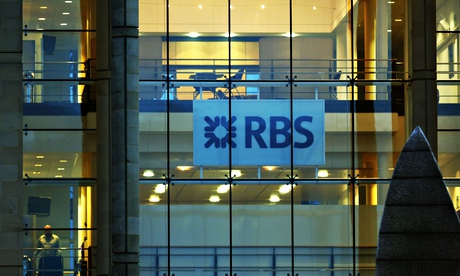
The truly depressing thing about this week’s £2bn RBS shares sell-off is not that it was an underpriced giveaway to the City (though it probably was) but that we can’t think of banking in any other way than rescuing them when they go wrong, then handing them back to private hands when it’s going right.
Labour’s tepid response has been to criticise the share price achieved, suggesting if only the chancellor held on a bit longer he might achieve a better price. It’s classic “Tory lite” stuff. Labour would still sell shares in RBS, but would do it better. Support Labour because it will be better at guessing where RBS shares will be next week, next month or next year? It’s nonsense.
Why has Labour bought into the ideology that banks must be in the private sector? Every one of the giant stock market banks failed in one form or another. RBS NatWest and Lloyds/Halifax needed direct bailouts from the taxpayer. Barclays went cap in hand to the middle east. HSBC survived – but only with a giant £12bn cash call to investors to keep it going. All the former building societies that demutualised – from Northern Rock to Bradford & Bingley – went under.
The one major banking institution that did not take taxpayers’ money – and which, instead, helped rescue others that failed – was Nationwide building society. And it was the only major institution not on the stock market.
So what have we done since the great banking crisis? Encourage the establishment of more Nationwides? Oh no. The mantra has been to create “challenger” banks, which, because they must be private, profit-maximising institutions, simply turn into “me-toos” of the existing banks. So Northern Rock was sold off (at a bargain price) to Virgin’s Richard Branson and other billionaires. TSB (a one-time mutual) was carved out of Lloyds, put on the stock market then taken over by Banco Sabadell. Williams & Glyn is going to come out of RBS and on to the stock market.
Will consumers get a better deal? Maybe – but it’s likely to be near invisible. My colleague complains her children’s savings account at Northern Rock paid a table-topping rate. Now it is under Virgin Money, she complains it’s no better than middling. But then what else should we expect from private sector banks running near-identical business models? Most of the future shareholders of RBS will be hedge funds and foreign institutions, such is the nature of the London Stock Exchange these days. Their interests are short term, focused on quarterly results and the share price. Why, once fully privatised, should RBS behave differently than it did in the past? Last month, Barclays’ boss, Antony Jenkins, who was trying to take the bank down a different line, got the boot. In the budget the major banks scored a huge victory, winning deep cuts to the bank levy – essentially aimed at keeping the bosses of HSBC and Standard Chartered happy.
Does anyone remember Vince Cable’s determination to break up “casino” banks – separating the gambling arms (aka “investment banks”) from their personal and business operations? Moves to “ringfence” the businesses have, so far, been glacially slow. When there is so much profit to be made by traders riskily leveraging the balance sheet of a large retail bank, it may never happen.
We have shifted so far to the right in our national psyche that proposals for a National Investment Bank by Jeremy Corbyn (a suitable future for a part of RBS?) are regarded as outlandlishly leftwing. Everything must be privatised or stock market-based. This is how we have a financial system that, for the bottom quarter of the population, consists of the likes of Wonga, Provident Financial and Brighthouse.
It’s brilliant that Sheffield Money is taking them on. Imagine if just a tiny percentage of the money used to bail out the bankers could have been spent setting up alternatives to the likes of Wonga. It would help millions in cities like Sheffield. But not the few in the City.