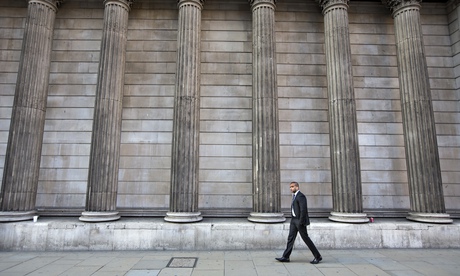
The masters of the universe are back. It’s bonus time in the City, and over the next few days while the rest of us will fume on the sidelines, a few thousand of the elect will trouser bonuses big enough to buy a house and leave enough change for an African safari.
Our tolerance for this bizarre and inexplicable system of reward is the most extreme but far from the most damaging effect of the hold that the City has on the country. Winston Churchill, mulling over the fatal return to the gold standard in 1924, wished that finance was less proud and industry more content. For a generation, politicians both Labour and Conservative have stoked City pride at the expense of industry with results that are written across the national landscape in long-term unemployment, damaged families, under-resourced infrastructure and political dislocation.
And of course, as the papers at last and reluctantly released by the Bank of England today show, pride and overweening confidence played their part in the economic crisis that began in 2007. It was part of reason for the Bank’s hold over its board of non-executive directors – the court – to which on matters of strategic direction (including, presumably, whether the economy was headed for the rocks) it was supposed to answer.
When the clouds of crisis gathered, the court was stacked with intelligent people who didn’t know about banking; public figures like Brendan Barber, the general secretary of the TUC. Their job was not to make life difficult for the Bank directors, but to make it easy. These were the years of plenty, of non-inflationary consistent growth and they were not there to speculate about the weather changing. They were certainly not there to take up what turned out to be the all-too prescient warnings of David Blanchflower, the academic economist and member of the monetary policy committee who saw a crisis looming. They were there to provide a chorus of approval for the gods in charge.
The Zeus among the gods was Mervyn, now Lord, King. He might, according to people who know him, be a nerdy academic, but he was also a tyrant, according to Blanchflower, a “my way or the highway” boss who ran the place with an iron fist. Blanchflower said morale among staff at the Bank was the lowest of any place he had worked. No surprise there: you can’t be top dog in the City – particularly when your salary is only a fraction of the commercial banking world’s annual bonuses – without being tough with it.
But it was much more than a matter of one man’s strengths, and weaknesses. In the context of a culture of institutional challenge, the Bank’s directors even had some reason not to take the court too seriously. There were suspicions of conflicts of interest, and worse, of leakiness. That combination of an inadequately knowledgeable board and a dismissive Bank leadership is now shown to have been lethal.
So the papers now released show that the court did not learn of the catastrophic scale of Northern Rock’s failings until the moment the Bank had to rescue it. And even then, there was no questioning of the tripartite system of regulation where the Treasury, the Financial Services Authority and the Bank itself all had responsibilities.
There may be a new mood at the Bank under its Canadian governor Mark Carney, but that didn’t stop it fighting a stubborn and obstructive campaign to prevent the release of the minutes. It has taken MPs on the Treasury committee years to lever this 500-page intimate picture of a critical moment in Britain’s history out into the public eye for scrutiny.
The Bank’s obsession with secrecy is institutional and pathological. It has total exemption from the Freedom of Information Act. Carney announced last month that he has managed to prise away a few of the constraints on openness. Historic records will slowly be released. From later this year, minutes of the MPC will be published at the same time as its decisions on interest rates. But, astonishingly, the audio recordings of the meetings will continue to be destroyed as soon as the minutes are approved. There are no transcripts.
Official minutes are a feeble indication of the nature of the debate that produced the recorded decision. But that’s only really bad for historians. What is institutionally and culturally corrosive is that secrecy reinforces the sense of infallibility, of riding outside the normal rules, which leads to a rejection of challenge. Read this devastating interview with David Blanchflower to get a feel of what it’s like to be the internal critic.
As a commenter on the Financial Times website this morning remarks, the Bank needs cultural transformation. He reports that when he worked at the Bank 15 years ago, he was expressly forbidden from even considering how something could be improved. This is no way to run a bank, least of all the bank that has such a powerful say in running the country.