
It's 7:02 p.m.: just minutes until first pitch.
A group of tired workers huddles in an office just a few paces away from the freshly mowed grass and manicured dirt of Safeco Field. With ball caps askew, foreheads damp and well-earned sodas in hand, they stare intently at a screen, admiring the day's work.
As pregame festivities come to an end and the last note of the "Star-Spangled Banner" fades, a choir of high-school-aged kids exits stage right.
"Watch the line!" a voice bellows in the office. "Dylan, can you go check on my line? I think someone kicked up a little chalk."
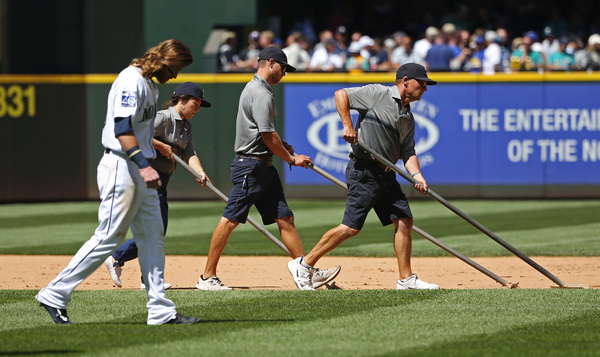
The voice is that of Bob Christofferson _ a man who's been fixating on details like that for 37 years. It's his job.
"It's a canvas, and we get an opportunity to paint it," says Christofferson, the head groundskeeper for the Mariners. "And every day, the finished product is 7 p.m. And I tell our guys, our field is on TV all the time. You look at it, you look at it on TV, did we accomplish what we wanted to?"
To say Christofferson is dedicated to his craft is an understatement. To say he's attentive to detail undersells how obsessive he is about the field he's in charge of keeping perfect each and every day. He's been doing it for the M's for 17 years, and before that for 19 years with the Tacoma Rainiers.
"The ballpark is on my mind 24/7, not 365, but during the whole the season ... I'm here a lot."
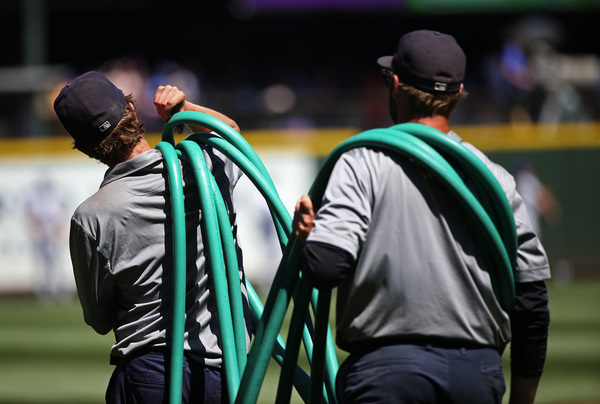
Safeco's "Sodfather" expects perfection. And the 13 members of his crew _ six on the day crew and seven on the night crew _ try to give it to him.
"I think most people around me think I'm a perfectionist," Christofferson said. "I think I'm realistic with the expectations, but the expectations are high. And they should be."
Assistant groundskeeper Tim Wilson agreed: "The goal is to make it as perfect as we possibly can. Every single day. All 81 home games and hopefully beyond into October."
Being so meticulous translates to results on the field, and everything the grounds crew does is for the players.
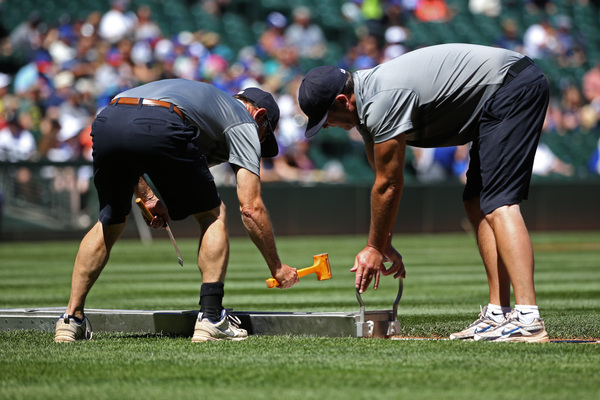
Take the outfield, for example. You'll see wide, even stripes running in three directions: one set to left field, one to right and the other to center. The design used to be checkers _ an aesthetic Christofferson preferred.
But in 2002, then-center fielder and fan favorite Mike Cameron came to Christofferson with an idea: Since hard ground balls wouldn't stay true with the checkered look, Cameron wanted to create a runway of sorts. Mow the grass in a long straight line, and it'll be easier to charge, he thought. And if Cameron liked it, why not mow that formation for each outfielder?
It hasn't changed since.
"Cammy was back here a couple weeks ago and I mentioned it to him," Wilson recalled, laughing. "I told him, 'You know, this pattern all started because of you.' He thought I was joking."
The crew also accommodates other players. They'll mold the mound after a game to cater to the preferences of the next day's starting pitcher. They'll make sure the infield grass and dirt are well watered on a sunny August day to slow the balls enough for the infielders to charge. Heck, they'll even pick up little pieces of water balloons after players sling them around the outfield on a particularly toasty afternoon.
"We're here to make their field as good as it can be for them," Christofferson said. "We're telling the third baseman and the first baseman all the time which way the ball is going to roll. In a game, I want it so they don't have to think about it.
"If you're a groundskeeper, you never watch the game the same. We're watching every ground ball that's hit. We're watching the pitchers, we're watching the batters, we're watching the infielders. We're watching the field for any kind of debris that gets on it."