Crystal Pite, Kate Prince and Hofesh Shechter are associate artists of Sadler’s Wells. Numbering 17 in all (if you count BalletBoyz as two), the associates are a kind of top table of dance achievers. By presenting Pite, Prince and Shechter on the same bill, Sadler’s Wells director Alistair Spalding is offering us a revealing cross-section of activity, in that all three choreographers are undergoing processes of change. Prince and Shechter, in particular, are experimenting with projects intended to take them in new directions. This is laudable; artists who don’t expand their horizons risk seeing them contract. But forcing change isn’t easy, as the evening demonstrates. The old tics, tropes and preoccupations have a way of muscling back into the work.
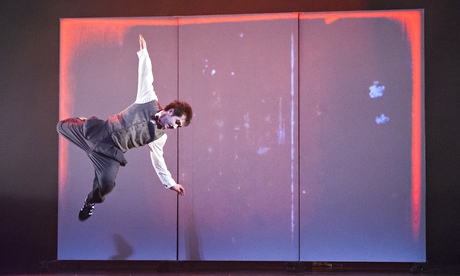
Smile, by Prince, casts an eye at the off-camera persona of Charlie Chaplin. Prince’s back catalogue includes the phenomenally successful Into the Hoods and Some Like It Hip Hop, but she’s now keen to explore projects “with a darker edge”. Her Little Tramp is Tommy Franzén, a steel-sprung dancer whose manic mugging to film tunes and fluent business with hat and cane are as impressive as they are ultimately unmoving. Franzén has many qualities as a performer, but Chaplinesque pathos is not among them. That his character is in thrall to the mirror and the roar of the crowd, and uncertain of his identity when alone, merely aligns him with every self-obsessed performer who ever lived, and when he seeks our sympathy to the words of Chaplin’s famous song “Smile though your heart is aching/ Smile even though it’s breaking…” he comes across as ingratiating rather than tragic.
This is not necessarily unintentional on Prince’s and Franzén’s part, but Smile misses its target, addressing neither Chaplin’s genius nor his cruel and predatory aspects, which included a sexual predilection for very young girls. The tears of this particular clown were part of his showbiz shtick. Dark material-wise, this piece lets him off the hook.
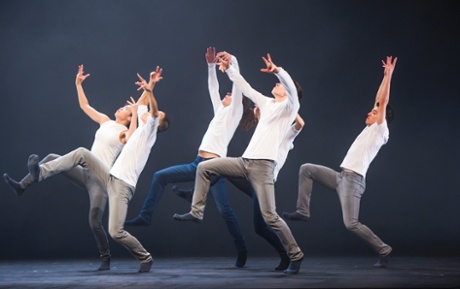
Shechter’s offering is The Barbarians in Love. Set to works by the baroque composer François Couperin overlaid with an electronic score that sounds, at times, like an angle-grinder going through granite, the choreography intercuts vague physical references to ballet with typically Shechter-esque crouches, shuffles, spasms and galvanic twitches. The six dancers appear to be subject to some kind of rigid control, represented by classicism, which they subvert by escaping into passages of less structured physicality.
A spoken soundtrack interviews the choreographer about his intentions. “I’m looking for something pure… innocence,” Shechter’s recorded voice informs us, before musing on what appears to be a full-blown midlife crisis, and confessing that he has cheated on his wife. The piece ends with the dancers lined up in varying degrees of nakedness, but it’s a curiously unrevealing tableau. Shechter’s early work as a choreographer, informed by his experiences growing up in Israel, had a taut, thrilling focus. A decade and a half later, his subject appears to be his own uncertainty. Whether this opaque piece is a necessary prelude to a new level of creativity, only time will tell.
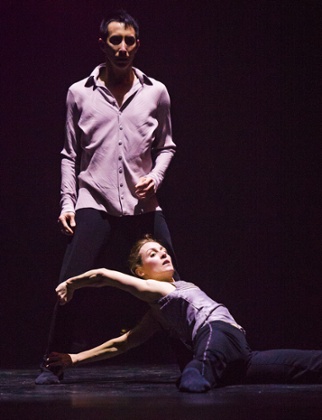
Crystal Pite’s A Picture of You, Falling is best known as part of her full-evening work The You Show. A fractured narrative for two dancers, Peter Chu and Anne Plamondon, the piece describes a failed love affair. As we listen to a cool, unemphatically spoken description of a sequence – “This is how you collapse” – we see the scene played out in front of us in exquisitely precise choreographic detail. Limbs flailing in liquid slow-motion, torsos revolving, legs folding. “This is the sound of your heart hitting the floor,” the voice continues, as a splayed hand drifts downwards, knuckles first, and bounces briefly before coming to rest.
Each dancer appears in turn, is briefly illuminated, and vanishes. Fragmentary interactions are sped up, slowed and reversed. These are moments trapped outside time, endlessly repeating. “This is the place… there were no curtains. You remember the wind?” The spoken words, and Owen Belton’s minimalist score, give little away. But we barely need them, so transfixingly subtle is the interplay of movement between the two protagonists. Pite’s choreography is driven by a relentless curiosity. What lies beneath, she asks. What is the story that our bodies tell? If the question is unanswerable, the asking of it is unforgettable.
Star ratings (out of 5)
Smile ***
The Barbarians in Love ***
A Picture of You, Falling *****
• The Associates is at Sadler’s Wells, London until 8 February
This article was amended on 09 February 2015 to correct a typo in the headline.