Finding your business groove is sometimes serendipitous. Just ask Shweta Tripathi, owner of the Brooklyn-based floral design business BeeSpoke.
Tripathi, a marketing manager who had started experiencing burnout, decided she needed a change. “I couldn’t recall not feeling exhausted,” she says. So she quit her job, traveled the world for six months and took indulgent classes once she was back home in New York, in an effort to center herself.
She tried juggling. French cooking. And a floral arranging class at Ovando, a high-end New York florist, where she ultimately found her new purpose.
At the class, Tripathi followed instructions to style carnations, orchids and roses in a vase. She felt electrified. “My hands were shaking,” she says. “I couldn’t put those flowers in the vase fast enough.” Her instructor and classmates praised her, as did her followers on Instagram, where she started sharing her arrangements.
Her resulting company, “BeeSpoke,” is named for the noble, focused pollinators of 30% of our crops and 90% of our plants – and the notion that flowers speak to us. “When giving flowers, you are saying, ‘I love you,’ ‘I miss you’ or ‘welcome to my home,’” Tripathi says. “So I transport that endearing message.”
Referrals and email newsletters generate one to seven orders, at $200 to $300 a pop, weekly from friends and family for weddings, anniversaries and dinner parties. And an art director friend commissioned Tripathi to create boutonnieres for two Men’s Warehouse photo shoots with two issues of The Knot magazine. “My name is out there now,” she says.
Pursuit of the perfect candle
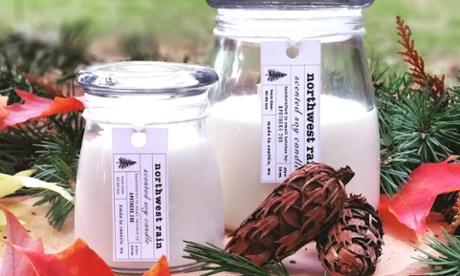
Serendipity partnered with a quest for perfection inspired Seattle-based Thalita Baccarin to launch Apotheke 206, a line of eco-friendly soy-based candles. Baccarin had always loved handcrafted candles, but found many lacking in terms of burn and scent. So she made her own – after two years of consulting websites and books and perfecting her fragrances from home.
The candlemaking market appears crowded: the National Candle Association estimates approximately $2bn US retail sales annually, excluding accessories. But Baccarin says she believes her niche products, priced at $12 to $25, connect with Washington customers who value nature and locally made goods.
She uses American-made materials, including non-GMO, US-grown soy as well as reusable jars made by American Union workers. Regionalizing her scents and names also helps, with offerings like “Washington Forest,” a woodsy, sweet blend with pine, balsam and orange notes.
After launching late in 2014, Baccarin, who also works as a University of Washington program coordinator, produces weekly orders of 60 to 250 candles during gift-giving season for six Seattle stores. She sells at a farmers’ market monthly and takes online orders, all with minimal marketing efforts beyond her visits to shops. “I’m amazed I’ve gained so much traction and so quickly with my venture,” she says.
Challenges exist, of course. Making candles is messy and requires space, ventilation and supplies, like a protective plastic tarp for her floor. Also, meeting orders alongside working her university job means constant daily work. Even so, Baccarin believes any struggle she feels worth it. “At the end of the day,” she says, “you feel so fulfilled you’ve achieved your mission.”
Combining art and architecture
Other visually driven hustlers, like Manhattan-based Anna Pietrzak, balance a creative day job and an artistic side venture. She designs international projects with a large architecture firm, and has also promoted her own art and photography through her website, online stores and an exhibit in a reputable Chelsea gallery.
Her series Moments of Movement, on life in New York, met great success. And in 2012, when she submitted the entire series to a competition in Poland, she won the gold medal for two pieces.
Pietrzak has been savvy with social media to boost publicity. By uploading images of her work to the online art community Society6, she submitted pieces to its zine, then did an interview with the app maker Morpholio.
Advice for artistically driven entrepreneurs
- Understand that toughness is necessary for seemingly delicate crafts. The New York Flower Market, where Tripathi buys her blooms, requires rising early and aggressively haggling for high-quality flowers. Also, customers’ expectations often mean turning around a $250 order within 12 hours. “Arranging flowers is Zen-like work, but functioning in this space is not,” Tripathi says.
- Don’t dwell on the competition. A market research report tracks 36,000 florists in the US, but through unconventional designs, colors and styling, Tripathi created a niche. Baccarin advises: “Really focus on what makes your brand different.”
- Find a supportive employer and promote yourself. In her current marketing role, Tripathi easily combines biweekly trips to the flower market and arranging from home. Her boss even orders arrangements for her dinner parties.
- Know that ignoring an idea for a venture ultimately could take more energy than launching one. “Starting a project feels intimidating to a visual artist,” Pietrzak says, “but once you gain momentum, it’s easier.”
Content on this page is brought to you by Squarespace. Receive 10% off your new Squarespace signup with offer code SIDEHUSTLE.