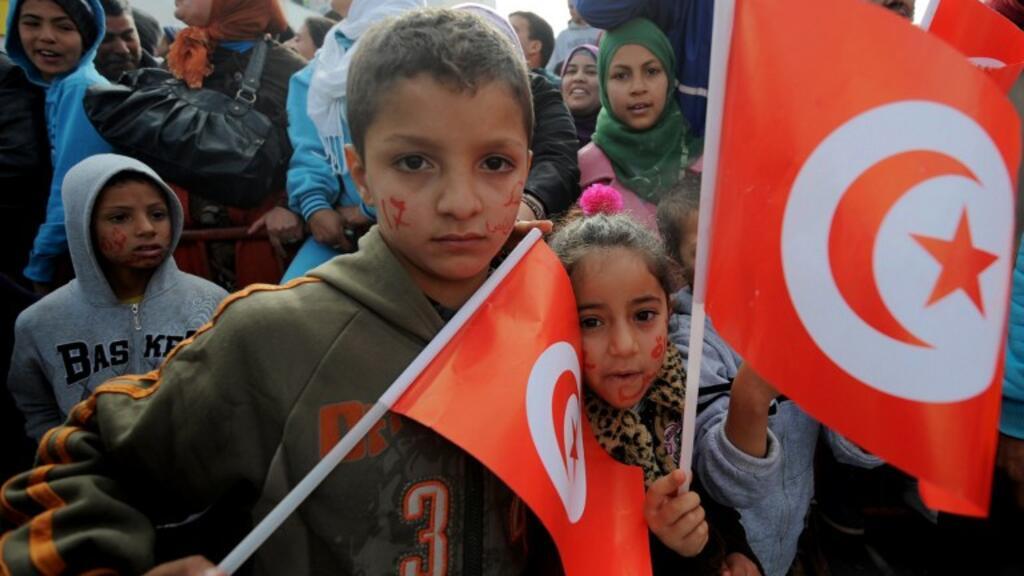
As Tunisia marks the 15th anniversary of the revolution that provoked the Arab Spring, RFI spoke to exiled former leader Moncef Marzouki, the first to be democratically elected after the fall of longtime ruler Zine El Abidine Ben Ali, about what the revolution achieved.
On 17 December 2010, in the city of Sidi Bouzid, a young street vendor named Mohamed Bouazizi set himself on fire in front of the regional government headquarters after police confiscated his goods.
His act of despair came to symbolise wider anger over the socio-economic situation in Tunisia, and repression by the Zine El Abidine Ben Ali regime.
The popular uprising that followed was dubbed the Jasmine Revolution. This 28-day campaign of civil resistance and demonstrations led to the fall of Ben Ali in January 2011.
Tunisia went on to hold free and democratic elections, and inspire a wider protest movement across the Maghreb and parts of the Middle East known as the Arab Spring.
Fifteen years on, the country is now ruled by Kais Saied, who was elected by a landslide in 2019 over dissatisfaction at the lack of post-revolution political and economic progress.
However, Tunisia's political opposition and human rights groups have denounced a rollback of rights and freedoms since 2021, when Saied dismissed the prime minister, suspended parliament and took executive control of the country, citing emergency powers he says were granted to him by the constitution.
RFI spoke to Moncef Marzouki – who is living in exile in Paris, having been sentenced in absentia to 22 years' imprisonment for "terrorism" offences over his criticism of Saied – about the legacy of the "Jasmine Revolution".
Tunisian government opponents handed jail terms ranging between 13 and 66 years
Moncef Marzouki: When we look at the current situation, the revolution has completely failed because we've gone back to square one – that is, to the Ben Ali era.
We have a president, Kais Saied, who was elected with 90 percent of the vote after eliminating all his opponents. The return of fear, the return of political prisoners... all the leaders of political parties are either in exile or in prison.
So, we're really back to square one. Except that something profound has been established or instilled in the minds of the Tunisian people: a taste for freedom. At some point, they saw that the freedom to criticise the president wasn't dangerous.
So something has remained in people's minds, and I think it will start up again. Those who say that the Arab Spring is the end don't understand anything. Because in fact, the Arab Spring has only just begun.
RFI: Fifteen years later, do you think that an act as desperate as Mohamed Bouazizi's could happen again in Tunisia?
MM: All regions of Tunisia have remained impoverished. Tunisia is becoming poorer every day. The middle class is becoming poorer. The current government finds itself in exactly the same situation as Ben Ali – namely that it is opposed by the wealthier classes because it has taken away all their fundamental freedoms, without providing anything for the population or helping to alleviate poverty.
So all this pent-up energy, both among the common people, as they say, and among the bourgeoisie, is going to explode. This is yet another reason why the volcano is going to erupt again.
Moving story of migrants in Tunisia scoops top prize at Marrakech Film Festival
RFI: Mohamed Bouazizi's actions were a protest at both the precarious socio-economic situation for Tunisian youth and the stifling of freedoms. On these two points, what evolution do you see between the presidency of Ben Ali and that of Kaïs Saïed?
MM: During the three years I was head of state, we truly established the rule of law. The judiciary was independent, freedoms were respected and no one was imprisoned for political reasons. We even began to fight corruption.
However, because there was what I would call a "regional veto" on democracy in Tunisia, and because we lacked support from Western democracies, unfortunately, the revolution failed.
It failed because of the mistakes we Tunisians made. But also because of this regional veto – which was essentially Algerian. Algeria was a corrupt and violent dictatorship. It was out of the question for them to accept a Tunisian democracy, which could have set a bad example, so to speak.
And the Algerian generals were right to [be wary of] the Tunisian revolution, because the Hirak in 2019 [the uprising in Algeria] was simply the tail end of the comet, a continuation of those revolutions.
The entire Arab political system, from Egypt to the United Arab Emirates, from Saudi Arabia to Algeria… This whole system felt threatened by this wave of revolutions. They pulled out all the stops to thwart these revolutions.
They thwarted them through the civil war in Syria, the military coup in Egypt, the civil war in Libya, and through the use of dirty money, information, disinformation and terrorism in Tunisia. So, once again, there was a regional veto against the Arab democratic revolutions.
Trial of NGO workers accused of assisting 'illegal' migration opens in Tunisia
RFI: Kaïs Saied has managed to win the favour of the European Union, particularly on the issue of migration. How do you see Tunisia's progress regarding human rights and democracy in this rapidly changing world?
MM: The attitude of the Europeans, I can't say it reflects very well on them. They support dictatorships, notably the Italian government, and they're ready to help Kais Saied stay in power. These are short-sighted policies. We keep telling our European friends, you're betting on authoritarian regimes, solely to use them as border guards.
But that's not the solution. The solution lies in social and economic development. That's how we address the root of the problem. That's why I say the democratisation of the Arab world is an internal matter for the Arab world, and we shouldn't count on European countries to help us with that. Aside from a few hypocritical pronouncements, I think there's nothing to be gained.
This interview has been adapted from the original version in French by Sidy Yansané.