Get all your news in one place.
100’s of premium titles.
One app.
Start reading
The Guardian - UK
The Guardian - UK
World

The Arab-Israeli conflict

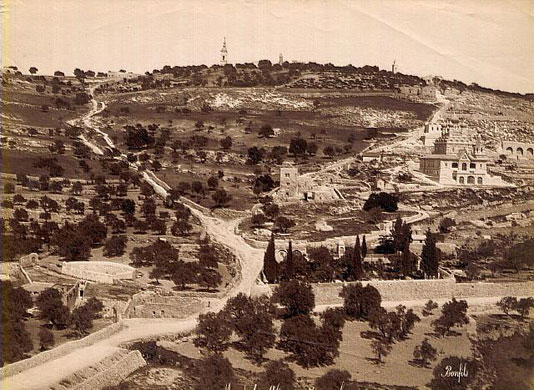
Israel-Palestine timeline: Mount of Olives, Jerusalem
1914-1918 The Ottomans - who had conquered the eastern Mediterranean in 1516 - sided with Germany during the first world war. Britain supported an Arab revolt against the Ottomans, promising self rule. The British also promised the Jews a homeland in Palestine – the then foreign secretary, Lord Balfour, issuing a declaration in 1917.

Pictured, temples and ruins on the Mount of Olives in the city of Jerusalem
Photograph: Michael Maslan/Corbis
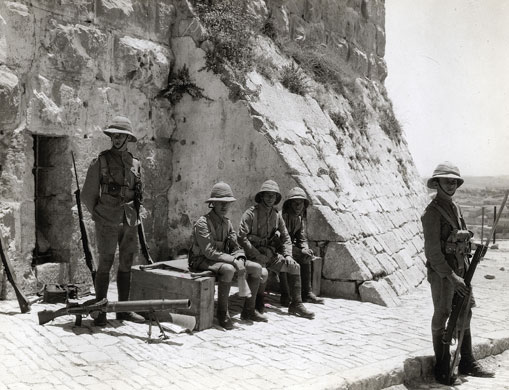
Israel-Palestine timeline: 1918. British Tommies At Jaffa Gate
1918 The Arabs took over Syria, led by Prince Faysal ibn Huseyn of the Arabian Hashemite dynasty. After the war, the League of Nations granted France and Britain control (‘mandates’) over the former Ottoman territories. France was given Syria, while Britain got a mandate over what became Israel, the West Bank, Gaza and Jordan.

Pictured, British soldiers at the Jaffa Gate
Photograph: Underwood & Underwood/Corbis
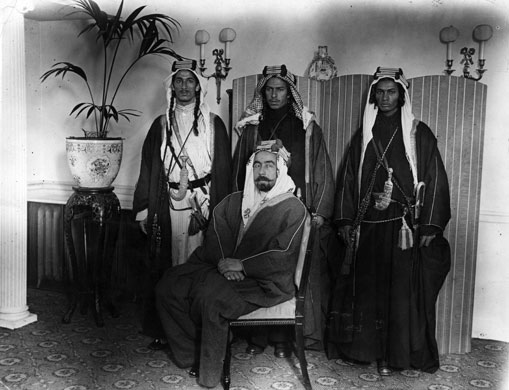
Israel-Palestine timeline: 1921. Emir of Transjordan and the ruler of Kerak, Abdullah Hussain
1921 The British divided their mandate in two. East of the river Jordan became the emirate of Transjordan and was ruled by Faysal’s brother Abdullah. West of the Jordan became the Palestine mandate and remained under British control.

Pictured, Emir of Transjordan and the ruler of Kerak, Abdullah Hussain with his three servants
Photograph: Topical Press Agency/Hulton Archive
Israel-Palestine timeline: 1930. Jewish survivors of the Buchenwald stand on the ship Mataroa
1930 Jewish immigration to what was now the Palestine mandate from Europe, which had been going on since the 1880s, increased just before the second world war due to persecution by the Nazis. The local Arabs wanted to limit the numbers arriving. There were clashes between the Jewish immigrants and Palestinians supported by neighbouring Arab states.

Pictured, Jewish survivors of the Buchenwald Nazi concentration camp, some still in their camp clothing, stand proudly on the deck of the refugee immigration ship Mataroa in 1945 at Haifa port, during the British Mandate of Palestine
Photograph: Zoltan Kluger/IGPO/Getty Images Europe
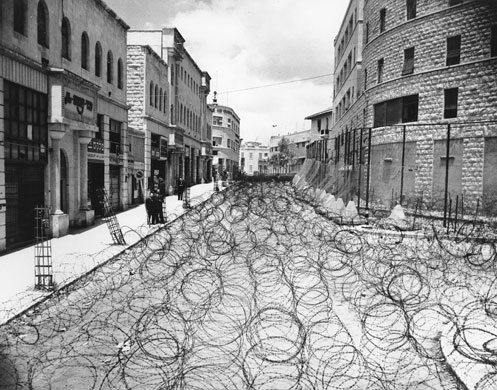
Israel-Palestine timeline: 1947-49. Barbed wire covers Princess Mary Avenue in Jerusalem
1947-49 Britain gave up its mandate and the United Nations took over supervision. The UN suggested two states: one Arab, one Jewish. The Jews accepted; the Arabs rejected the plan. David Ben-Gurion declared the foundation of the state of Israel on 15 May 1948. Egypt, Syria, Lebanon and Jordan invaded but were beaten back. The 1949 armistice extended the area the UN had proposed for the Jews.

Pictured, barbed wire covers Princess Mary Avenue in Jerusalem
Photograph: AP
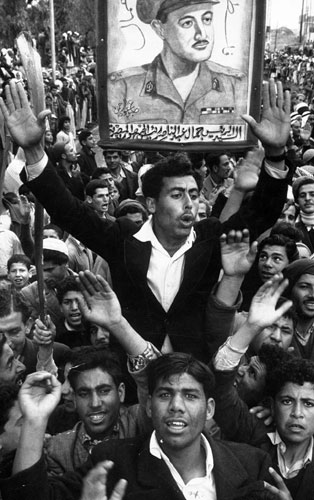
Israel-Palestine timeline: 1956. Crowds hold up a poster of their leader Gamal Abdul Nasser
1956 Gamal Abdel Nasser came to power in Egypt. He integrated the armies of Egypt and Syria and nationalised the European-owned Suez canal. Israel joined with Britain and France, and on 29 October 1956, invaded the Sinai peninsular in Egypt. International pressure forced the Israelis to give up Sinai and the UK and France to remove their troops from the Suez canal.

Pictured, crowds hold up a poster of Nasser
Photograph: James Whitmore/Time Life Pictures
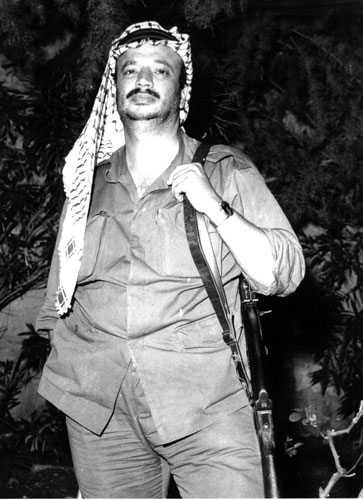
Israel-Palestine timeline: 1964. Yasser Arafat, chairman of Palestine Liberation Organisation
1964 The Palestinian Liberation Organisation was founded. Under the chairmanship of Yasser Arafat it would claim after the debacle of the six day war to be the sole representative of the Palestinian people. It vowed to reclaim their land and destroy the state of Israel.

Pictured, Arafat at a front line area in Jordan
Photograph: AP
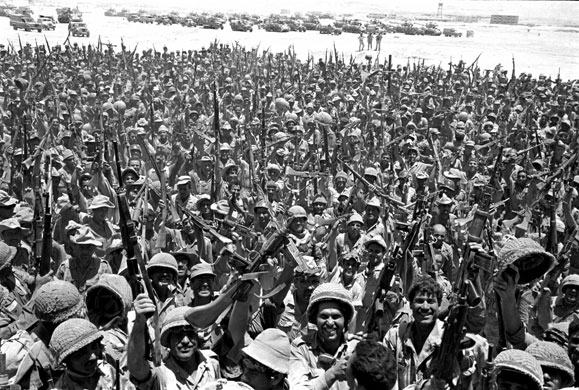
Israel-Palestine timeline: 1967. Israeli soldiers celebrate in Sinai during the Six Day War
1967 Hostilities between Israel and its neighbours continued and both sides built up their military strength. On 5 June 1967, Israel launched a 'pre-emptive strike' against the Arab troops along its borders. In the six-day war, Israel seized the Sinai from Egypt, the Golan Heights from Syria, the West Bank and the Old City of Jerusalem from Jordan. Talks have centered around the return to pre-1967 borders ever since.

Pictured, Israeli soldiers celebrate in the Sinai peninsula
Photograph: IMD
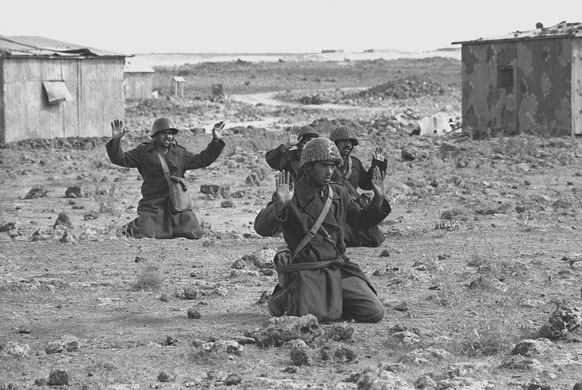
Israel-Palestine timeline: 1973. Syrian soldiers raise their hands in surrender on the Golan Heights
1973 On 6 October, Syria and Egypt launched a surprise attack on Israeli-held lands to coincide with the Jewish holy day of Yom Kippur. After initial losses, the Israelis regained nearly all the territory they occupied during the six-day war.

Pictured, Syrian soldiers raise their hands in surrender on the Golan Heights, five days into the Yom Kippur War
Photograph: Getty Images North America
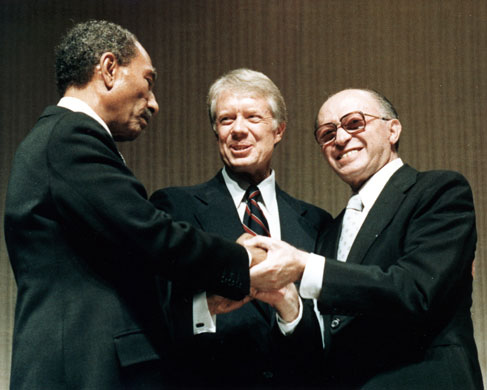
Israel-Palestine timeline: 1979. Anwar Sadat, Menachim Begin with President Carter
1979 The US combined diplomacy with financial muscle to soften relations between Egypt and Israel. In 1979, the Egyptian president, Anwar Sadat, signed a mutual recognition pact with Israel and Sinai was returned to Egypt

Pictured, Sadat, US president Jimmy Carter and Israeli prime minister Menachem Begin shake hands at the signing of the Camp David accords
Photograph: Bettmann/Corbis
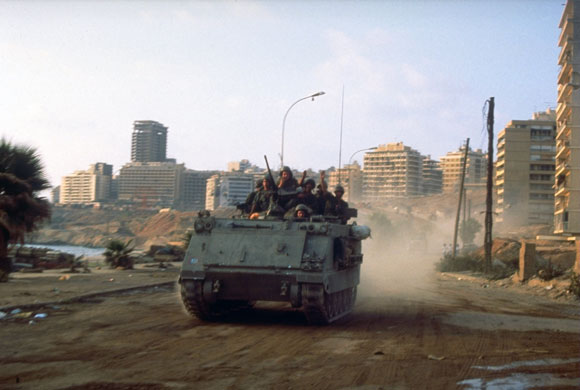
Israel-Palestine timeline: 1982. Israeli soldiers aboard APCs rumble through the streets of Beirut
1982 In response to terrorist attacks on northern towns, Israel invaded Lebanon as far north as Beirut on 6 June 1982. In 1985, Israel withdrew from most of Lebanon but maintained a 'security zone' along the border until 2000, policed by Israeli soldiers and members of the South Lebanese army.

Pictured, Israeli soldiers in Beirut during the invasion
Photograph: David Rubinger/ Time & Life Pictures/Getty Images
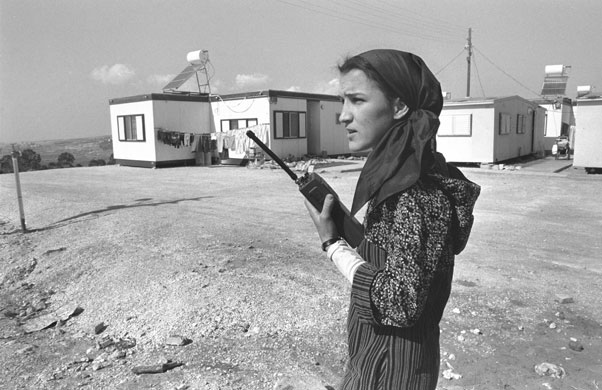
Israel-Palestine timeline: 1987. Establishment of Jewish settlements on Palestinian land continued
1987 During the early 1980s, the establishment of Jewish settlements on Palestinian land continued systematically. In 1987, the Palestinians in the West Bank and Gaza launched the intifada (popular uprising) against Israeli occupation.

Pictured, a woman from the Dolev settlement uses a walkie-talkie to communicate with the nearby settlers' regional council
Photograph: Getty Images
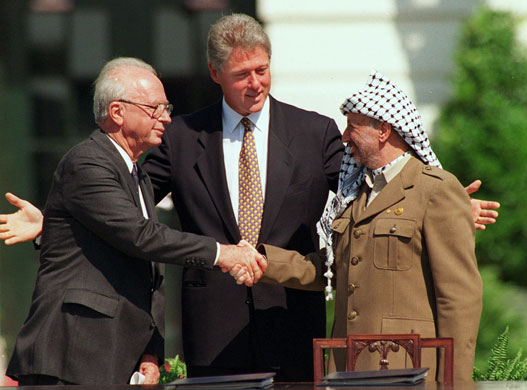
Israel-Palestine timeline: 1993: President Clinton presides over the signing of the 1993 peace accord
1993 The Oslo accords were agreed, which provided for mutual recognition between the PLO and the state of Israel, and limited Palestinian self rule in the West Bank and Gaza. Jordan signed a peace deal with Israel

Pictured, Bill Clinton presides over ceremonies marking the signing of the accord with Israeli prime pinister Yitzhak Rabin, left, Arafat, right
Photograph: Ron Edmonds/.AP
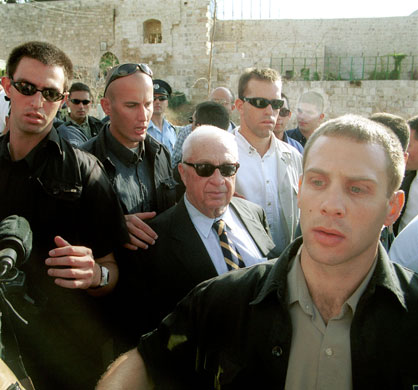
Israel-Palestine timeline: 2000. Opposition Leader Ariel Sharon visits Western Wall
2000 Attempts to reach a final settlement at Camp David hosted by Bill Clinton, with Yasser Arafat and Israeli prime minister Ehud Barak failed. The summit foundered on sovereignty over that part of the old city of Jerusalem known as the Temple Mount to Jews and Noble Sanctuary to Muslims. Ariel Sharon, leader of the rightwing Likud, meanwhile visited it escorted by 1,000 police. Designed to underscore Israeli sovereignty, the visit sparked violent demonstrations. The second Intifada began.

Pictured, Israeli security men guard Sharon as he leaves the sacred space
Photograph: Brian Hendler/Getty Images
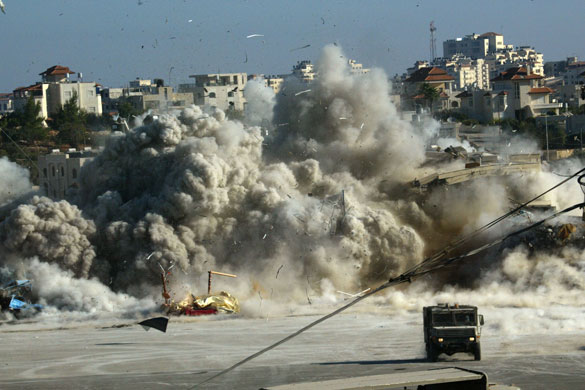
Israel-Palestine timeline: 2002. Israeli army blows up a building in Arafat's compound in Ramallah
2002 A suicide bomber killed 29 Israelis at a seaside hotel in the bloodiest single attack in the second Intifada. Israel isolated Arafat in his compound, called up military reserves and re-occupied wide areas of West Bank where Palestinians had gained self-rule under the Oslo accords. Israel began building its West Bank barrier. George Bush, who urged Palestinians to replace Arafat, outlined a 'road map' to a Palestinian state. Key elements included a stop to Palestinian attacks and a dismantlement of Israeli settlements built since March 2001.

Pictured, the Israeli army blows up a building in Arafat's West Bank compound
Photograph: Atta Oweisat/AFP
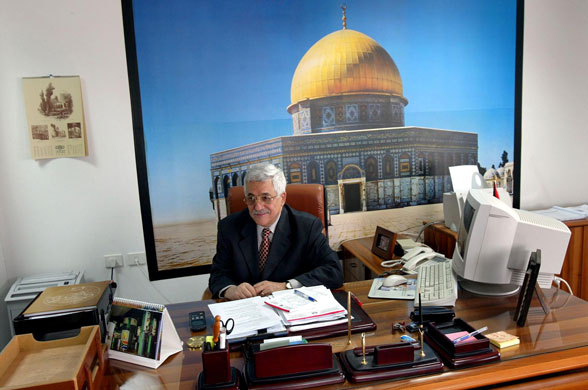
Israel-Palestine timeline: 2003. Mahmoud Abbas became Palestinian prime minister
2003 US-backed Mahmoud Abbas became the Palestinian prime minister.

Pictured, Abbas, also known as Abu Mazen, sits in his office in the West Bank city of Ramallah
Photograph: David Silverman/Getty Images
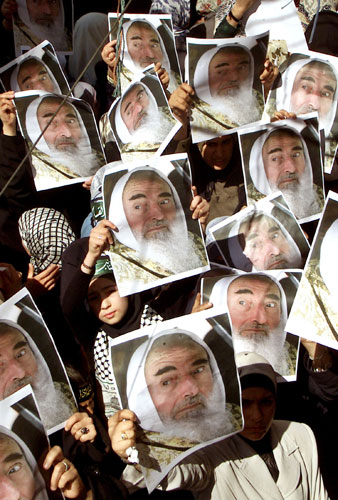
Israel-Palestine timeline: 2004. Palestinian refugees hold posters of Hamas Leader Sheikh Ahmed Yassin
2004 Israel assassinated Sheikh Ahmed Yassin, co-founder of Hamas in Gaza City. Yassin’s successor, Abdel Aziz al-Rantissi, was killed in similar missile strike a month later. Arafat died on 11 November. Mahmoud Abbas succeeded him as PLO chairman and won election as president on platform of halting violence and making peace with Israel.

Pictured, Palestinian refugees in Lebanon hold posters of Sheikh Yassin
Photograph: Ali Hashisho/Reuters
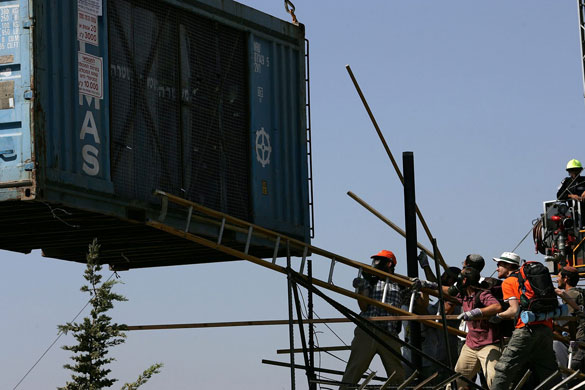
Israel-Palestine timeline: 2005. Israeli West Bank Settlements evacuated by force
2005 Sharon and Abbas announced a ceasefire (with Abbas persuading militant factions to observe an informal calm at least until the end of 2005). Violence subsides. Israel completed an evacuation of 15,000 Jewish settlers from Gaza - after 38 years of occupation - but Palestinian rocket salvoes from Gaza followed, prompting renewed Israeli air strikes. Sharon left Likud and formed Kadima, a new party that was intended to give him a freer hand to deal with the Palestinians.

Pictured, settlers and activists attempt to fend off a shipping container carrying police at the West Bank settlement of Sanur, one of the four in the territory alongside the 21 in Gaza marked for dismantlement
Photograph: Spencer Platt/Getty Images Europe
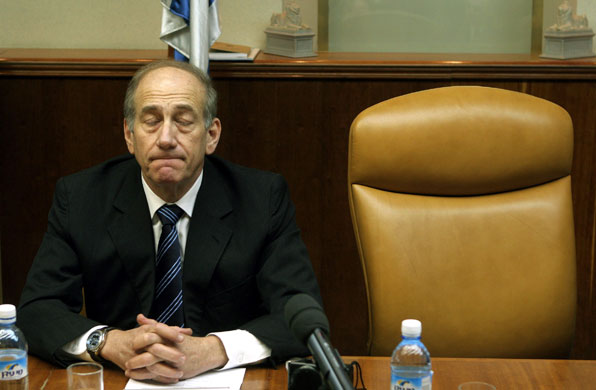
Israel-Palestine timeline: 2006. Ehud Olmert sits next to Ariel Sharon's empty chair
2006, January The political landscape changed in both Israel and the Palestinian territories. Sharon was in a coma after a massive brain haemorrhage, his powers transferring to Ehud Olmert. Hamas then trounced Fatah in parliamentary elections. The two eventually formed an uneasy (and short-lived) coalition with Hamas' Ismail Haniyeh as PM and Fatah's Abbas as president. Israel refused to deal with it, citing Hamas' non-recognition of Israel.

Pictured, Olmert sits next to Sharon's empty chair during an emergency cabinet meeting
Photograph: Lior Mizrahi/Reuters
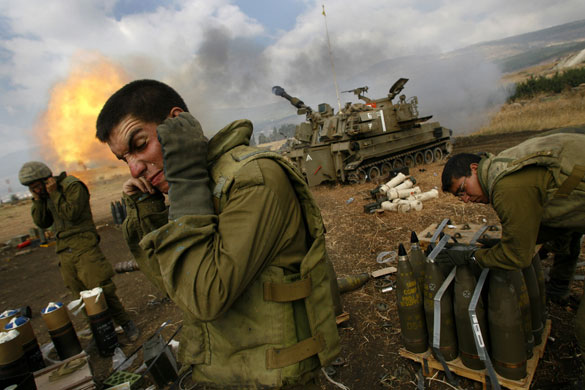
Israel-Palestine timeline: 2006. Israeli soldiers cover their ears as an artillery unit fires shells
2006, July Israel fought Hizbullah in a month-long war that caused at least 1,100 Lebanese and 156 Israeli deaths. The conflict began when Hizbullah ambushed, killed and kidnapped members of a patrol on the Israeli side of the border. The official Israeli commission that investigated it said it ended without a 'defined military victory'.

Pictured, Israeli soldiers fire shells towards southern Lebanon
Photograph: David Guttenfelder/AP
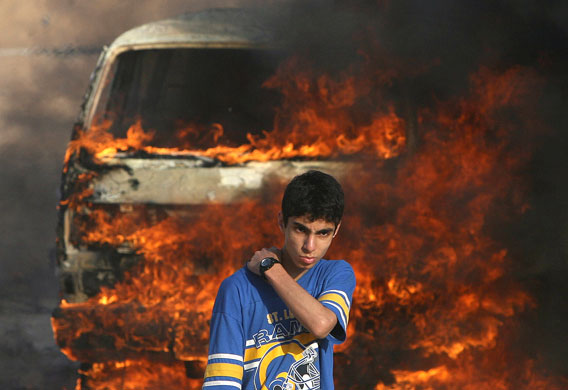
Israel-Palestine timeline: 2007. A Palestinian youth during clashes between Fatah and Hamas in Gaza
2007 The Fatah-Hamas coalition collapsed when Hamas took control of Gaza in bloody battles that left hundreds dead. Israel declared it a 'hostile territory' and cut fuel and electricity supplies. The political and territorial split - which continiues to this day - means Hamas controls Gaza while Fatah under Abbas controls the West Bank. In the US, Bush hosted a Middle East peace conference in Annapolis, Maryland. It was first US attempt in seven years to broker a deal.

Pictured, a Palestinian youth stands in front of a burning vehicle during Fatah-Hamas clashes
Photograph: Mohammed Abed/AFP
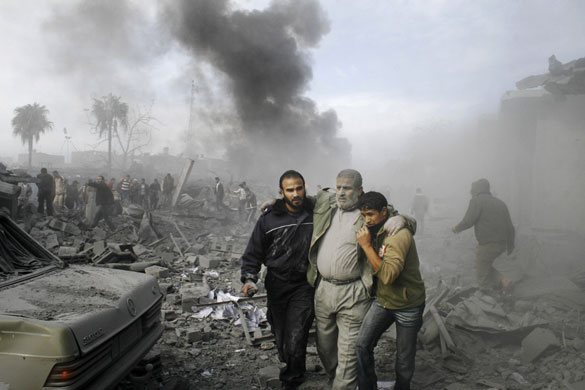
Israel-Palestine timeline: 2008. An injured Palestinian after an Israeli missile strike in Rafah
2008 and 2009 Hamas-controlled and Israel-blockaded Gaza was subjected to two major offensives following rocket attacks on southern Israel. The first, in February 2008, killed more than 120 Palestinians; the second, in December 2008 and January 2009, left more than 1,300 Palestinians and 13 Israelis dead before a ceasefire was agreed. The next month Binyamin Netanyahu's Likud won the general election and went into coalition with extreme rightwinger Avigdor Lieberman and Ehud Barak of Labour. New US president Barack Obama and secretary of state Hillary Clinton made efforts to find an Israeli-Palestinian peace.

Pictured, an injured Palestinian is helped from the rubble following an Israeli missile strike on Rafah in December 2008
Photograph: Hatem Omar/AP
Sign up to read this article
Read news from 100’s of titles, curated specifically for you.
Already a member? Sign in here
Related Stories
Top stories on inkl right now
One subscription that gives you access to news from hundreds of sites
Already a member? Sign in here
Our Picks
Fourteen days free
Download the app
One app. One membership.
100+ trusted global sources.