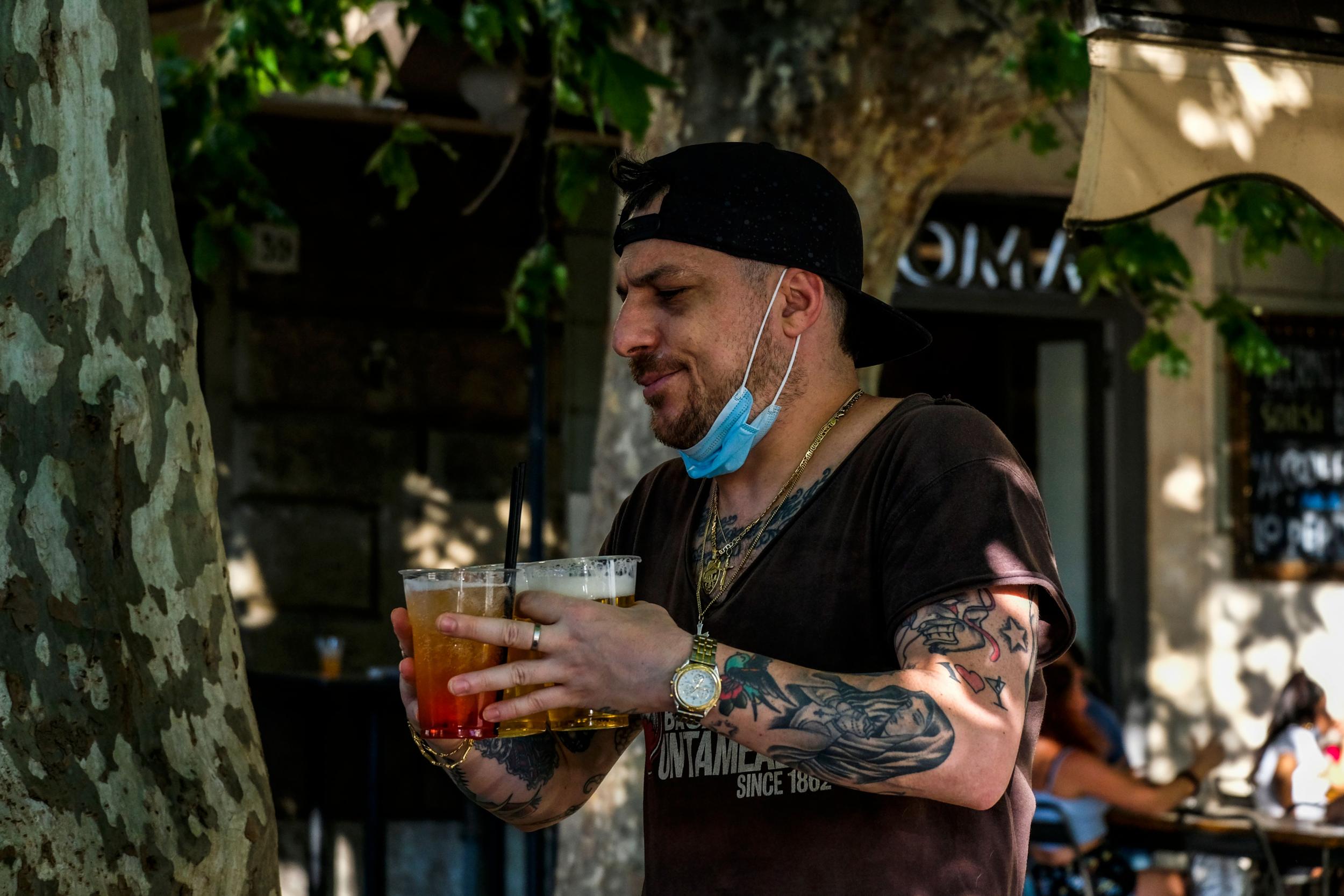
Drawn outdoors by ideal weather, Italians this weekend gathered at beaches, bars and piazzas, drinking and sometimes flouting social distancing rules while soaking in the nation’s celebratory post-lockdown mood.
But on Monday, as images of nightlife played on Italian TV, a chorus of politicians warned that the country had gotten reckless and risked backsliding in its fight against the coronavirus.
“This weekend has not been serene,” Giuseppe Sala, the mayor of Milan, said in a message posted on Facebook. “We cannot imagine another one like it.”
The quick resumption of nightlife from Milan to Naples came as a reminder that even countries deeply scarred by the virus might struggle to put a prolonged cap on crowds and carefree socialising.
On Monday, Milan was just one of the Italian cities and towns that tried to impose fresh restrictions, banning the sale of takeaway alcoholic drinks after 7pm. A mayor in southern Puglia said he was shutting down a beach until the end of the month, as a way to “stem the invasion of last weekend”.
“The appeal to common sense hasn’t worked,” the mayor of Pulsano, Francesco Lupoli, said.
In what amounted to a public service announcement, the governor of the northern Veneto region, Luca Zaia, shared a video on social media showing images of people shaking hands, having drinks with masks worn like necklaces, before cutting away to an image of somebody in a hospital bed. “Covid-19 is fought in hospitals,” the message said at the end, “but above all outside.”
Since their country emerged in late February as the epicentre of the European outbreak, Italians have been largely committed to following the rules, abiding by a tight lockdown that banned people from regularly venturing outdoors. But the country has moved quickly in unwinding its restrictions. Many factories and construction projects restarted on 4 May. Beaches, restaurants and bars reopened on 18 May, as did museums.
When Italy began emerging from lockdown, Prime Minister Giuseppe Conte said that the months ahead depended on the behaviour of Italians. “We take upon ourselves the risk of an opening, but with all precautions,” he said.
For now, Italy has not seen any spikes in the virus; deaths, hospitalisations and new cases are down substantially from the peak in late-March. But government advisers and virologists say it will take several weeks to fully discern the consequences of the eased restrictions.
Italians remain banned from travelling to other regions, though the government intends to lift that restriction in early June.
But in an interview with La Stampa, Italy’s minister of regional affairs, Francesco Boccia, a member of the Italian Chamber of Deputies, suggested such a timetable could be reconsidered – in what would be another major blow to the country’s tourism industry. He said a decision would depend on the number of new infections.
“We aren’t surprised by what happened this weekend, but although it is understandable and human after two months to get out of home, we must not forget that we are still inside the Covid (pandemic), and thus those who feed the nightlife are betraying the sacrifices made by millions of Italians,” Mr Boccia said.
Mr Boccia also floated the idea of recruiting 60,000 volunteers to monitor the streets and enforce social distancing. But many Italian politicians, both in the governing coalition and in the opposition, called the idea problematic or unfeasible. Mr Zaia said he hoped people who wanted to socialise could simply use better judgment.
“Sending somebody to explain you need to wear a mask means there is a cultural problem,” Mr Zaia said, according to the Italian news agency ANSA.
The Washington Post