Back story
Today, 41,000 girls around the world will be married against their will. Denied their right to choose if, who and when they marry, they will probably drop out of education and face the twin risks of sexual violence and early pregnancy.
Child marriage has long been recognised as a most fundamental abuse of a girl’s human rights – yet it’s a global problem that here in the UK we’ve stopped talking about. It’s something we’re all vaguely aware of but that we may not properly understand. Something to which we’ve even become a little bit numb, perhaps.
And yet our experience supporting girls in 50 countries around the world tells us that – more than many challenges that girls face – marrying as a child has a pervasive impact on a girl’s chances of living a healthy, happy and fulfilling life.
That’s why, through the latest phase in Plan UK’s flagship Because I am a Girl campaign, we’ve decided to tackle child marriage head on and make sure it’s one issue the UK public can’t forget about.
Aims
If an ad campaign can be compared to grabbing a weary commuter by the shoulders and giving them a good shake, then that is our aim. We want to get the public thinking and talking about child marriage – to get the problem into their head and compel them to engage with it.
And once engaged, our mission is to make clear that at Plan we have solutions to the problem and that, crucially, through small, simple actions, they can play a part in them. We want them to support us in taking a stand, achieving something not only with their cash but with their influence, too.
Our approach therefore is to integrate a fundraising campaign with an awareness and engagement campaign. So as well as financially supporting our Girls Fund projects (on preventing child marriage, FGM and other forms of violence against girls), the campaign aims to inspire advocates for our work. We want to reach people who care, who want to do something to end child marriage and want to inspire others to do the same. The funds are also set to enable a new Girls Fund project to open aiming to reduce child marriage in five high risk areas in Tanzania, working with 1,300 adolescent girls.
Strategy
Every day the public are bombarded with competing messages from different charities; you have just a few seconds to make an impact. Like any NGO in a crowded marketplace, we are always looking for fresh ways to get the public’s attention. This campaign is an opportunity to experiment with a new approach for Plan – namely to be more provocative in our publicity material as we believe this can increase our impact.
The merits and drawbacks of provocation as a marketing technique are well debated. But there’s no denying that controversy can work, and we decided in this instance to move away from a more typical depiction of a girl from the developing world in need. In this context, it’s worth highlighting a difference between abject shock tactics and smart provocation. Our aim here is to provoke thoughtful reaction: we believe this will better meet our combined fundraising, influence and campaigning targets.
A sensitive issue such as child marriage requires careful, clever treatment. We need to draw attention to the issue – indeed we believe we have a responsibility to do so – without detracting from the authenticity of the need and without stripping those affected of their dignity.
Therein lies the crux of modern charity marketing. More than ever, with the various and often competing pressures – particularly in integrated campaigns that combine our need to raise money, to raise awareness and to influence decision makers – we must define our own values and red lines. With a more cynical, better informed and hard-pressed public, this question, which goes to the core of our identity and mission as a charity, demands a clear and confident answer.
Execution
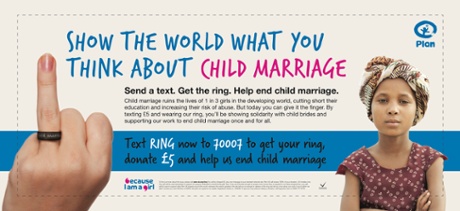
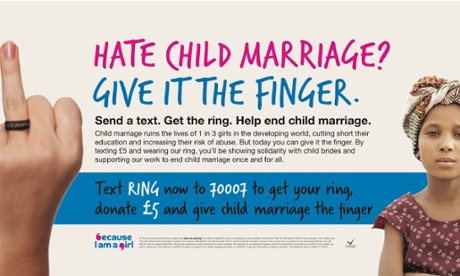
And so “give child marriage the finger” was born – and the associated idea of wearing a ring to show support for ending the practice. Cheeky and a bit rude? Certainly. But also, by referencing what people in the UK positively associate with weddings and marriage, nuanced and smart.
The ring mechanic in particular is judged to be a clever extension of the classic text donation ad. It’s an incentive to give, but more importantly it’s a driver of further engagement. Like a wristband or a ribbon, the ring is a public show of support, a conversation prompt and an easy social media share. Unlike those, it has an inherent link to the subject matter of the campaign. Combined, the text donation and the ring empower supporters; their financial support for on-the-ground programmes is enhanced by their public commitment to the cause here in the UK.
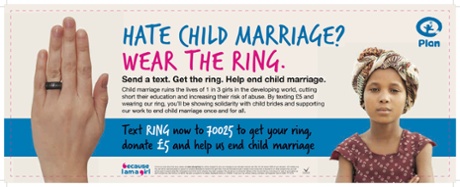
The cheekiness of the ad carried some risks. The “give the finger” creative proved too much for some traditional advertising channels including the London underground and some train networks, on grounds of obscenity. We knew that was a risk and had planned accordingly. Firstly, we also targeted digital channels which allowed us more room for manoeuvre. In terms of the train ads, we speedily prepared new advertising with the key feature – the ring – remaining at the heart. With the original ads still running elsewhere, we will have an interesting test case on our hands about public reactions to different levels of provocation.
Results
Will the compromise we had to make lessen the effectiveness of the campaign? We’re already seeing lower response from the adapted ads. But we are confident about the performance of other channels, and across the board, the follow-up conversations we’ve been having with those who have engaged with the ads have been positive. As we’d hoped, the ring is proving an excellent means for engaging our target audiences with the issue and prompting regular donations from engaged, thoughtful donors – people who want to use their voice as well as their wallet.
Mike Thiedke is director of public engagement at Plan UK. Follow @PlanUK on Twitter.
Do you work for an NGO that’s run an unusual campaign? Email globaldevpros@theguardian.com to tell us why it should feature in this series.
Join our community of development professionals and humanitarians. Follow@GuardianGDP on Twitter.