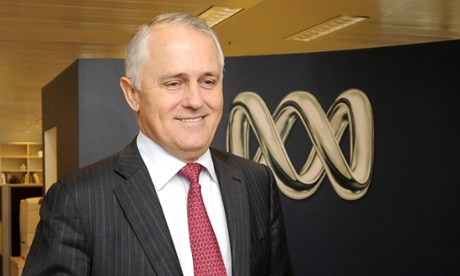
If nothing else, Turnbull’s announcement of cuts to the ABC and SBS might finally give pause to lefties who deep down think he’s their friend. Sure, he looks rather dashing in a leather jacket. But he’s been in the cabinet room for every decision this government has taken, and nothing that has gone on in there — the imprisonment of refugee children, punitive welfare cuts — has made him reconsider his position.
Why should the ABC be any different? Turnbull can wear a hangdog look, but he’s still swinging the hatchet handed to him. The rule of thumb stands with very few exceptions: good men do not serve as Coalition ministers.
Turnbull has tried to sugar-coat the decision. He has offered repeated reassurances about programming that aren’t his to make. In response, and within the limits imposed by his position, ABC managing director Mark Scott has made it clear that he’s hopping mad. He pointed out that given that there is no provision for redundancies, and on top of measures announced in May’s wildly popular federal budget, the cumulative impact of cuts will likely amount to around 8% a year. The ABC thinks 500 jobs will be lost. It’s hard to imagine that relatively marginal parts of the operation, like Radio National, won’t come under increasing scrutiny.
There’s no doubt that the cuts will encounter resistance. So far, not all of it has come from the usual suspects. Christopher Pyne gave us the gift of laughter yesterday when he started hawking a petition demanding the ABC maintain inefficient in-house production in South Australia. He may not be the only Liberal MP in an affluent, urban, older electorate — or for that matter in media-poor rural areas — who finds themselves discomfited by questions from their constituents. There may be some small comfort in imagining the blowtorch of electoral indignation leading some government MPs to selectively campaign against the consequences of their own policies.
The liberal left is preparing to take up the cudgels on behalf of the ABC and SBS, and there are good reasons to do so. The main one is that without it, Australia’s public sphere would be fatally diminished. But before we take to the barricades, we should ask ourselves what we are fighting for and why. Even if the government’s cuts are somehow reversed, the questions being asked here and abroad about public broadcasting will not go away.
In a world of limitless information, what is the long term purpose of public broadcasting? When we can follow the bombing of Gaza via on-the-ground Twitter accounts, does the ABC really need a network of foreign correspondents or a 24-hour news channel? As on-demand content becomes more easily available, do we need a dedicated pipeline for prestige overseas content? In an age of viral culture, why do the same old faces crop up again and again in the ABC’s entertainment roster?
When, despite its best efforts, the audience for mainstream ABC broadcast content skews towards retirement age, what will the constituency be in 10 years for whatever is saved now? As Turnbull acknowledged yesterday, the ABC’s charter affords it some protection from the brutal calculus of the ratings game, but a billion dollar media enterprise is not going to survive as a nursing home diversion for baby boomers.
It would be a mistake, even as an emergency measure, to reactively seek to protect the ABC as it has been, and to pretend that its model is viable into the future. This is not about top-down restructuring on the model proposed by Mark Scott — where silos based on media will be broken down and the organisation rearranged on the basis of genre. Rather, we need to think about the relationship that needs to exist between public broadcasters and us, their public. This means putting everything on the table, and being imaginative, not merely defensive.
While ABC staff frequently have close and relationships with their audiences, corporate management structures are remote and stubbornly undemocratic. Turnbull would only like to make them more so. What about a radically decentralised ABC, where local stations are not just responsive to audiences, but responsible to them by means of local structures of governance?
Younger audiences just don’t appear to get much value from broadcast formats and genres. If the notion of youth programming hosted and curated by older people is too patronising, why not hand young people the reins and directly support them to produce this material themselves? It has done wonders at Triple J.
If current affairs has become bogged down in ritualistic political interviews and press gallery groupthink, why not do more to directly incorporate the voices and demands of the Australian community — to allow citizens, rather than the political-media complex to set the agenda? Why, when the ABC is at risk of being degraded to the point where it is unrecoverable, are we too timid to imagine what it might like if it really were ours?