Steven Spielberg’s Cold War spy-swap drama Bridge of Spies is a movie of glorious craftsmanship, human sympathy and flair. It’s a consciously old-fashioned piece of Hollywood storytelling conceived in something like the heartfelt, ingenuous style of Frank Capra. Where once we had Mr Smith Goes To Washington — here we have Mr Hanks Goes To West Berlin.
The movie is based on a real-life story: in 1962, America planned to recover Gary Powers, the U2 spy-plane pilot captured by the Soviets, by handing over their own incarcerated Russian spy Rudolf Abel, an agonisingly tense deal that could go wrong at any time. The screenplay is co-credited to British dramatist Matt Charmian and to Joel and Ethan Coen, who have presumably created some of the movie’s more crepuscular and black-comic scenes. (Where there’s a hit there’s a writ they say, and this movie is now subject to legal action from the British author Giles Whittell, who also wrote non-fiction a book about these events.)
The deal was brokered by the American lawyer Thomas B Donovan, played by Tom Hanks, who had earlier accepted the poisoned chalice of representing Abel in court when this Soviet spy was caught and convicted. Abel is played by Mark Rylance, whose distinctive charisma and light, musical voice is just right for making this character opaque and unreadable: not a bad guy, though certainly not a good guy in any accepted sense. (Hanks has the dibs on that.) He is certainly an elegant, eccentric foil to the plainspeaking candour of Hanks’s American lawyer. Repeatedly, Donovan will ask Abel in his prison cell: “Aren’t you worried?” and Abel will deadpan: “Would it help?”
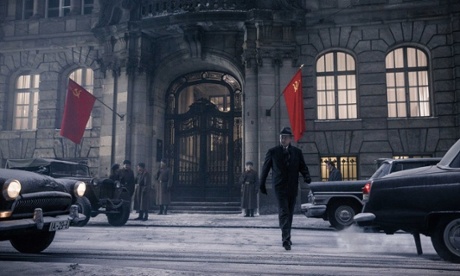
Spielberg immerses the audience in an entire, created world of 60s Berlin and 60s New York, and his movie hits its confident stride right away. The “chase” sequence at the very beginning, in which Abel is pursued through the subway system, is a veritable masterclass in film-making — supremely confident and yet understated.
What is so striking about this kind of story is that, rightly or wrongly, I think audiences here will be used to the John Le Carre way of thinking about it — the drab, exhausted and cynical world of moral equivalence and the balance of power: each side believes its ideology is superior, of course, but appreciates how the nuclear balance and balance of ideological belief is keeping a kind of peace. Somehow, Spielberg conjures from this world something very different from Le Carre: he uncovers old-fashioned, uncomplicated decency and moral courage in this situation and even a kind of covert diplomatic entrepreneurialism. The movie and Hanks’s performance itself is a richly satisfying mix: just the right amount of hokum — homely, wily and kindly. It’s the work of a master.