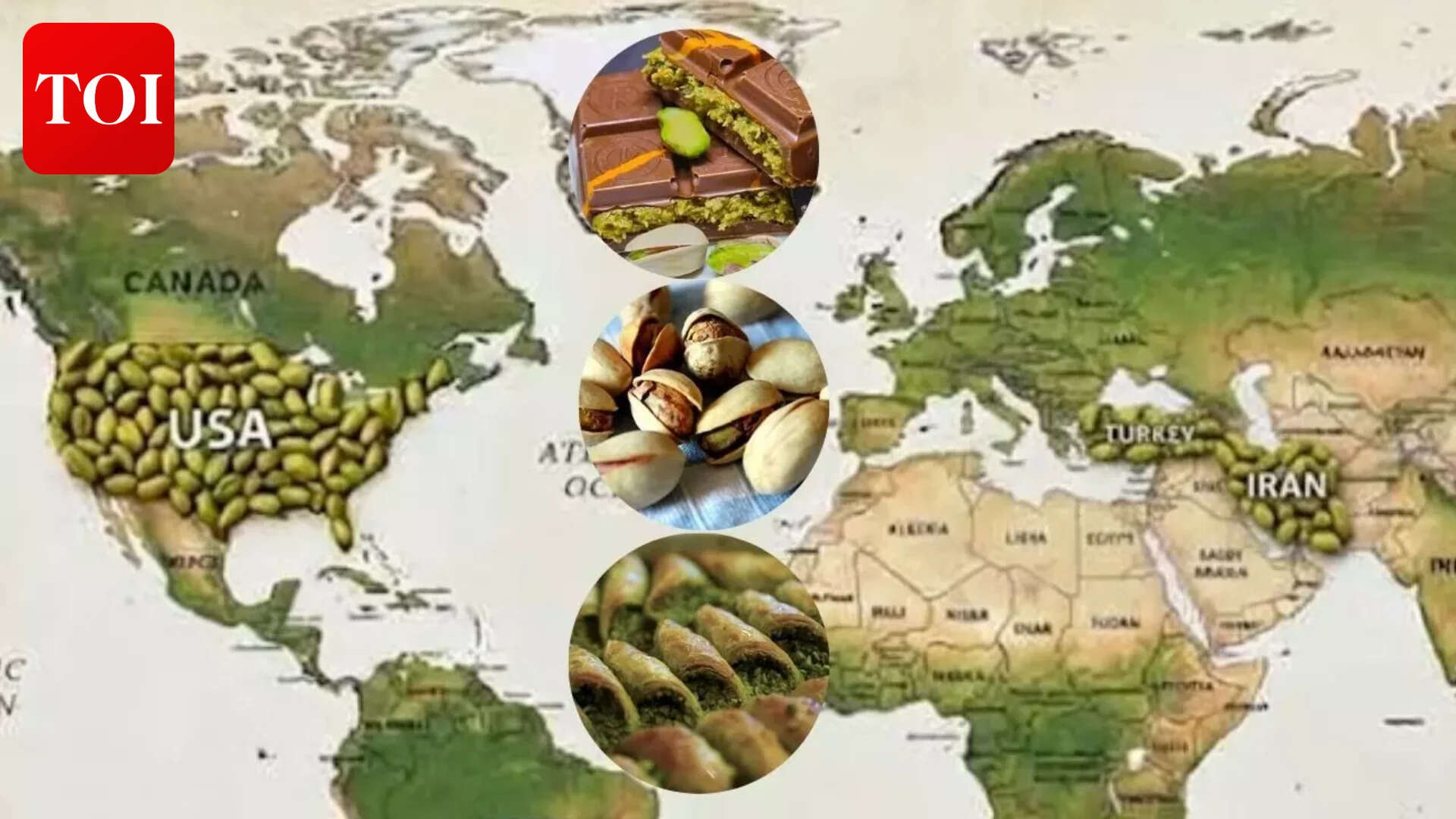
The world of the pistachio is currently going nuts. Often known as "green gold," the nuts' industry is currently defined by a high-stakes tug-of-war between three global titans: the United States, Iran and Türkey. Together these three nations control over 85% of the world's pistachio production, thus exerting heavy control over the availability of your favourite Dubai Kunafa chocolate and Turkish baklava.
However, as of March 2026, the landscape of this multi-billion-dollar industry is being radically reshaped, not just by agricultural cycles but also by the drums of war sending away any hopes of recovery with the ever-tightening grip of economic sanctions.
For decades, Iran was the undisputed ruler of pistachios, providing the world with the beloved salty nut. But today, as it finds itself embroiled in a deepening conflict, its seat at the top is being threatened by competitors located in California in the US and Gaziantep in Türkey.
The green trio
The global pistachio market is currently valued at $5.49 billion in 2026 and is expected to reach $7.02 billion by 2031, as per a report by Mordor Intelligence. Unlike its fellow competitors including almonds and walnuts, pistachios can not be grown in dozens of countries, as they thrive in specific arid climates and thus have a concentrated supply chain across the globe.
-
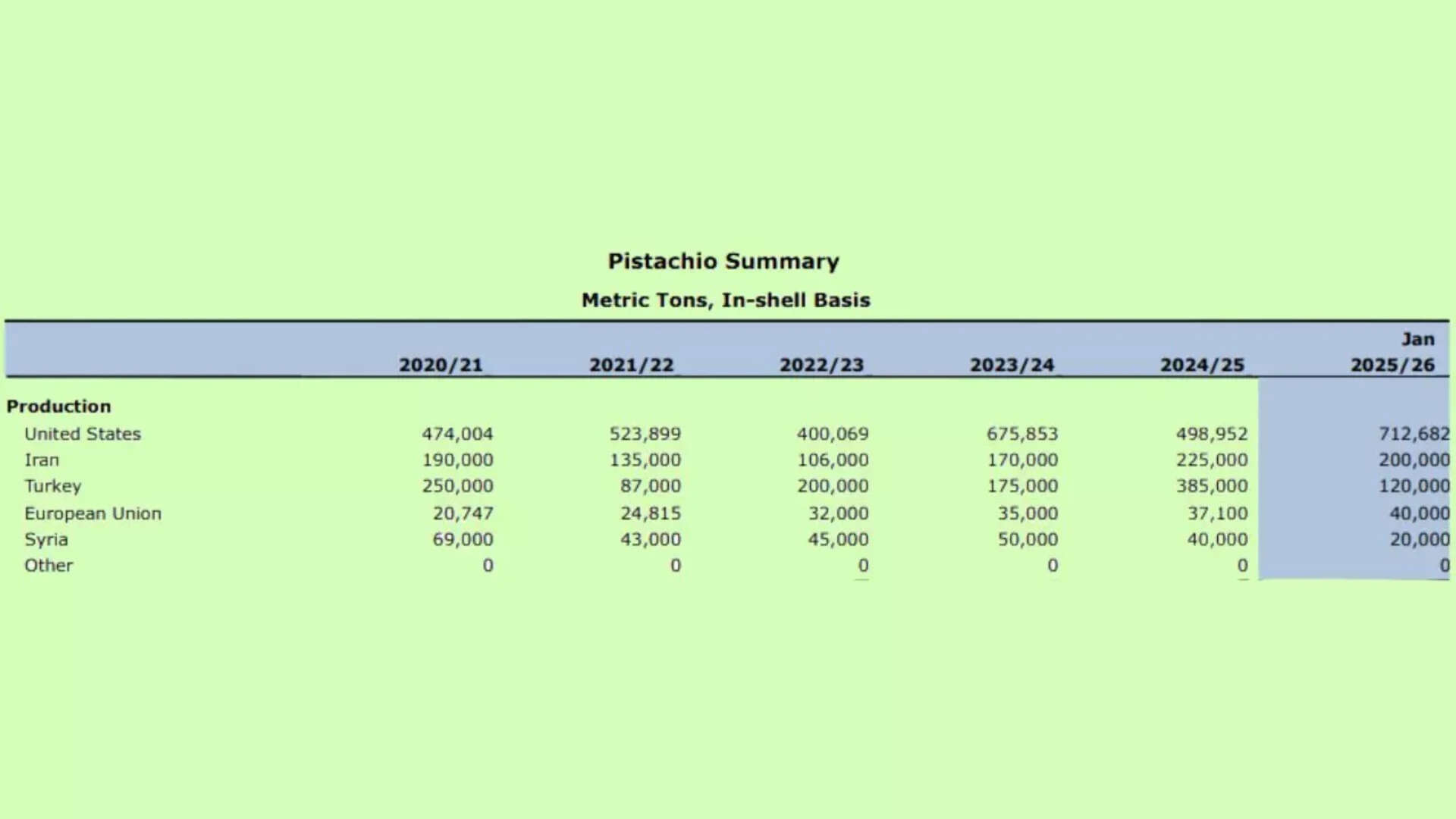
Iran: Iran is the historical heartland of the nut, producing the prized varieties of Kerman and Akbari, popular for their oil content and rich flavour. While its production of dried in-shell nuts was approximately 225,000 metric tons in 2024, it fell to 200,000 metric tons in 2026.
-
Türkey: Türkey's production of the nut is distinct, focused on the smaller, greener Antep pistachio used in the world-renowned baklava. In 2024, the country produced 385,000 metric tons of pistachios as per USDA data. However, its industry is heavily geared towards domestic consumption and specialised exports.
-
US: Centred in California’s San Joaquin Valley, the U.S. has transformed from a minor player in the 1970s to the world’s leading producer. In the 2025/26 season, U.S. production hit a record 712,000 metric tons, accounting for roughly 65% of global output.
Iran's "empty shell" crisis
As of 2026, the Iranian pistachio empire has been facing an existential threat. Military escalations in the region have moved beyond the political rhetoric to affect the economy. According to Global Data, the country temporarily banned the export of all "food and agricultural products" in order to ensure the supply to its own people.
The war on Iran has created three major bottlenecks for the country to be able to continue its pistachio trade:
-
Logistical paralysis: With the ongoing conflict, shipping routes have become treacherous. Moreover, insurance premiums for cargo leaving Iranian ports have tripled, making the nut extremely expensive for buyers in Europe and Asia.
-
Infrastructural problems: With constant power outages and disruptions in irrigation, the crop for the year may be ravaged enough to not be saved. While Iranian farmers tend to use minimal irrigation for their crops, there has been a report of a higher share of blank nuts with smaller sizes.
-
Financial isolation: A majority of sanctions prevent Iranian exporters from partaking in the SWIFT banking system. While some trading still flows through the UAE and Turkish ports, the complexity and risks of these transactions act as a "shadow tax" on every ton sold.
America reaps the harvest
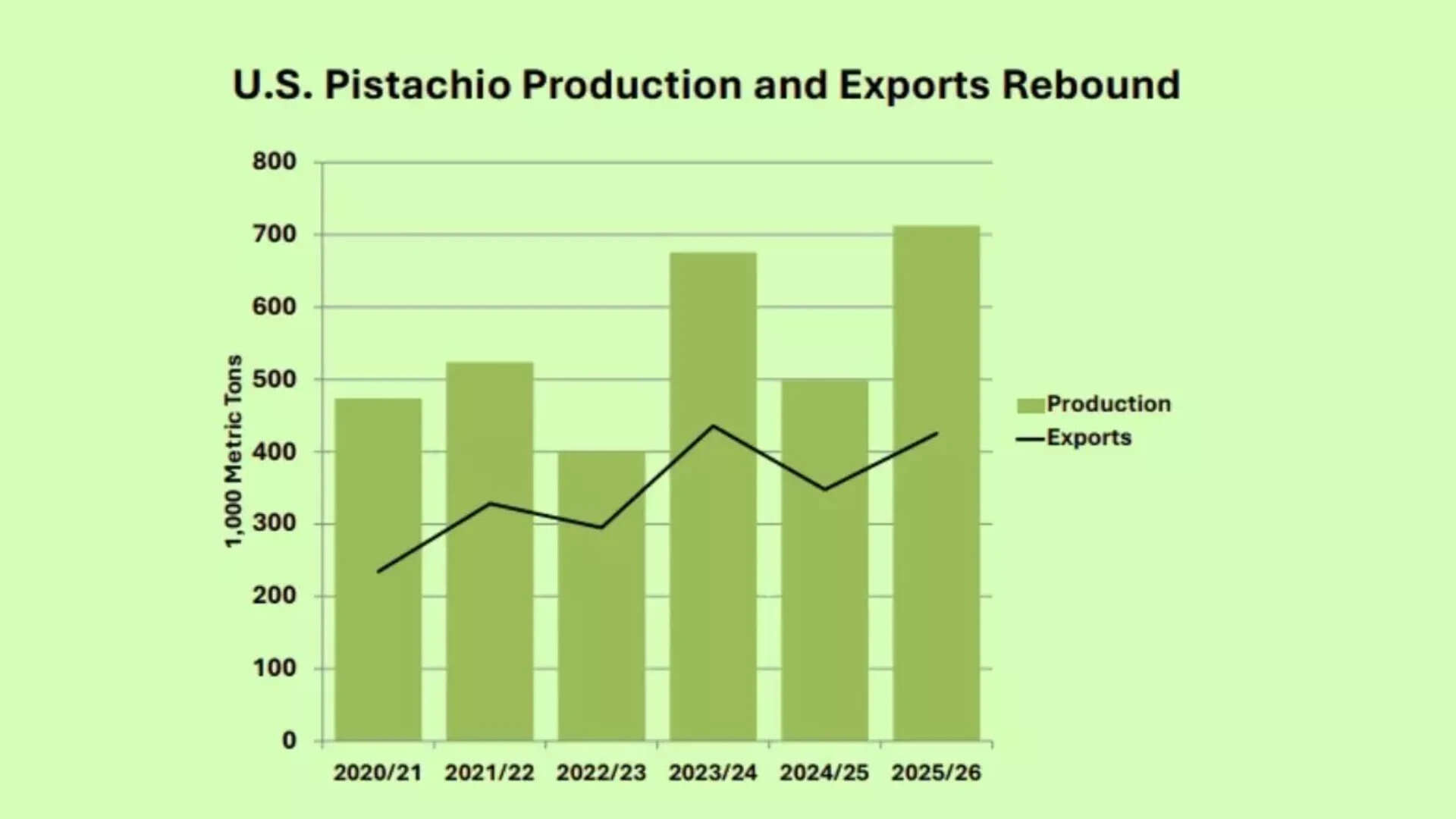
The United States is the primary beneficiary of Iran's decline. For American farmers, the timing of the Iranian crisis aligns with a "record crop" year in California.
According to USDA Data from February 2026, American exports of pistachios are expected to rebound by over 20% this year to a near-record 425,000 tons. Moreover, reduced outputs from Iran, Türkey, and Syria are expected to stimulate US shipments to top markets in Asia and Europe.
The shift is not just about volume, but about reliability. International buyers in Germany and China, formerly major importers of Iranian pistachios, are increasingly favouring U.S. origins to avoid the "aflatoxin concerns" and "logistical risks" associated with Iranian supply.
According to Bloomberg Opinion, per capita consumption of pistachios in the US has tripled. Add to that the fact that American companies like The Wonderful Company have gained long-term contracts, and the pistachio war may be too difficult for Iran to win back.
Not just now, America has historically benefited from bottlenecking Iran's pistachio trade. The nut came to the United States from the Middle Eastern country in 1929, brought by botanist William E. Whitehouse and planted in California. Kerman a variety sold by Iran grew well and began to be distributed around the state.
Through the years, America has not only grown in its crop production but also strategically hindered Iran's exports. It began with the 1979 Iranian revolution when Iranian students seized the US Embassy in Tehran taking American diplomats and staff hostage. The 444-day standoff saw 52 hostages held until January 1981, severely damaging US-Iran relations. Since then, US has imposed restrictions on activities with Iran, lifting them at times, but majorly maintaining the stance, to date. Moreover, as per Bloomberg Opinion, since 1986 there has been a 241% tariff on Iranian pistachios, further crumbling the industry.
Türkey: The benefiting middleman
Türkey occupies what can be explained as the most strategic place in this conflict. On one hand it is one of the leading competitors, on the other, it is a vital trade corridor.
As the world's third-largest producer, it benefits from the rising global prices triggered by the Iranian shortages. With global pistachio prices expected to see a double-digit rise in 2026, Turkish exporters can reap from the "green gold" now more than ever.
Moreover, the troubles in Iranian shipments will also be beneficial for the country. Türkey has historically served as a "laundry" for Iranian goods. Pistachios from Iran are often shipped to Türkey, processed and then re-exported as Middle Eastern products to bypass direct sanctions.
The pistachio wars: Who wins?
The "pistachio wars" demonstrate a harsh reality of global trade: one nation's geopolitical tragedy is another's agricultural windfall. While the U.S. and Turkey are seeing their "Revealed Comparative Advantage" (RCA) indices rise, Iran’s share of the global pie is shrinking to levels not seen in half a century.
Establishing a pistachio orchard takes about 5 to 7 years before the first harvest. As Iranian farms lose the capital to maintain their farms and security to harvest them, the transfer of pistachio powers to US and Türkey seem less of a temporary fluctuation and more of a permanent shift in the global economy.