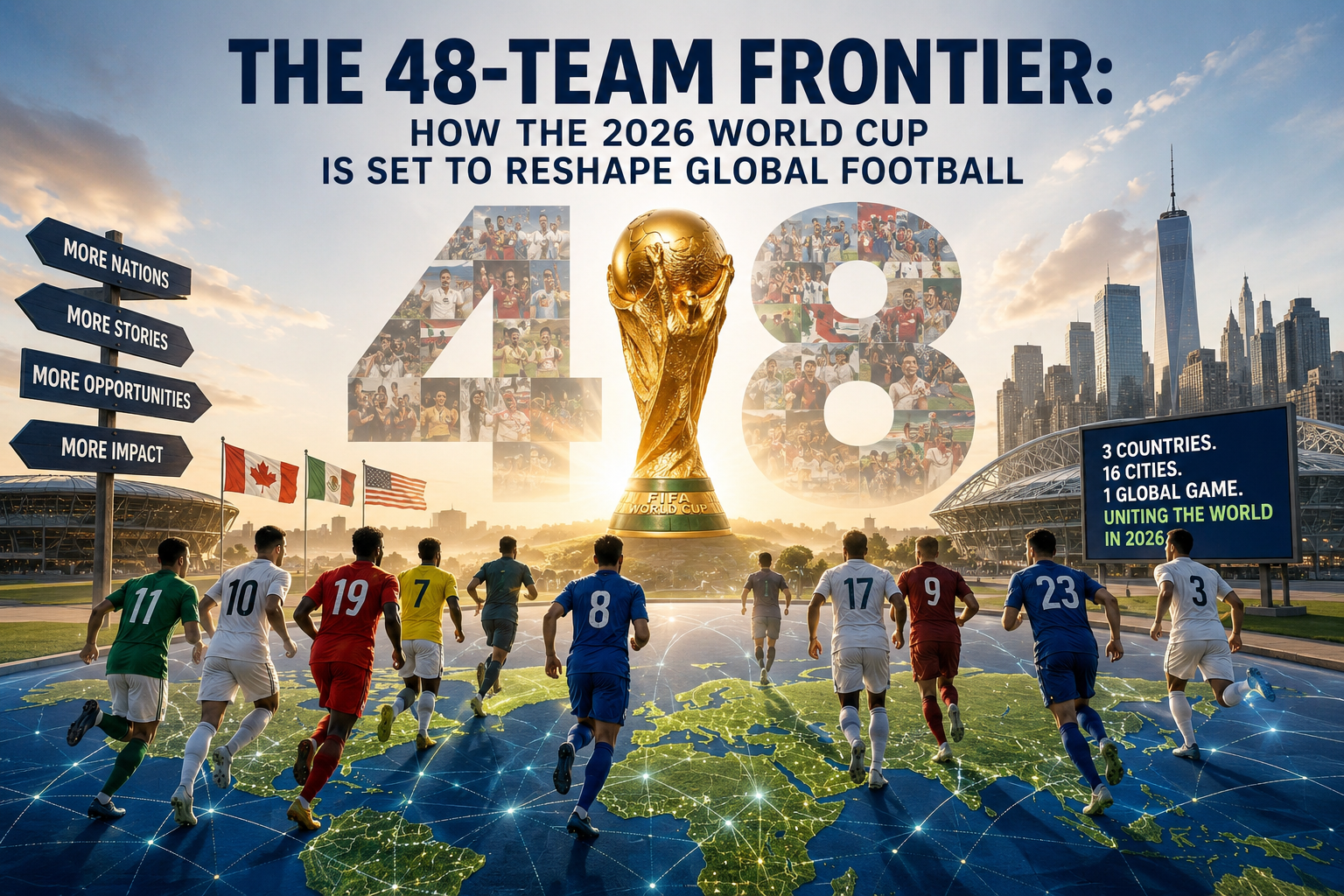
The countdown is entering its final stretch. On June 11, the global sporting landscape will pivot decisively toward North America as the United States, Canada, and Mexico play host to the most ambitious, expansive, and logistically breathtaking tournament in football history. Spanning 104 matches and introducing a relentless schedule of up to six matches per day during an intense opening fortnight, this summer marks a definitive departure from tradition. For a mainstream audience tuning in across the globe, the 2026 World Cup promises to be a century-defining spectacle that blends high-tech innovation, dramatic format changes, and compelling generational storylines.
Redefining the Scale of International Football
The most significant talking point ahead of kick-off is the historic expansion of the tournament format to 48 teams. The traditional 32-team structure, which provided the blueprint for the modern era, has been unlocked to accommodate an incredibly diverse array of footballing nations. From the opening matches on June 11 through to the conclusion of the group stage on June 27, fans will be treated to four separate daily kick-off slots. While the expansion initially sparked debate among purists, the reality presents an optimistic, festival-like atmosphere that welcomes emerging nations and tournament debutants into the global spotlight.
However, a tournament stretched across an entire continent introduces unprecedented operational and physical variables. Elite squads will have to navigate entirely different climates and environments in a matter of days, moving between the thin air of high-altitude Mexican stadiums, the intense summer heat of the American South, and the coastal humidity of Canadian venues. This geographic reality places an immense premium on squad rotation and sports science. With an additional Round of 32 injected into the single-elimination phase, any nation aiming to lift the famous trophy must possess the depth to endure an exhausting eight-match journey.
Innovation on the Pitch
The evolution of the tournament is visible not just in the brackets, but in the very fabric of the game itself. Adidas has introduced the 'Trionda' as the official match ball, a design that represents a major milestone in sports engineering and officiating precision. Constructed with just four panels—the fewest ever utilised for a major international tournament—the ball has been aerodynamically tailored to ensure maximum flight stability rather than pure distance.
Crucially, the ball acts as a live data hub. Embedded at its core is a 500Hz motion sensor that tracks every individual touch 500 times per second, instantly relaying positional data to the Video Assistant Referee centre. According to technical briefs published by FIFA, this connected technology syncs seamlessly with optical camera tracking systems to deliver semi-automated offside decisions and clarify marginal goal-line or handball disputes within seconds. For the general viewer, this means fewer lengthy, frustrating VAR delays and a much smoother, faster-paced viewing experience. Tactically, initial aerodynamic testing suggests the ball's unique surface drag slightly reduces the range of long-distance strikes, meaning we are likely to see teams focus on intricate, short-passing combinations to unlock penalty boxes.
Tactical Trends and Transitional Giants
As the world's premier tacticians finalise their strategies, the tournament's competitive hierarchy reveals a fascinating contrast between settled powerhouses and heavyweights in transition. France enters the summer as arguably the most complete unit on the planet under the steady guidance of Didier Deschamps. The veteran manager enjoys an embarrassment of riches; even beyond a frontline anchored by Kylian Mbappé and Ousmane Dembélé, the French squad boasts a frightening assembly of emerging talent, including Bayern Munich's creative spark Michael Olise. A recent, resilient friendly victory over Brazil in Massachusetts—achieved despite playing a large portion of the match with ten men—demonstrates that France possesses the tactical flexibility and mental toughness required to navigate a gruelling tournament path.
In contrast, other traditional giants are managing complex rebuilding phases. Germany arrives under Julian Nagelsmann with immense individual capability but unresolved structural questions. Following Manuel Neuer's international retirement and fitness setbacks for Marc-André ter Stegen, Hoffenheim’s Oliver Baumann steps into the high-pressure role of starting goalkeeper. Furthermore, Nagelsmann's decision to deploy captain Joshua Kimmich at right-back rather than his preferred central midfield position illustrates the defensive compromises the Germans are making to patch up wide vulnerabilities. While Germany is heavily favoured to navigate a group containing Ecuador, Ivory Coast, and Curaçao, their true test will arrive in the later knockout rounds when their defensive cohesion faces world-class counter-pressing operations.
The tournament's expanded structure means that momentum and structural discipline will quickly outweigh raw star power. As highlighted in the comprehensive tournament projections and data-led team outlooks on bettingTips4you, the introduction of a larger knockout bracket inherently rewards teams with a established defensive anchor over those currently undergoing positional transitions, making the early rounds highly unpredictable for the traditional elite.
The Race for the Golden Boot
With more matches on the schedule and an influx of lower-ranked opposition surviving the group stages, the race for the Golden Boot is shaping up to be exceptionally prolific. The tournament's top goalscorer award remains one of the most prestigious individual accolades in sport, governed by strict tie-break rules that reward assists and penalise excessive minutes played if players finish level on goals.
England captain Harry Kane, who claimed the award in 2018, stands as a prime contender. Backed by a highly creative English midfield and a favourable group stage draw against Panama, Croatia, and Ghana, Kane has a clear pathway to establish an early scoring rhythm. He faces stiff competition from Mbappé, the golden boot winner from the previous edition, and the ageless Lionel Messi, who remains the central focus of a dominant Argentina side facing Jordan and Algeria. Meanwhile, Norway’s Erling Haaland brings world-class finishing to his very first World Cup tournament, though he must guide his nation through a fiercely competitive group featuring France and Senegal.
A Global Cultural Milestone
Ultimately, the 2026 World Cup transcends tactical formations and technological advancements; it represents an unprecedented cultural milestone. By decentralising the tournament across three vast nations, football is securing its future in newer markets while honoring the deep-rooted passion of its traditional fanbases.
The convergence of cutting-edge AI ball tracking, shifting generational player cycles, and the romance of underdog debutants ensures a spectacle that is both highly modern and beautifully unpredictable. When the opening whistle blows on June 11, the world will tune in to witness a tournament that is not just larger in scale, but richer in narrative, setting a vibrant new benchmark for the future of the world's game.