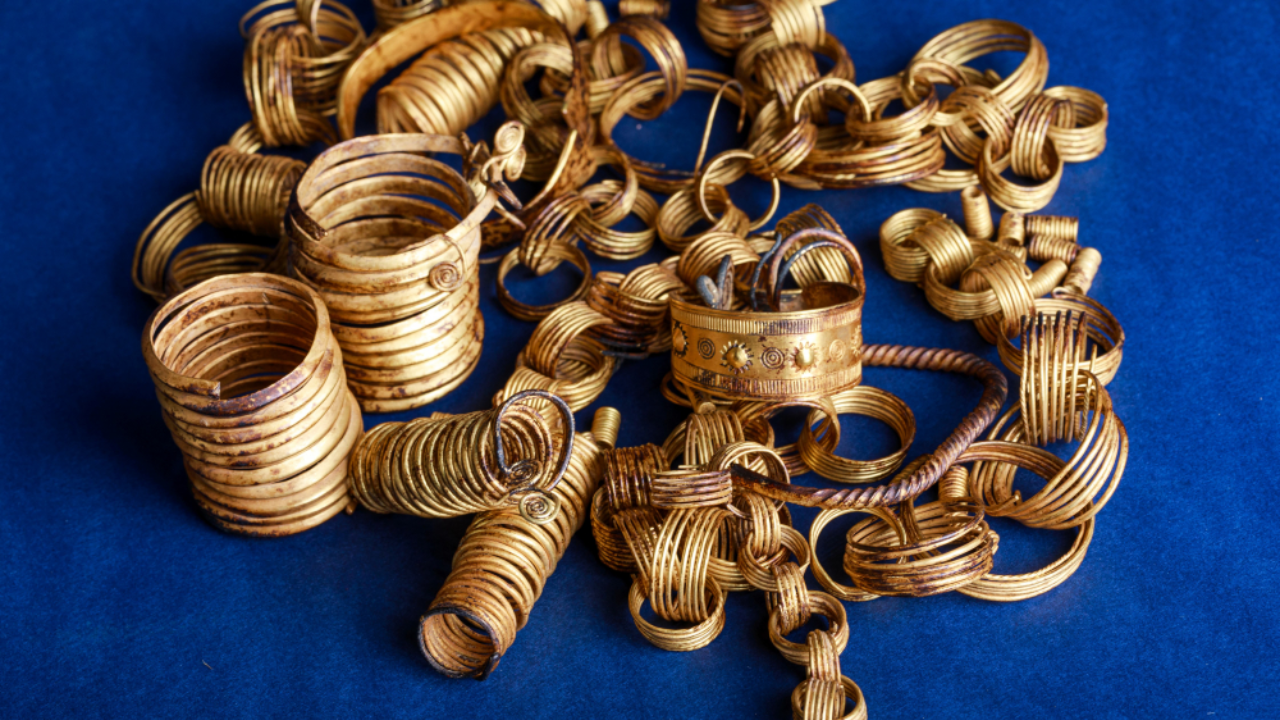
The Gold Hoard of Gessel is considered one of the most spectacular archaeological discoveries in Europe. Found near Gessel and close to Syke in northwestern Germany, this remarkable Bronze Age gold hoard dates back approximately 3,300 years, to around 1300 BC. Consisting of 117 gold objects with a combined weight of about 1.7 kilograms, the treasure is among the largest Bronze Age gold hoards ever discovered in Europe. The find offers valuable insights into ancient life, trade and economy, metalworking craftsmanship, and the social structures of prehistoric communities. Researchers believe the gold objects may have functioned as a form of ancient currency, while ongoing studies are investigating both the origin of the gold and the reasons behind its burial.
This extraordinary archaeological find sheds new light on Bronze Age wealth, trade networks, and cultural practices in prehistoric Europe.
What is the Gessel gold hoard from 1300 BC
Unearthed by surprise in pipe excavation work in 2011, the discovery of the Gessel gold hoard quickly became news all over the world. It is believed that the treasure, discovered in the Diepholz area in Lower Saxony, Germany, comprises only gold items.
As revealed by experts from the Lower Saxony State Office for Cultural Heritage, the hoard comprises 114 rings of spirals in chains, out of which some are rings, a bracelet, an incomplete armband, and a sophisticated brooch, which altogether amount to kgs, making the collection one of the heaviest gold treasures of the Bronze Age period found in Europe so far. According to the archaeologists, most of the spirals were used as standardised items of wealth or exchange rather than jewellery.
All these items were packed into a linen bag with bronze pins, implying that the grave was organised in advance and purposefully.
Why is the Bronze Age treasure so significant
However, what makes the Gessel gold treasure even more significant than its sheer volume is what it tells about the society of the era.
One of the outstanding artefacts from the find is a golden brooch adorned with concentric rings and sun-shaped decorations. According to experts, this artefact can be considered unique for all of Central Europe as an example of highly advanced metal processing skills of craftsmen living in the times of the Bronze Age.
Moreover, the treasure sheds light on the economics of prehistoric societies. The abundance of golden spirals found there makes scholars assume that precious metals were already widely used in some form of monetary system that had nothing to do with coins.
In the words of the Lower Saxony State Office for Cultural Heritage, when describing reproductions of the treasure: "The Gessel gold hoard is one of the largest gold finds in the medieval centre of Europe".
New research aims to solve the hoard’s mysteries
Despite more than a decade of study, many questions remain unanswered. Though extensive research titled ‘ The Bronze Age gold hoard from Gessel, town of Syke, district of Diepholz: Description of the individual gold objects, observations on their manufacture, and initial archaeological classification ’ by Henning Haßmann, Tina Heintges, Andreas Niemuth, Bernd Rasink, and Friedrich-Wilhelm Wulf, supported by the German Research Foundation (DFG), was a comprehensive investigation into the hoard. Archaeologists, natural scientists and museum specialists are examining the artefacts, the burial site and the surrounding landscape to better understand the treasure’s origins and purpose.
This research will help understand the origin of the gold, how the items were made and why so many pieces ended up in one place. The scientists are also investigating whether the items belonged to a high-ranking person, a merchant or a talented metallurgist.
The scientists believe that the gold could have come from outside of northern Europe, which may help establish links between the region and the vast network of Bronze Age merchants who travelled across Eurasia.
A treasure that still captivates archaeologists
Over 3,300 years since it lay buried underground, the Gessel gold hoard still manages to intrigue scientists and visitors alike. The fine quality of its manufacture, its enigmatic burial history and possible connections with overseas trade have made it a very significant find from the European Bronze Age.
With each scientific advance, there is hope that this amazing cache will shed some light on the people who possessed the treasure, its origins, and the reasons for its careful burial. Meanwhile, the Gessel gold hoard stands as a shining example of the richness and complexity of Bronze Age Europe.