
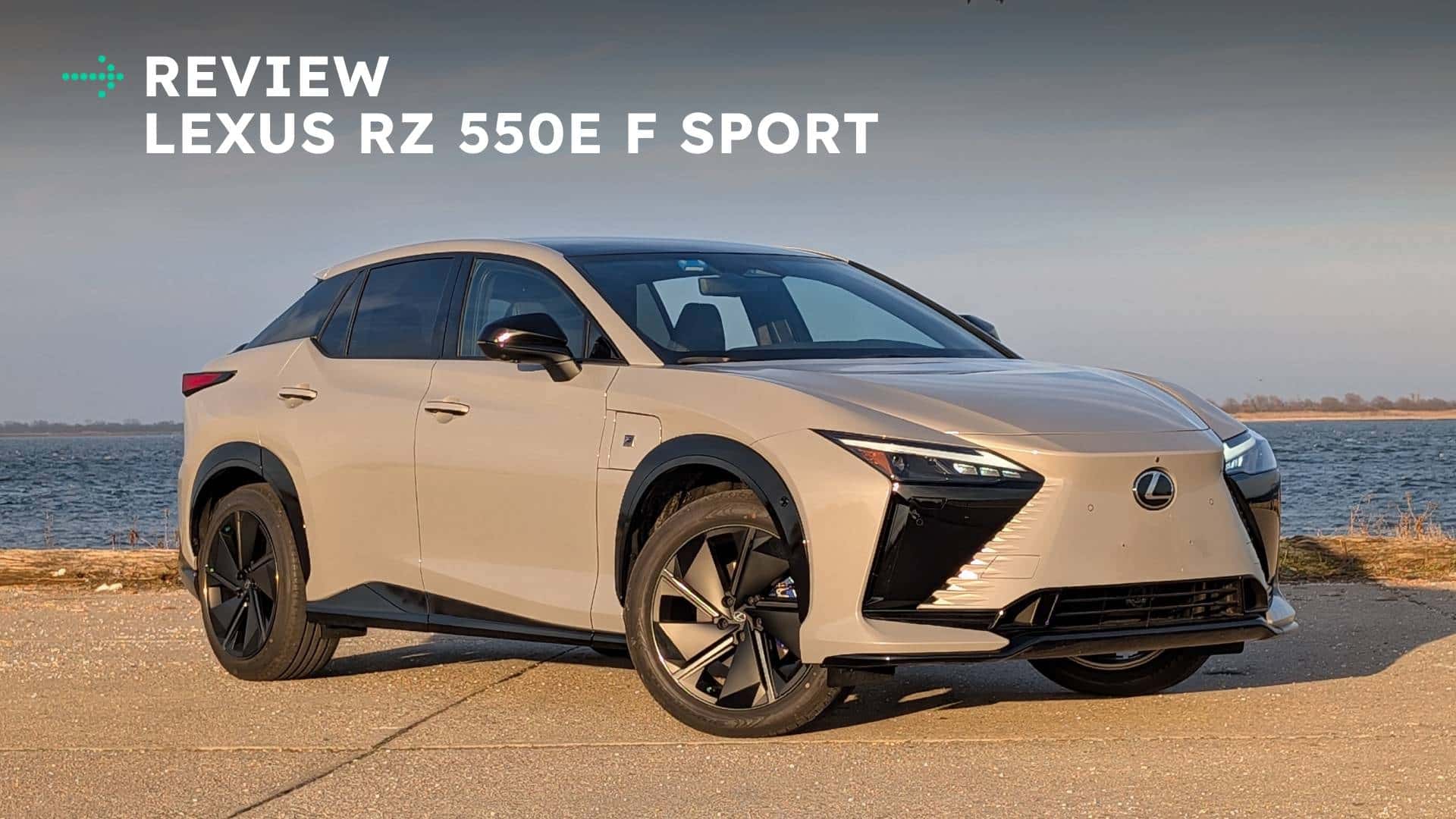
While electric vehicle sales cooled in the first quarter due to the end of the federal tax credit and a regulatory rollback, Toyota and Lexus EVs bucked that trend. The updated 2026 bZ emerged as the best-selling non-Tesla EV in Q1. Sales of the Lexus RZ surged 206% year over year to nearly 4,500 units.
Some of that sales boost can likely be attributed in part to the big upgrades the Lexus electric crossover received for 2026. The RZ now comes with a larger battery pack, faster charging, and a Tesla-style North American Charging Standard (NACS) port fitted straight from the factory. The lineup also expands at the top end with the new, quicker 550e F Sport trim.
WHY LEMONADE?
This story was published in partnership with Lemonade. Lemonade Insurance uses technology to keep things simple and offer lower prices for a wide array of EV drivers. They offer discounts for safe and low mileage driving, and further discounts for drivers of EVs and PHEVs. If you have a Tesla with FSD, you can even get discounts for the miles driven on FSD. Click here to get a quote for your EV today.
*Lemonade and the FSD discount are available in select states, learn more at the link above.
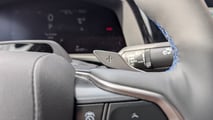
This variant introduces what Lexus calls “Interactive Manual Drive,” a system that lets drivers simulate gear changes using paddle shifters on the steering wheel, like combustion cars. The system does a thorough job mimicking a manual gearbox. But it’s not nearly as polished as the Hyundai Ioniq 5 N, whose simulated transmission feels better aligned with the car’s broader performance focus.
The RZ, by contrast, offers a milder interpretation of the same idea, bringing manual shifts to an everyday electric luxury crossover. It is fun to drive with a mature ride and handling setup, but it’s not quite the “Corner Rascal” that the Ioniq 5 N is. Instead, the 550e is a stupidly fast family EV that lets you reminisce about the aural drama and behavior of a combustion engine.
However, the theatrics of this virtual gear shifter aren’t enough to overlook this trim’s other shortcomings, including a frustratingly low real-world range and a price tag that’s harder to justify the closer you look.
[Full Disclosure: Lexus loaned me the RZ 550e for a week-long test in New York and paid for the tolls. It arrived with a full charge.]
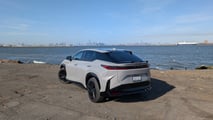
Gallery: 2026 Lexus RZ 550e F Sport


The Way “Manual Shifts” Work
Electric motors deliver power across a wide range of speeds and RPMs without relying on complex multi-speed transmissions, as gas cars do. In most cases, a single-speed setup is enough to extract an electric motor’s full performance. Having virtual shifters in an EV is less about essentials and more about recreating a familiar driving experience. In some ways, it’s also a great example of how far modern automotive software has come.
The RZ’s virtual shifter leans hard into that idea. At its core, it’s just software—code in the vehicle’s electronic control unit (ECU) that interprets throttle inputs and vehicle speed to determine how the “gearbox” should respond at any given moment. The result is an eight-speed virtual transmission that feels surprisingly accurate in mimicking the cadence of a manual.
2026 Lexus RZ 550e F Sport Specs
Engaging the manual shifter requires pressing the “M Mode” button on the center console. Then the paddles behind the steering shift like a dual-clutch transmission or a crisp sport-tuned torque converter. The first gear is programmed to reach 30 miles per hour, the second goes up to 48 mph, the third to 60 mph, and so on. They all hit a virtual rev limiter, where acceleration flattens until you shift higher.
On regular roads, the experience feels a bit contrived. But around twisties, the system starts to make more sense, even though it remains a bit gimmicky. Hold a higher gear at low speeds, and you’ll feel the dulled acceleration and reduced torque. On inclines, the system nudges you to downshift to get in the correct power band. And on descents, you can lean on “engine braking” to reduce speed without using the actual brakes.
The gauge cluster displays “up” and “down” shift indicators, while synthetic engine sounds are piped through the speakers to mirror the rhythm of a conventional gearbox. A high-pitched whine during acceleration and a mild four-cylinder growl when you’re off the throttle numbs the experience, though. There’s a feature called “Active Sound Design” that lets you adjust the virtual shifter's volume to Low, Medium, or High.
I wish Lexus had fully committed to the theme here with more combustion-engine aural drama, rather than making it sound like a mix of EV and gas. If you go in expecting sensations like the LC 500’s V8 or the LFA’s V10, you’ll come away disappointed. The synthetic sounds are closer to a remote-controlled toy car than to a full-blown performance crossover, even though the underlying simulation is pretty accurate.

The whine from the speakers blasting into my ears was unbearable after a point, so I did most of my driving with the virtual shifter off, just like a regular EV. And oddly, that’s also the best way to enjoy this car.
How The RZ 550e Drives
The U.S. gets a tamer version of the 550e F Sport. Overseas models offer yoke steering and a steer-by-wire setup, while the U.S.-spec car sticks with a conventional steering wheel and a mechanical link to the front wheels. The RZ 550e is still genuinely engaging to drive, and in fact, its driving dynamics are arguably its strongest suit.
That alone sets it apart in a segment where many electric crossovers tend to be lazy in the ride and handling department. Blame the usual suspect for this epidemic: the heavy, floor-mounted battery. The RZ, on the other hand, is still quick, composed, and far more agile than its roughly 5,000-pound curb weight would suggest.
The dual-motor setup delivers 402 horsepower and nearly 200 lb-ft of torque at each axle. The claimed 0-60 mph time of 4.1 seconds means it’s 0.3 seconds faster than the LC 500, a dedicated V8-powered sport touring coupe costing nearly twice as much.
Push it into corners, and the stiffer springs and well-judged damping keep body roll in check, helping the RZ stay flat and planted. The suede-textured bucket seats, exclusive to this trim, also tightly wrap around you, limiting lateral cornering jolts. The trade-off shows up at lower speeds. On typical New York City roads, the ride felt occasionally harsh. The chassis settled down with the build-up of speed, smoothing out into something far more composed and refined.
A big contributor to the RZ’s handling is also its power distribution. In Range mode, it maintains an equal 50:50 front-to-rear split. Switch to Sport, and the system becomes far more dynamic. It can send up to 100% of the power to the rear axle or vary the split (for instance, 80:20) during corner entry for a sharper turn-in, then bias rearward on corner exit to improve stability and traction.
It is nowhere as dialed in as the Ioniq 5 N, but it makes a stronger case as an everyday performance crossover than the Hyundai. However, it would have been an even better everyday EV if a few things were more sorted, particularly range, efficiency, and one-pedal driving.
How Is It As An EV?
The RZ’s range and charging performance are somewhat of a mixed bag. Its battery size has grown from 71.4 kilowatt hours for the previous model years to a 75 kWh pack for the updated 350e and 450e trims. The 550e steps up to a slightly larger 77 kWh unit, with an EPA-estimated range of 229 miles on 20-inch wheels. In real-world driving, I didn’t come anywhere close to that figure.
With a regular 10% to 80% charging schedule, you’re working with about 150-160 miles of usable range on longer trips. Even that number swings wildly depending on conditions. During my week of testing, New York City's weather varied from near-freezing to unseasonably warm. At 33 degrees Fahrenheit, efficiency struggled to climb past 2.7 miles per kilowatt-hour in mixed driving. A few days later, in 80F, that figure jumped to around 4.0 miles per kWh.
EV batteries tend to be less efficient at colder temperatures, as slower electron movement within the cells results in greater internal resistance and more energy losses. But the RZ seems more sensitive to cold weather than many of the EVs I’ve driven this past winter. If outright range is a priority, the 350e makes a stronger case. It carries an EPA estimate of over 300 miles and should deliver better efficiency with its front-wheel-drive layout, smaller wheels, and less power-hungry motors.
Four levels of brake regeneration, adjustable via the paddle shifters, are a nice-to-have that boosts efficiency, but the strongest regen setting doesn't bring the car to a complete stop. Having true, one-pedal driving continues to be a huge miss on Lexus EVs.
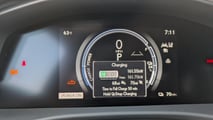
That said, all RZ trims now get the Tesla-style NACS connector straight from the factory, unlocking easy access to more than 25,000 Superchargers nationwide. In practice, though, charging at a Supercharger wasn’t as easy. It took me three attempts to initiate the charging session. While it wasn’t immediately clear whether the issue stemmed from the dispenser or the vehicle, a warning symbol indicating an EV system malfunction appeared on the gauge cluster during charging, even though charging itself seemed to be working fine. The warning disappeared once the session ended.
Once I initiated the session, however, charging seemed to have improved significantly. The RZ went from 18% to 80% in 26 minutes, peaking at 160 kilowatts, slightly above its claimed 150 kW maximum, adding roughly 130 miles of range in that time. Lexus claims a 10-80% charging time of 30 minutes under ideal conditions, and what I observed confirms that. The included battery preconditioning setting should also make charging more efficient when the conditions are not so ideal.
Verdict
The RZ 550e isn’t trying to be a wild, track-focused machine like the Ioniq 5 N. It’s more of a refined, everyday performance crossover. The problem is, it misses some of the fundamentals that make EVs great daily drivers in the first place. In addition to limited driving range, it also misses out on route planning, which is a glaring omission in 2026. The infotainment also feels dated and laggy.
It still delivers where Lexus traditionally excels. The cabin is plush, trimmed in high-quality materials, and feels like a clear step up from mass-market Toyotas. Its NVH levels are top-tier, blocking out outside noise to levels comparable to those of expensive BMWs and Cadillacs. But those things can also be had on the cheaper 350e and 450e trims, which I'd recommend over the range-topping 550e.
There’s still potential here. The 550e’s virtual shifting system could use a more nuanced sound design and greater adjustability in traction and responsiveness. But in its current form, it feels under-baked.
At nearly $60,000, including destination, that’s a problem. If you’re chasing driving engagement and gas engine fakery, spending the extra $7,000 on the Hyundai Ioniq 5 N will feel far more rewarding. And if you want a performance crossover that isn’t trying to mimic a gas car, the market isn’t short on alternatives. The Cadillac Optiq-V and Lyriq-V, the Ford Mustang Mach-E Rally, the Genesis GV60, and the Tesla Model Y Performance all make a stronger case.
The 550e ultimately feels like an experiment rather than a fully sorted product, landing in an awkward middle ground. It’s quick, fun to drive, and intriguing, but not quite compelling enough where it matters most.
Contact the author: suvrat.kothari@insideevs.com
Click here to see all articles with lists of the best EVs