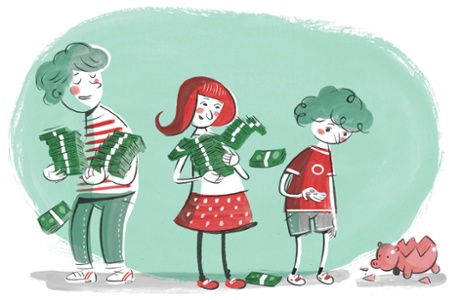
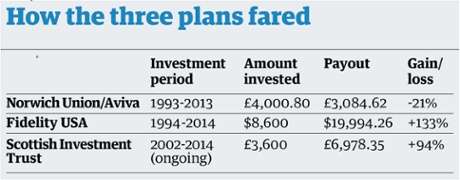
Jim Cowie has thoughtfully invested around £4,000 for each of his three grandchildren so they would all have a nest egg for their 20th birthdays. The one invested with Fidelity paid out £12,000 last year. The one invested with Scottish Investment Trust is only 13 years old, but is already worth nearly £7,000. But Norwich Union, now known as Aviva, took the first grandson’s £4,000 – and after 20 years gave back just £3,000. To say that Cowie, now 78, is horrified and bewildered is putting it mildly.
“It can only be described as a disaster. Something went very badly wrong,” Cowie says. “Twenty years is long enough for a competent investment company to generate satisfactory results, especially when the market over the same period has done well and the investment was supposed to be broad based and for growth.”
Back in 1993 the glossy brochures from Norwich Union said: “Investment returns of 14% are still being achieved on 10-year policies. This is well above returns earned on bank and building society deposit accounts, which means that with-profit policies still represent good value for money.”
NU’s marketing said that the sum of £50 a month, invested over 25 years, was producing cash payouts of more than £60,000. Cowie was paying in less – £50.01 every three months, totalling £4,000.08 over the 20 years – but he was nonetheless stunned to be told in 2013 that all he would be getting back was £3,084.62.

If he had simply left the money sitting in a typical building society account it would be worth around £5,500 today. Even if he had left the money under the mattress it would be worth more than he has got back from Aviva. Instead, over two decades he has lost 23% of his initial investment.
Cowie is now faced with digging deep into his own pocket to make up the difference so that each of his grandchildren is treated equally. NU/Aviva has flatly refused to compensate him.
What Cowie finds most puzzling is how badly the investment compared with the returns on the stock market during that period.
Since 1993, when Cowie first started paying into the Norwich Union Child Plan, the FTSE 100 index has more than doubled from 2,900 to 7,000, and the dividends he earned, reinvested, would have boosted the policy’s returns even further.
Cowie, a maths graduate from the University of Glasgow, who went on to become a director at British Telecom, then a senior policy adviser at the World Bank, asks: “What went wrong in Norwich Union/Aviva to produce such poor results?”
What emerges is a shocking mix of extraordinarily high charges, optimistic projections, complicated and expensive insurance, poor investment performance, and loose regulatory standards at the time of sale.
Policy charges NU’s initial estimate of administrative costs for running his money was 2.3%. In other words, the investment would have to grow by that amount a year just to stand still. But the reality was very different: NU/Aviva took 7.2% in fees from every quarterly premium paid, says Cowie. This meant that from the outset the policy was handicapped and faced a struggle to achieve projected returns.
Insurance cover Cowie was also shocked to discover that rather than the money being invested, a large chunk of it went to buy life cover – insurance that he says he never wanted nor asked for.
His policy acceptance document from 1993 said NU would pay out £2,191 in the event of his death, plus possible additional bonuses.
What wasn’t made clear was that 29% of all the money he invested would be taken by NU to pay for the insurance. In reality, NU invested just £2,535.20 of his £4,000 in premiums on the stock market. A total of 36% of his money went to cover its fees and insurance.
Investment performance Cowie asks why, even after taking into account the amount taken out for insurance and fees, NU/Aviva’s performance has been so “woefully” bad?
In effect, just £31.69 of his £50 a quarter went into NU/Aviva funds, but even this money was managed miserably, achieving a return of just 1.9% a year. “This is incredibly poor,” Cowie says, especially when he can directly compare it with the performance of the other funds he has for his grandchildren.
Regulatory standards In 1993 NU was supervised by city regulator Lautro, which allowed companies to issue documents to investors about future returns which bore almost no relation to their actual costs and fees. It allowed life and pension companies to say that the initial charge would be 2%, followed by an annual charge of 0.2% a year when, in reality, they were a huge multiple of that level.
What is more, Lautro let companies predict that investments would grow by 7.5% a year – or more. The truth was, charges were much higher, and returns much lower – a double whammy for Cowie’s Child Plan, and for millions of other endowment plans.
Cowie took his case to the Financial Ombudsman, but it found in favour of Aviva, arguing that under the rules prevailing at the time NU had not mis-sold the policy, and that it can’t be held responsible for poor investment returns.
Ombudsman Doug Mansell said: “Disappointing investment performance will not normally be considered a valid case for complaint… I consider the investment performance experienced is a reflection of the investment conditions that have prevailed over the period… I can find no basis upon which to uphold his complaint.”
Cowie strongly disputes the finding, and is also angry it took 16 months to obtain a ruling. “As had been shown to the ombudsman, the performance was extremely far below that of both the market and of comparable investments made for other grandchildren over a similar period with two other firms.
“I am convinced that an unacceptable performance has been whitewashed by the agency that is supposed to ensure that clients are treated fairly.”
We asked Aviva how it could have performed so poorly. In a statement it said: “This type of plan was designed to provide a cash lump sum at a significant age for a child. The maturity date was chosen at outset and normally ran to the child’s 13th, 18th or 21st birthday.
“The plan meant the child benefited from the cash lump sum without having to rely on the continued survival of the plan holder – a valuable feature when this was a child’s grandparent.
“Consequently, the plan included a with-profit endowment and also life insurance on the plan holder. Our literature was very clear that there would be life insurance protection, and the proposal form included a health questionnaire – therefore the plan wasn’t purely an investment arrangement.
“Life cover was an integral part of the policy. This would have been a material cost within the monthly premium, reflecting the value of the life cover and would have been dependant on gender, age and health of the plan-holder at the time the plan was arranged. These plans were written over 20 years ago and life cover costs were materially higher than they are now.
“Investment conditions have changed dramatically since the early 1990s, with interest rates and inflation coming down considerably over this period.
“Projections of benefits of these plans would have been based on the standard growth rates being used at the time the plan was arranged.”
But Cowie is not alone in voicing his disgust over the performance of the NU Child Plan. A grandmother who put more than £6,000 into one received a payout of just £4,000 in 2009, 17 years later. “My hope is that publicity might come to the attention of others who have suffered, as I have, and build momentum for some form of compensation for whatever went wrong – as something surely did,” Cowie says. “Protest cannot be fairly dismissed by suggesting that investing is inherently risky.”