The Japanese word "heso" means belly button, but it can also often refer to the focus of something or the key to an affair or a matter. Expecting there to be only one, I did some research about the "heso" of Tokyo and learned that Tokyo has two. In addition to the two "heso," there are also a number of "centers" in Tokyo.
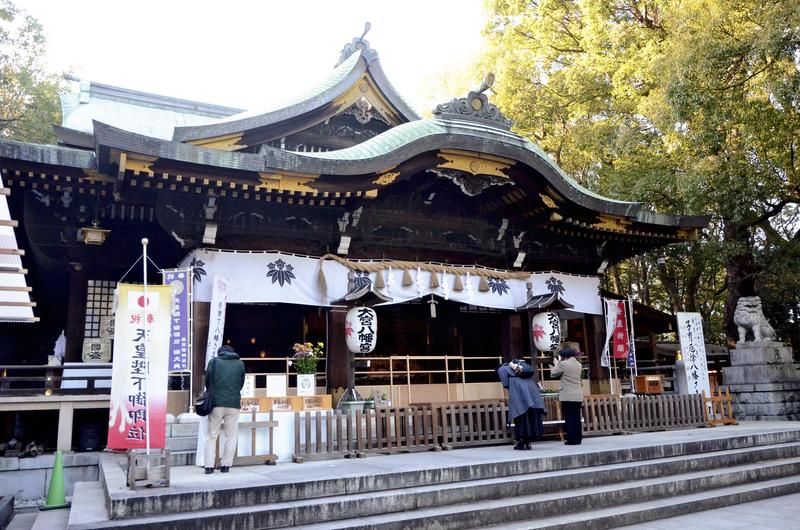
As I walked through a road flanked by trees leading to the Omiya Hachimangu shrine in Suginami Ward, the main hall came into view. Omiya Hachimangu is known as "Tokyo's heso."
As a heso belly button is the remnant of a time when a mother and child were connected by a umbilical cord, many people visit Omiya Hachimangu to pray for a safe and easy childbirth and childhood.
Despite having a history spanning more than 950 years, the shrine only became a popular spot about 20 years ago. What contributed to this is that the shrine is located near an area that is the "center of balance" for Tokyo's population.
"After the 1990 national census, it was discovered that a spot near this shrine was the center of Tokyo, population-wise," priest Masafumi Kato, 25, said. "Since then, the shrine has been called 'Tokyo's heso.'"
Omiya Hachimangu enshrines Emperor Ojin and his parents Emperor Chuai and Empress Jingu, all of whom lived more than 1,000 years ago. For that reason, Kato said, "The bond between parent and child matched the image of 'heso.'"
The tea lounge at the shrine serves "heso fuku mochi" -- mochi with a black bean on top representing a belly button -- enhancing the popularity of the shrine.
Tokyo's other "heso" is the city of Hino in the Tama region in Tokyo, a claim clearly stated on the municipal government's website. "It means that Hino is the geographic center of Tokyo," a city official said.
The official said if a circle were drawn to enclose all of Tokyo, except for its remote islands, the city would be at the center of the circle. It is not known when the city started to call itself the "heso" of Tokyo. However, the official said: "We began to call Hino a 'heso,' because if we were to refer to it as the center of Tokyo, it would possibly lead people to think of the Imperial Palace or downtown areas in the 23 wards in Tokyo."
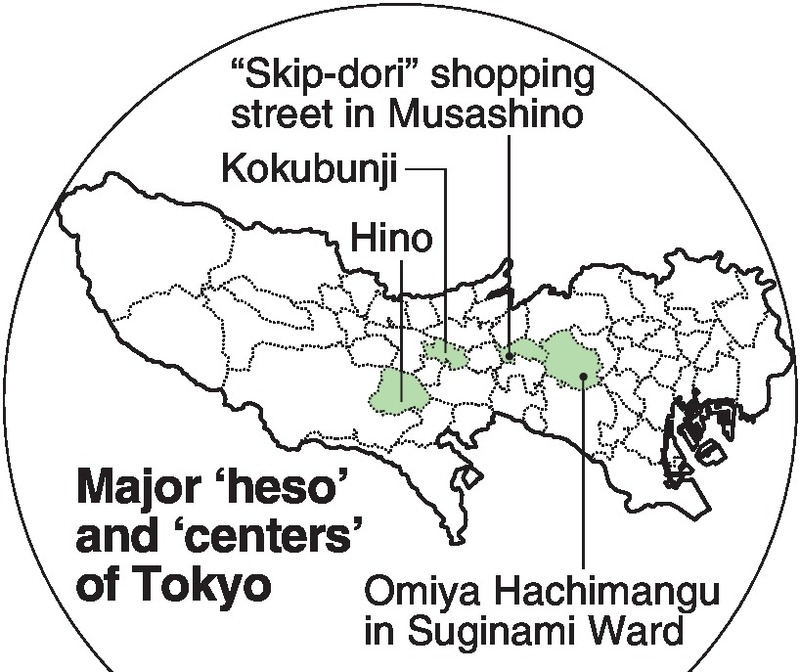
Just as the Omiya Hachimangu is the population center of Tokyo, there's also a gravitational center of Japan. The Mathematics Certification Institute of Japan in Taito Ward, Tokyo, has determined that it is a spot near a park in the residential area of Fujimoto 3-chome in the city of Kokubunji. The institute does not call it "heso."
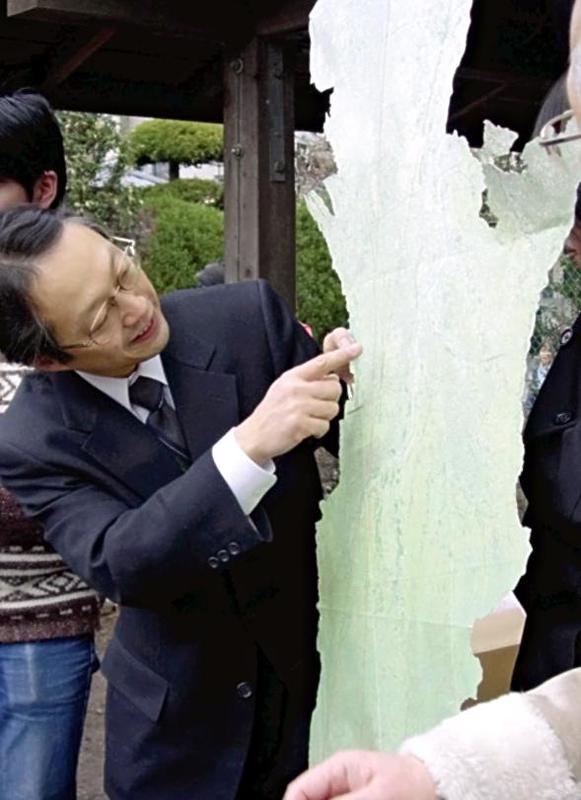
"We simply wanted kids to become interested in mathematical centers of gravity," said Seiichi Matsumoto, 60, of the institute. The institute has placed a sign in the park giving more information about the gravitational center.
Calculating the gravitational center of Tokyo is not difficult. The institute prepared a piece of cardboard and cut it in the shape of Tokyo, except for its remote islands.
Then, they hung the cutout map against a wall with one point of the map's edge attached to a plumb line, or a weighted vertical string. After tracing the line made across the map by the string, they hung it up again from a different point on the edge and traced a second line across it. The point where the two lines crossed was the center of gravity of the board, and therefore of Tokyo.
Interestingly, if you put the point of a needle under the map at this point, the board will actually balance on it.
"If you have a map of any place, such as your local city, you can calculate the center of gravity of that place with this method," Matsumoto said.
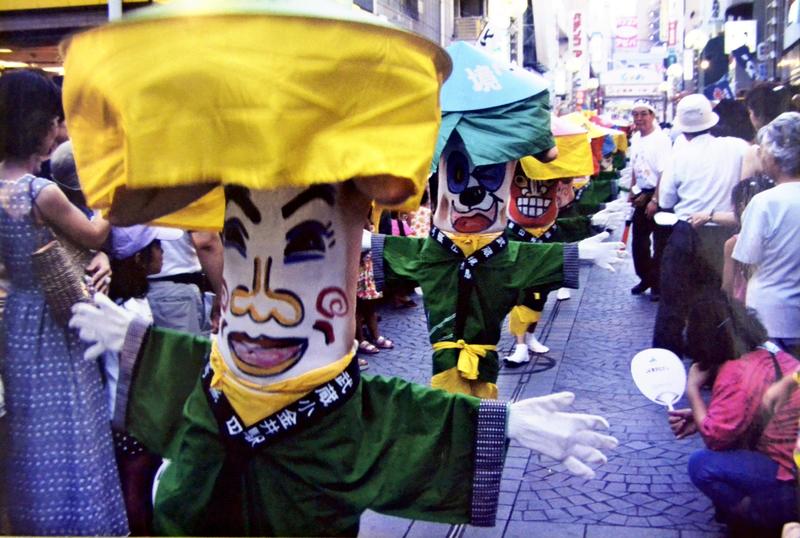
There are also "heso" in Tokyo that have disappeared. There was a "heso odori" dance that was performed in the city of Musashino until 2003. Kazuhiro Shimoda, 58, who runs a green tea shop on the "Skip-dori" shopping street in front of Musashi-Sakai Station in the city, showed me a photo of a number of people dancing and parading with faces drawn on their bellies and wearing large hats.
The dance was started in 1989, in the wake of renovation of the whole street. Shop owners got together and tried to come up with ideas to invigorate the shopping street. "The Musashi-Sakai Station is in about the middle of the [JR] Chuo Line, so it is the 'heso' of the Chuo Line," one person said.
So, 15 people, including the street's shop owners, traveled to Furano, Hokkaido, where a "heso" dance like this originally started, to seek advice.
The funny dance drew the attention of neighboring communities and more than 200 people, including the shop owners and local students, performed the dance at its peak.
However, due to financial issues and lack of successors, it has become difficult to continue to organize the dance, and the last one was performed in 2003.
"By drawing faces on their bellies, it was a dance that could be enjoyed by everyone from children to the elderly," Shimoda reminisced.
Read more from The Japan News at https://japannews.yomiuri.co.jp/