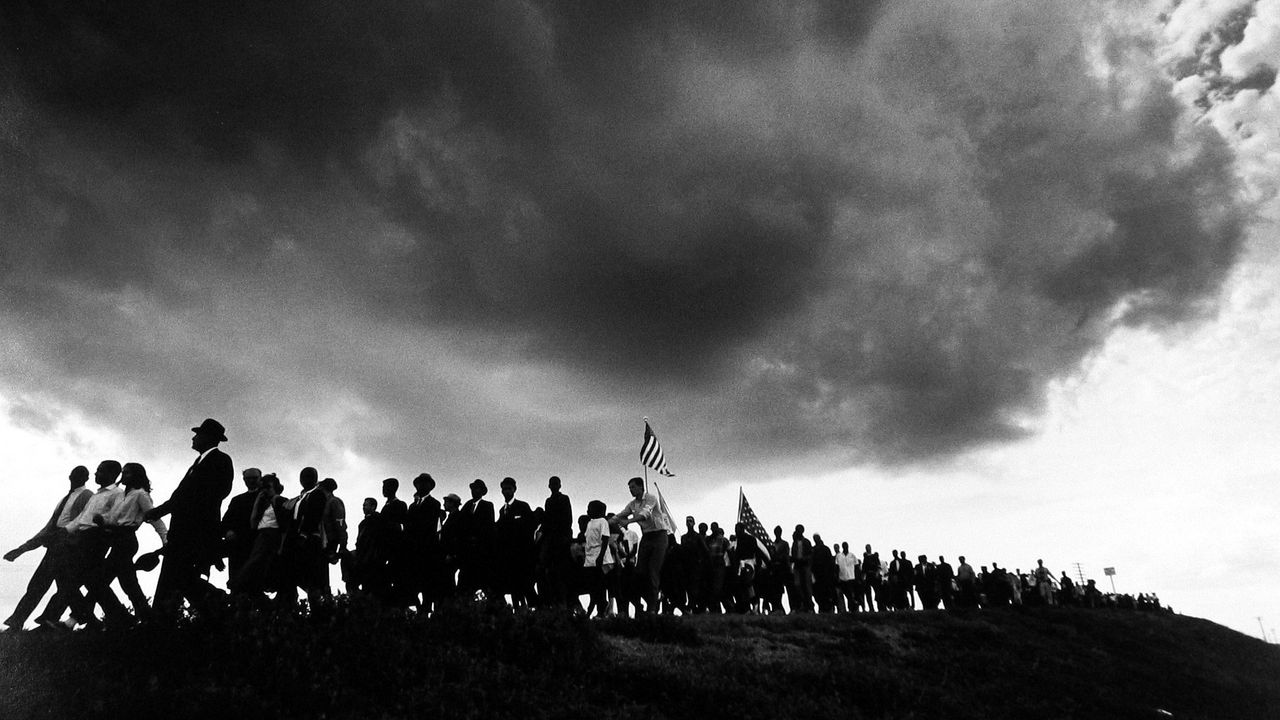
Scroll through the coverage of the historic 1965 Selma to Montgomery civil rightsmarch and you'll find plenty of close, urgent pictures. Clenched jaws. Raised placards. Martin Luther King mid-stride at the front of the crowd. James Karales' contribution to that archive, now touring as part of Presence: The Photography Collection of Judy Glickman Lauder, does something dramatically different.
Rather than focus on faces, Karales stepped back, dropped low and let a vast, roiling thunderhead swallow two-thirds of the frame. The marchers become a ribbon of silhouettes along the bottom edge, faceless, anonymous; their only individual detail a hat brim here or a raised flag there. On paper, it really shouldn't work as well as it does. And that's exactly why it's worth studying.
Karales was on assignment for Look magazine, having trained under W. Eugene Smith at Magnum, and by 1965 he'd already spent years learning to find the quiet, introspective moment inside a chaotic news story rather than reaching for the obvious drama. That instinct is all over this frame.
Ulimately, it lets the Alabama sky do the emotional work: an enormous dark cloud bearing down on a line of people walking toward an uncertain future. The American flags rippling above the crowd read almost as an act of defiance against the weather itself.
It's the kind of picture that photojournalism students are taught to avoid making. No hero shot, no identifiable protagonist, no clean single point of focus. Yet it's arguably the most reproduced, most instantly recognisable image to come out of Selma that isn't a portrait of King himself.
The importance of structure
What makes the picture work is entirely down to structure. Karales shot from a low angle, almost at ground level, which does two things at once. It pushes the marchers' silhouettes up against the sky rather than the landscape behind them, and it exaggerates the scale of the cloud looming above. The horizon line sits low in the frame, roughly a fifth of the way up, leaving the sky to dominate.
That's a brave ratio to commit to on the day. The instinct of most photographers would be to give the subject more room and the sky less. Here, though, the cloud isn't background, it's practically a second subject; a visual stand-in for the pressure and menace the marchers were walking into.
The use of silhouette matters too. By exposing for the sky rather than the crowd, Karales strips away individual identity and turns the marchers into a single mass; a movement rather than a collection of people.
It's a technique documentary photographers still reach for when they want an image to speak for a cause rather than a single participant: think of any wide, backlit shot of a protest march since. Karales was doing it with a 35mm camera and no idea if the shot would work until the black-and-white film came back from the lab.
A lesson in restraint
There's a broader lesson here: sometimes the most truthful picture isn't the one that gets you closest to a face. Karales' choice to hang back and let atmosphere carry the weight produced an image that's outlasted plenty of tighter, more conventional shots from the same march. It's proof that restraint, when well judged, can hit harder than proximity.
Presence: The Photography Collection of Judy Glickman Lauder, including Karales' Selma to Montgomery March, Alabama, is at the Southampton Arts Center until to September 27, before touring to Sarasota, Charleston and Miami through early 2028.