So worn out was Italian chef Dorando Pietri, completing the marathon (London’s first) at the 1908 Olympics, that in photographs he looked as if he were trying to limbo dance under the finishers’ tape. The 22-year-old had already collapsed several times during the race. “I looked like a man suffering from paralysis,” he wrote afterwards. His great effort counted for little; a doctor had helped Pietri to his feet after one fall, so race stewards disqualified him. Queen Alexandra was outraged and later presented the Italian with a special cup. Read Simon Burnton’s excellent essay on the race here Photograph: Allstar/IOC
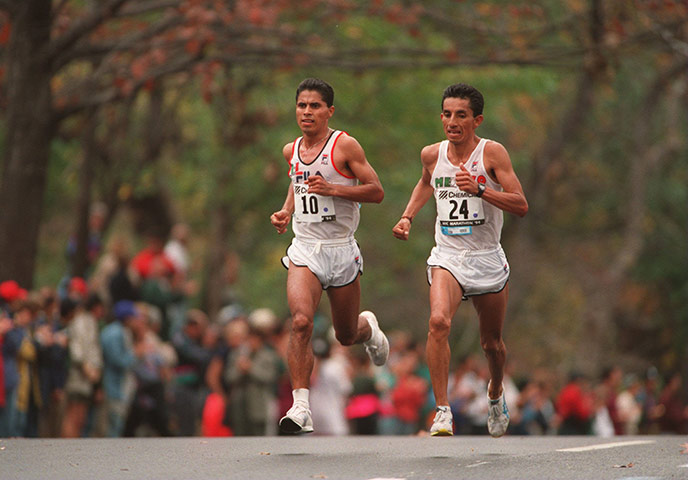
Stop! Turn back! Germán Silva, a runner from Mexico, was within a mile of finishing the 1994 New York marathon, neck and neck with a compatriot, Benjamín Paredes. When the race moved into Central Park, though, Silva took a wrong turn down an intersecting road. “He maybe had a little mental lapse!” cried a TV commentator as Silva, mortified, turned around and desperately tried to make up the deficit. “This is absolutely horrible,” said the commentator, but the marathon had a happy ending: Silva, driven, perhaps, by embarrassment, won by 20 yards Photograph: Simon Bruty/Getty Images
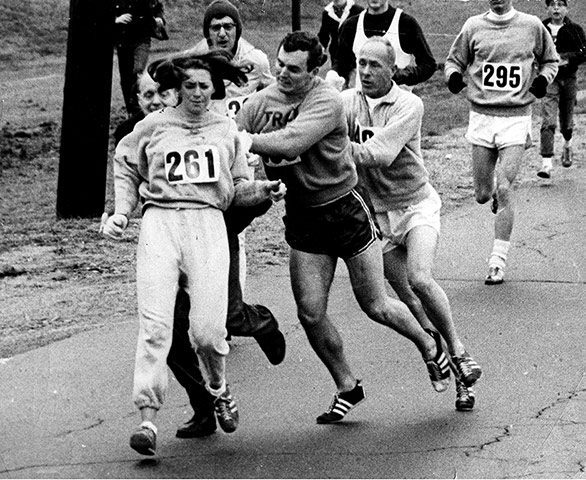
“No dame ever ran the Boston marathon!” This was Kathrine Switzer’s trainer, Arnie Briggs, when told by the 19-year-old that she planned to enter America’s famed race. Rules at the time forbade women’s participation and Briggs agreed to support her only if she could last 26 miles in a practice run. She ended up clocking 31 miles while Briggs, jogging beside, passed out. Switzer’s participation was controversial; during the race, journalists hung out of cars, shouting questions. But she finished, posting a credible time, and five years later the rules were amended Photograph: Boston Globe via Getty Images
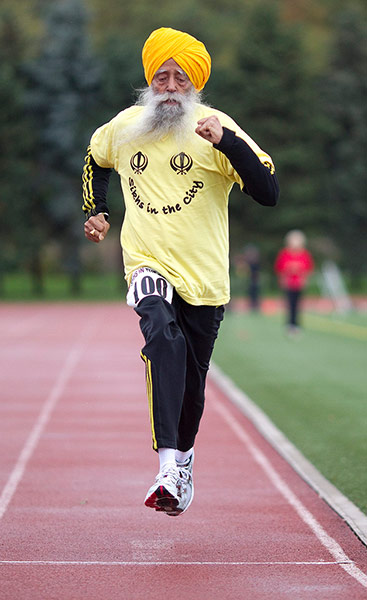
Londoner Fauja Singh took up running late in life – at 89. He had lost his wife and son, and found that long-distance running gave him new zest: “It was God’s way of keeping me alive.” Soon Singh was running 10k races and then full-length marathons; at the age of 99, a doctor told him he had the physiology of a 40-year-old. In 2011 Singh made global news when he finished the Toronto marathon aged 100, the first centenarian ever to do it. Motivation? “ I just wanted to break that bloody record.” Singh retired last year, at 102. “My body is not as strong as it was,” he said Photograph: Chris Young/AP
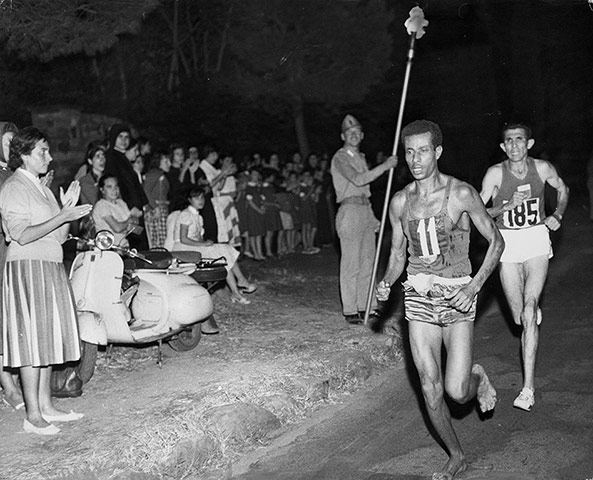
Abebe Bikila, a soldier in the Ethiopian imperial bodyguard, arrived at the Rome Olympics in 1960 with brand new trainers. They gave him blisters, though, and Bikila thought he might do better without. Correct: he won marathon gold for Ethiopia, setting world and Olympic records. Asked why he ran without shoes he said: “It’s much more comfortable.” Four years later, at the Tokyo Games, he won again, though shod this time. Special trainers had been made for him by an admiring sportswear firm and Bikila thought it would be impolite to refuse them Photograph: Central Press/Getty Images

Since the mid-1950s marathoners have run a punishing 26.2-mile route from the town of Marathon to Athens – tribute, of course, to the Greek legend that prompted all this exertion in the first place. In April 1969 a gas fitter and amateur runner from Coventry, Bill Adcocks, lined up to contest the Athens race. He wore thin plimsolls, generally liked to run with a knotted handkerchief around his neck and was not, understandably, many people’s favourite that day – but Adcocks won with an astonishing time, 2:11:07, that remained unbeaten for 35 years. It was finally beaten in 2004, when the Olympics returned to Greece Photograph: PR
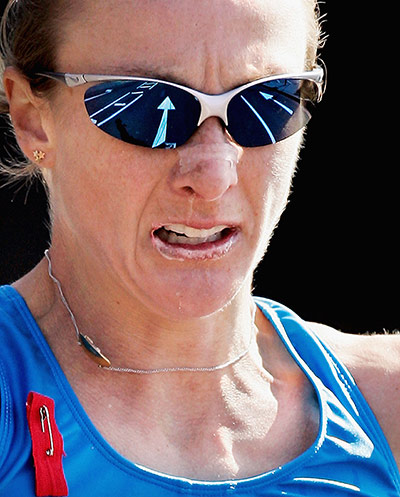
With all due respect to Paula Radcliffe, a peerless runner (whose time in the 2003 London marathon is considered unbeatable), this had to be included. Race favourite in 2005, Radcliffe was somewhere around the 22-mile mark when she felt rumblings of her grilled salmon breakfast. She tried to “run through the problem”, eventually realising a toilet break was essential. Crouched on a kerb, hand pressed on a Vittel advert, Radcliffe squatted for a quickie that was broadcast globally. “I want to apologise to the nation,” she said afterwards, though really that apology should have come from the cameraman who zoomed in on her, mid-relief Photograph: Ian Walton/Getty Images
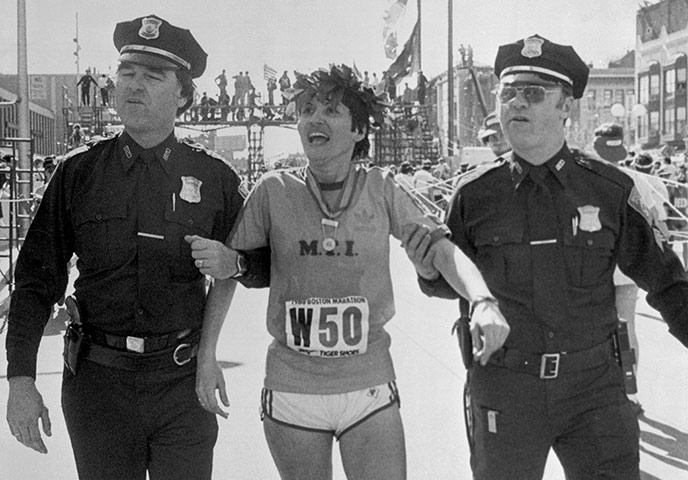
In 1980, administrative assistant Rosie Ruiz didn’t fancy running all 26.2 miles of the Boston marathon. So she joined from the crowd, according to onlookers, at about the 22-mile mark. Running the final stages without “style or form” (reported one witness), Ruiz crossed the line first and was named the winner. “What were your splits?” another top finisher asked afterwards. “What are splits?” Ruiz replied. An inquiry found that not only had she cheated in Boston, she’d cheated in the New York marathon months before, riding the subway for part of that race. Ruiz was stripped of her Boston win and did not race again Photograph: Bettmann/Corbis
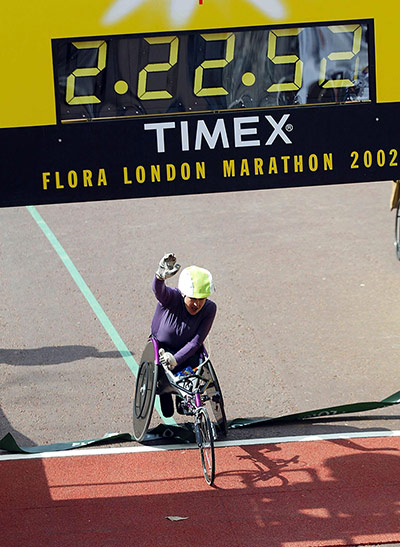
Crammed in just before a Commonwealth Games and just after the birth of her first child (no biggie), Tanni Grey-Thompson entered the London marathon in 2002 without much hope of winning. “Just getting round and being back fit will be good for me,” the Paralympian said in the build-up. She came first, of course – a record sixth victory on a London course that, with its last phase along the cobblestones of the Mall, is particularly punishing for wheelchair athletes. Grey-Thompson’s six wins went unmatched for a decade until David Weir triumphed for a sixth time in 2012. Weir will aim to go one better in Sunday’s race Photograph: Phil Cole/Getty Images
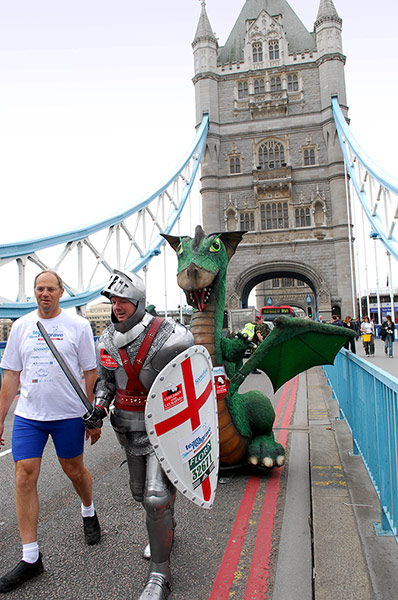
This list would not be complete without recognition of the hundreds of thousands of charity-minded sadists who run marathons every year in heavy costume. Fundraiser Lloyd Scott has no equal in this field. A former footballer who had suffered from leukaemia in his late 20s, Scott ran the 2006 London marathon wearing a full suit of armour and the 2008 event dressed as a 9ft robot… Perhaps his greatest achievement was a series of marathons in 2002 and 2003 – London, New York, Edinburgh – completed wearing a 130lb deep-sea diving outfit. “We were on the course for five days,” he said of the London leg Photograph: Nils Jorgensen/Rex Features