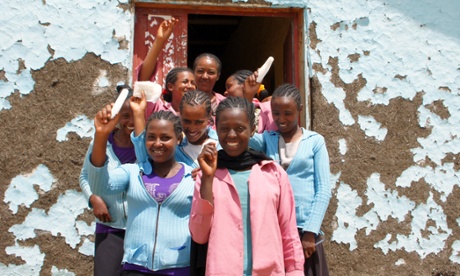
Like girls and women across the world, 16-year-old Joan is self-conscious about bleeding on her clothes during her period. But this teenager from Lira, Uganda can’t just run to the shop and buy more sanitary pads or tampons.
“I used to use cloths that I would cut from my old T-shirts to keep the blood from staining my dresses, but they were not enough and blood would still stain my clothes,” she told a local NGO that visited her school to teach her how to make reusable pads.
“Boys used to laugh at me and I eventually simply stayed home whenever my periods started.”
Joan is not alone, and Uganda is not the only place where periods are a problem for girls. The issue is widespread – particularly in rural, remote areas, where it can lead to girls dropping out of school entirely.
In Sierra Leone, more than a fifth of girls miss school because of their periods. In Afghanistan and Nepal, three out of 10 girls miss school for the same reason.
The world cannot afford the cost of girls dropping out of school. If a girl attends school for the majority of seven years, she marries later and has fewer children. She’ll also be more likely to delay having sex, be less likely to be forced into sex, and, if she is sexually active, more likely to use contraception. An educated girl adds to a country’s GDP, and is essential for lifting her, her family and her community out of poverty.
These numbers are just a glimpse into a wider problem, but one that is proving hard to measure.
Marni Sommer, assistant professor of sociomedical sciences at Columbia University, says that the broad range of varying environments, contexts and cultures provides a challenge in itself: “The water, sanitation and hygiene, and related aspects of those schools, can differ very much.”
On top of that, Sommer says the widespread social stigma of menstruation creates barriers, not only to education but also to understanding the scale of the problem.
“Menstruation is not something a girl is going to openly admit that she misses school for,” she says. “Some girls may leave school for a few hours each day skipping classes, while others may skip school altogether. Attendance data in many of these countries is of very poor quality and not reliable, and girls are also not going to be marked absent for menstruation.”
A raft of promising new campaigns, initiatives and enterprises have begun to tackle the obstacles of access to products, while smashing the taboo of what is a completely natural function.
University students at one Indian university are using sanitary pads themselves to carry protest messages against sexism and rape. That’s a big step for a culture where even shops keep female hygiene products hidden out of sight [LINK: ].
It’s also significant for a country where nearly a quarter (23 per cent) of girls drop out of school after they start menstruating, and where only 12 per cent of women use sanitary pads.
This widespread lack of access to hygienic products drove one man in southern India to create a sustainable way of producing affordable sanitary products while employing girls and women. The mission and entrepreneurial spirit of Arunachalam Muruganantham led to his company, Jayashree Industries, being selected for the Girl Effect Accelerator. This model could be just the type of social enterprise that fills the gap in an under-served yet immense market.
But more needs to be done to ensure that girls don’t miss out on an education because their bodies are functioning normally. There’s no shame in being a girl, and with the right tools and support girls won’t have to hide at home once a month.
After Joan learned how to make reusable sanitary pads, she shared: “Now I don’t get ashamed or embarrassed when I get my periods. I even attend classes during my periods and nobody notices.”
Content on this page is paid for and provided by Girl Effect, a sponsor of the Guardian Global Development Professionals Network.