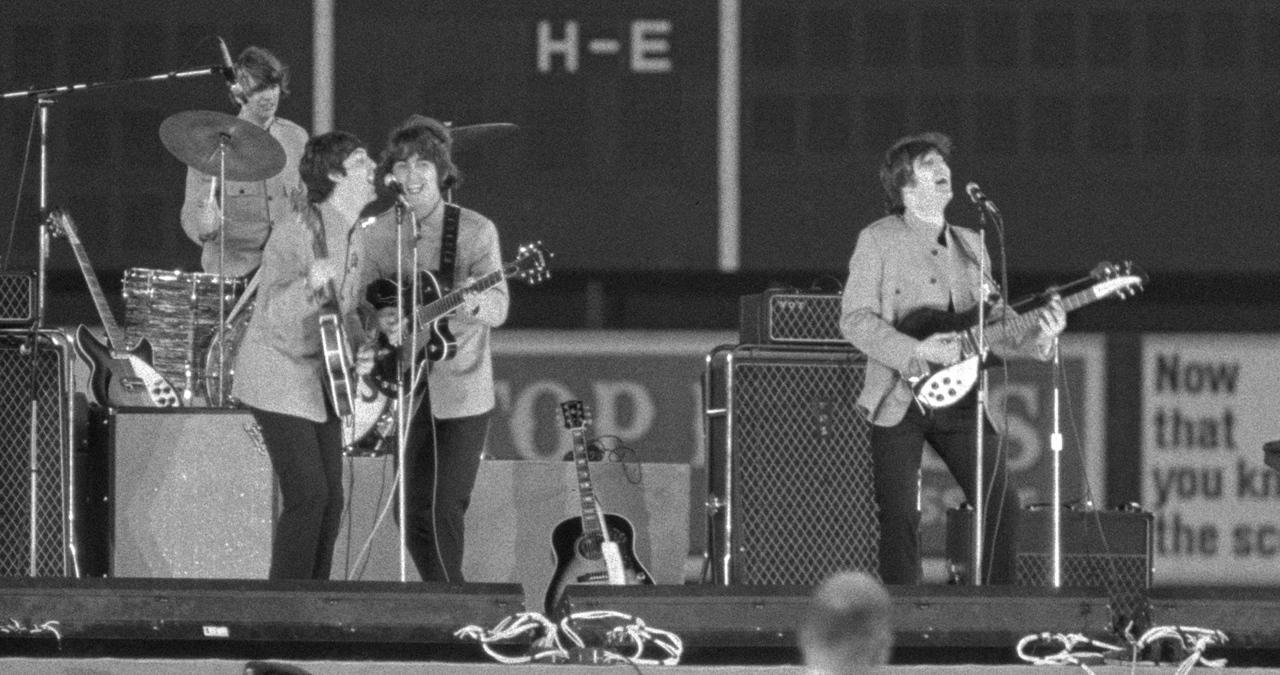
Anticipation is rising for the looming premiere of the remastered and expanded Beatles Anthology series, due to air on Disney+ from November 26th. As part of the laborious cleaning-up process of both footage and audio, Giles Martin has revealed this week that the AI de-mixing technology deployed on Get Back has been integral for extracting and remixing the isolated stems of classic Beatles' live performance footage. Including the iconic 1965 Shea Stadium show.
Speaking to The Chris Moyles Show on Radio X on Tuesday, Martin elaborated on how the ‘MAL’ AI de-mixing technology has been used to spruce-up the audio of the now-nine-part documentary series’ live performances - particularly that extraordinary Shea Stadium show footage which opens Part Five.
“We developed this thing called MAL, known after [Beatles road manager] Mal Evans,” Martin told Moyles. “You know, God bless AI, and it's good and bad. You can actually dig in. So, for instance, for the Anthology, I went to Shea Stadium or the Washington concert, and I can now, using machine learning, isolate John's voice or isolate the drums and bring the drums out," Martin said.
"On [the original footage of] the Washington concert, you can't hear the drums at all. Now you can hear the drums. But I'm not adding anything to it. I'm not like, you know, recreating anything. It's like finding something underground. It's like detectorists for audio people.”
Long before the advent of stadium-level PA solutions for the live music domain, the Beatles’ 1965 New York Shea Stadium performance was pumped out to the assembled record-breaking crowd of 55,000 people via hundreds of tiny loudspeakers that peppered the stadium. As discussed in the Anthology, these were typically used for announcements. "It can't have sounded too good," recalled Paul McCartney back in 1995.
The Beatles themselves - lacking in-ear monitors or any of the other bells and whistles live musicians take for granted these days - couldn’t even hear themselves very well over the screams - if at all.
“We couldn’t really hear ourselves when we played as the crowd [was] so loud,” Paul McCartney recounted to Billboard.

Martin goes on to say how the now MAL-isolated vocals from Shea Stadium presented an oddly unique perspective on this landmark moment in their narrative that the drowned-out Beatles would have been astonished to hear.
“Well, that's the weird thing. When I can isolate with the voice, I'm thinking, ‘I can hear John now and I can see him on screen singing,’ and there's his voice coming out on his own. I'm thinking, ‘He's never even heard this and he was there!’”
Earlier this year, Giles sat down with us and detailed exactly how this extraordinary technology works, demonstrating how it was core to the creation of the band’s most recent single Now and Then.
That song used a stripped-out and dusted-down version of John Lennon’s vocal from a rough cassette demo as its foundation.
In the new interview with Moyles, Martin explained how the technology first grew out of the painstaking sound extraction process of the reels of film and audio first captured by Michael Lindsay-Hogg and his crew during the making of the Let It Be documentary film in 1969. This restored source material became the Get Back series.
“[Peter Jackson] had a dialogue editor using police forensic surveillance techniques to remove guitars from voices. And I went, ‘Oh, wait a second. If we can do that, can we not kind of take drums and bass off?’ And we started working on this project, and that's how we mixed [the recent remaster of] Revolver.
The remastered Beatles Anthology 2025 series premieres on November 26th on Disney+.
You can tune into The Chris Moyles Show on Radio X weekdays from 6:30am -10am and on Global Player