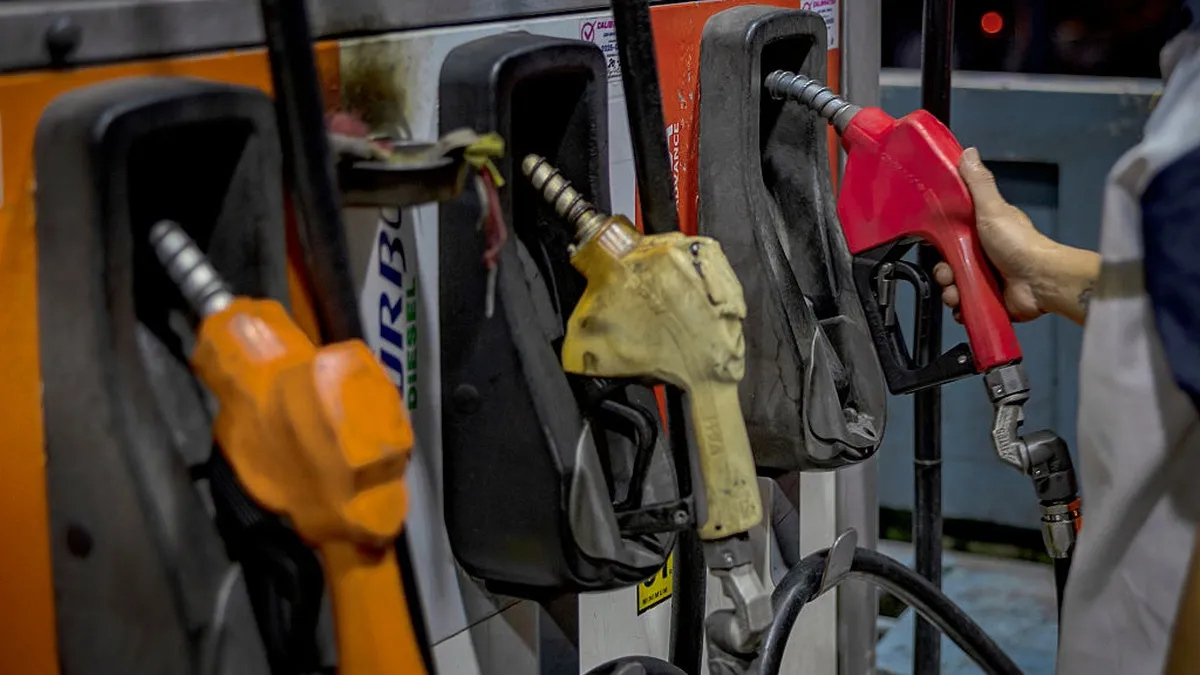
If you’re someone who always clicks the gas pump a few extra times to round up to an even dollar amount, you’re probably going to end up with a really expensive repair bill.
A mechanic named Trez recently became popular on TikTok by showing exactly what happens inside your car when you keep forcing liquid gas into a system that’s only meant for vapor. This damage doesn’t hurt your engine, but it completely destroys an important part called the charcoal canister.
According to Motor1, Trez, who posts as @fedsmademewrench on TikTok, used a 2016 Honda Civic as his main example in a video that over 533,000 people watched. He started his video with a clear warning, saying, “Are you the person at the gas pumps that’s constantly trying to top off their tank when it’s full? This video is for you.”
He explained that the Honda came to his shop with several error codes related to the EVAP emission system. These codes were P04F1, P0441, P1454, and P04DF, all showing low or high purge flow detection problems. What’s interesting is that the customer had already tried replacing the purge valve themselves, but that didn’t fix anything at all.
This simple habit costs drivers hundreds
Before looking at the damage, it helps to understand what the EVAP system actually does. The Evaporative Emission Control system is important for catching fuel vapors from the gas tank so they don’t escape into the air. When the engine is off, these vapors are stored inside a charcoal canister. Later, when the driving conditions are right, a purge valve opens up and pulls those vapors into the engine to be burned during normal combustion.
The important thing to remember here is that this entire system is designed only for vapor, not liquid gas. Trez showed viewers a detailed diagram of the system to explain the problem clearly. When you ignore the automatic shutoff and keep clicking the pump nozzle, you’re forcing liquid fuel past an important one-way valve that’s designed to keep fluid out of the vapor lines.
@fedsmademewrench a lil PSA for all the gas pump clickers out there, everytime you force gas into the tank when its full, its going places it should not go! Charcoal canisters are very expensive to replace! save your canisters! keep in mind this is somthing that happens after constant overfilling every time you visit gas pump #fyp #diagnosis #fix #fy #gas
♬ original sound – Trez, FedsWrench
He said, “So when you are full of gas and you’re up here clicky clicky clicky, this little one-way valve here is gonna have a little bit of gas intrude into its line.” Once that liquid fuel reaches the charcoal canister, things get bad quickly. Trez confirmed, “So once a little bit of liquid fuel makes it all the way in here, this is inside the canister, and that’s when things start to go south.”
The liquid soaks the filter, making the charcoal break down and turn into debris. Trez proved this by sticking a small camera into the vapor feed line of the Civic and seeing a lot of debris blocking the lines throughout the system. That’s exactly why replacing just the purge valve didn’t work for the customer. Like other mechanics who’ve encountered questionable DIY repair attempts gone wrong, this wasn’t a simple fix.
Some drivers aren’t exactly believing the advice, with one claiming “45 years old and I’ve owned 15 cars and I’ve done this since I was 16. never a problem. my father is 70 and been doing it for 50 years. never problem.”
Still, plenty of people promised to change their habits right away now that they understand the cost. Mechanics regularly discover surprising issues when customers bring in vehicles with odd problems, and this gas pump habit is clearly one that many drivers need to break. One commenter said, “No more clicky clicky…..got it.”