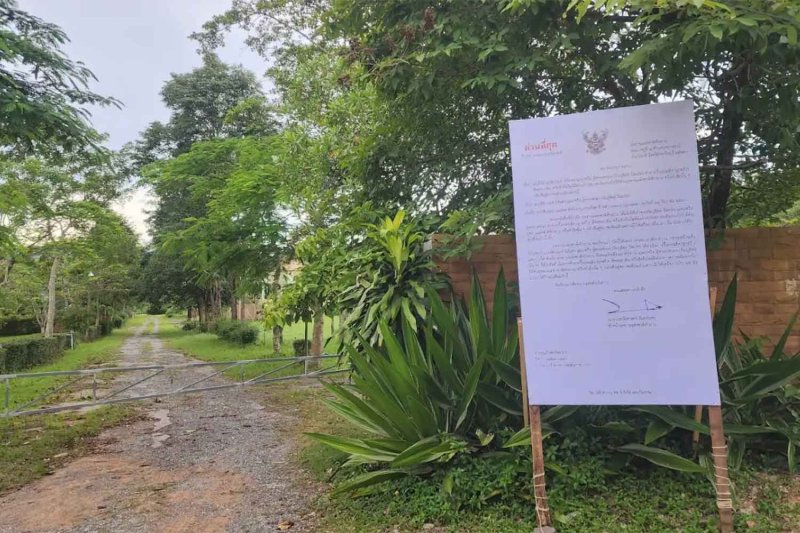
Nakhon Ratchasima: Authorities have ordered the demolition of Im Poo Hill Resort in Wang Nam Khiao district after the Supreme Court ruled it had encroached on land inside Thap Lan National Park, as the government steps up efforts to reclaim protected forest and resolve long-standing land disputes affecting local communities.
A demolition notice has been posted at the resort, giving the occupant 15 days to remove the structures.
If the order is ignored, Natural Resources and Environment Minister Suchart Chomklin said the Department of National Parks, Wildlife and Plant Conservation will carry out the demolition under the law.
The action follows Mr Suchart's inspection of Thap Lan National Park on Sunday, where he met senior officials, local authorities and related agencies to address more than four decades of overlapping land claims.
He said the government would accelerate verification of land rights for original villagers on a plot-by-plot basis to ensure fairness, while taking firm legal action against commercial operators encroaching on protected forest.
Im Poo Hill Resort, in tambon Thai Samakkhi, is among more than 500 hotels, resorts and houses subjected to legal action since 2017, with courts ordering demolition and restoration of the land as national park forest.
Authorities have also posted notices at two other resorts whose cases have reached final judgement.
Mr Suchart said occupants must dismantle buildings within 15 days or face enforcement action to restore the land for forest rehabilitation.
He added that unlawful commercial exploitation of natural resources falls under predicate offences in the Anti-Money Laundering Act, and action will continue against all establishments with final court rulings.
Alongside enforcement, the government has outlined a framework to resolve overlapping land claims in Thap Lan National Park by dividing affected areas into five groups based on land possession and use.
The plan proposes removing Agricultural Land Reform Office land and state land used for military purposes from park boundaries in line with the One Map policy. Rights verification will be expedited in the Thai Samakkhi model village project, while areas under the National Security Land Development Project and the Land Allocation for the Poor in Degraded Forest Reserves will be considered for boundary adjustment, with residents consulted on the form of land rights.
For other disputed areas, authorities will conduct strict plot-by-plot verification to distinguish legitimate residents from investors before legal action.
Mr Suchart said residents should not be concerned, as the government remains committed to protecting the rights of legitimate landholders while preserving forest land.
Recommendations from the site visit will be submitted through the National Land Policy Committee to the cabinet, including the establishment of a buffer zone to mitigate against long-term ecological impacts to the forest.